
 Print Page




WisdomTree
Gold Monthly
May 2026

Nitesh Shah
Head of Commodities and Macroeconomic Research, WisdomTree Europe
Nitesh Shah is a seasoned financial professional with over 24 years of experience in research and investment strategy. As Head of Commodities & Macroeconomic Research at WisdomTree Europe, he leads market analysis and insights across asset classes, with a focus on commodities and exchange-traded products. Previously, he held roles at Moody’s, HSBC Investment Bank, The Pension Protection Fund, and Decision Economics, building expertise in market analysis and strategy.
Nitesh earned a master’s degree in International Economics and Finance from Brandeis University and a bachelor's in Economics from the London School of Economics. His insights are frequently featured in financial media, and he is a sought-after speaker at industry events. He also hosts the ‘Commodity Exchange’ podcast, where he discusses trends shaping global markets. Passionate about guiding investors, Nitesh provides actionable insights to help them navigate complex financial landscapes.
Inflation fears meet higher yields
Rising yields overshadow inflation fears
Gold weakened over the past month as a stronger US dollar and rising sovereign bond yields created headwinds for the metal. However, we continue to view these pressures as cyclical rather than structural and believe the medium-term backdrop for gold remains constructive.
The closure of the Strait of Hormuz has triggered broad commodity price disruptions across energy, fertilisers and industrial metals, driving a sharp rise in global inflation expectations. Central banks now face a difficult trade-off: monetary policy cannot resolve supply-side bottlenecks, yet failing to respond risks allowing inflation expectations to become unanchored.
As a result, markets have rapidly repriced interest rate expectations. In the United States, expectations for rate cuts have largely been removed, while markets are now pricing close to three additional hikes in the euro area and almost two in the United Kingdom for the remainder of the year. This repricing has pushed sovereign bond yields higher and created near-term pressure on gold prices.
In the US, the rise in yields has been concentrated at the long end of the curve, resulting in a bear steepening dynamic. This suggests investors are becoming increasingly concerned about persistent inflation, fiscal sustainability and rising term premia, even as expectations for the Federal Reserve policy rate remain comparatively stable. Rising long-term yields increase the opportunity cost of holding non-yielding assets such as gold.
Importantly, inflation itself should ordinarily support gold prices. However, when nominal and real bond yields rise simultaneously, the supportive effect of inflation can be offset, which is the environment currently facing the gold market.
Figure 1: Gold and nominal bond yields
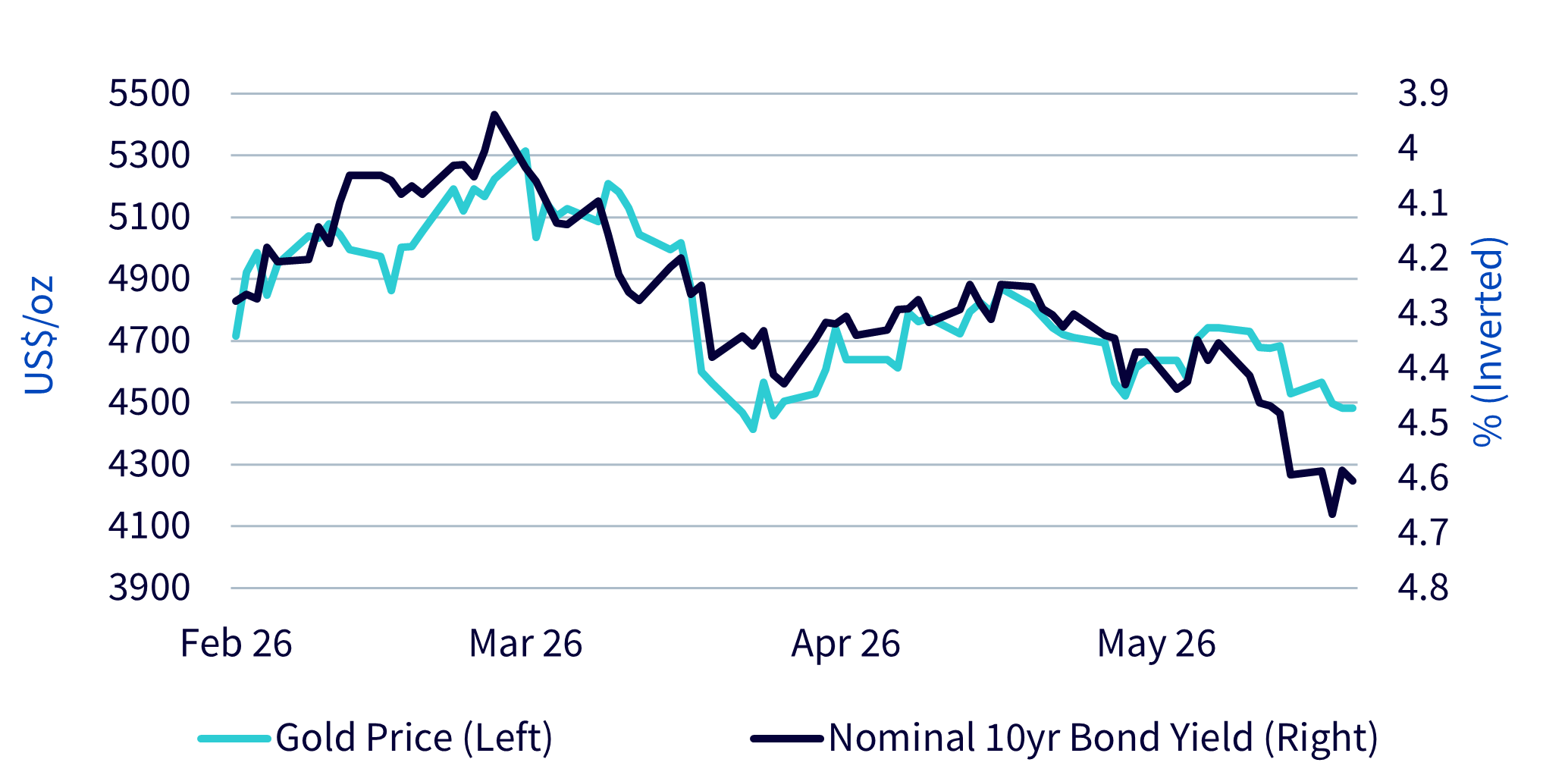
Source: Bloomberg Finance LP. WisdomTree, February 2026 - May 2026. Historical performance is not an indication of future performance and any investments may go down in value.
Twin deficits could ultimately undermine the dollar
The US dollar has also remained resilient, supported in part by America’s status as a net energy exporter during a period of global energy scarcity. Higher energy prices have improved US terms of trade relative to many major importing economies.
However, we believe structural pressures on the dollar are building. Expanding fiscal deficits alongside a widening current account deficit, the so-called “twin deficits”, have historically been associated with periods of dollar weakness when external financing requirements become increasingly large.
Over the medium term, the combination of elevated inflation risks, fiscal deterioration and eventual dollar weakness should prove supportive for gold prices. In our view, the current pressure from higher policy rates and bond yields is more likely to represent a cyclical headwind than a structural change in the gold outlook.
Figure 2: US dollar and US twin deficits
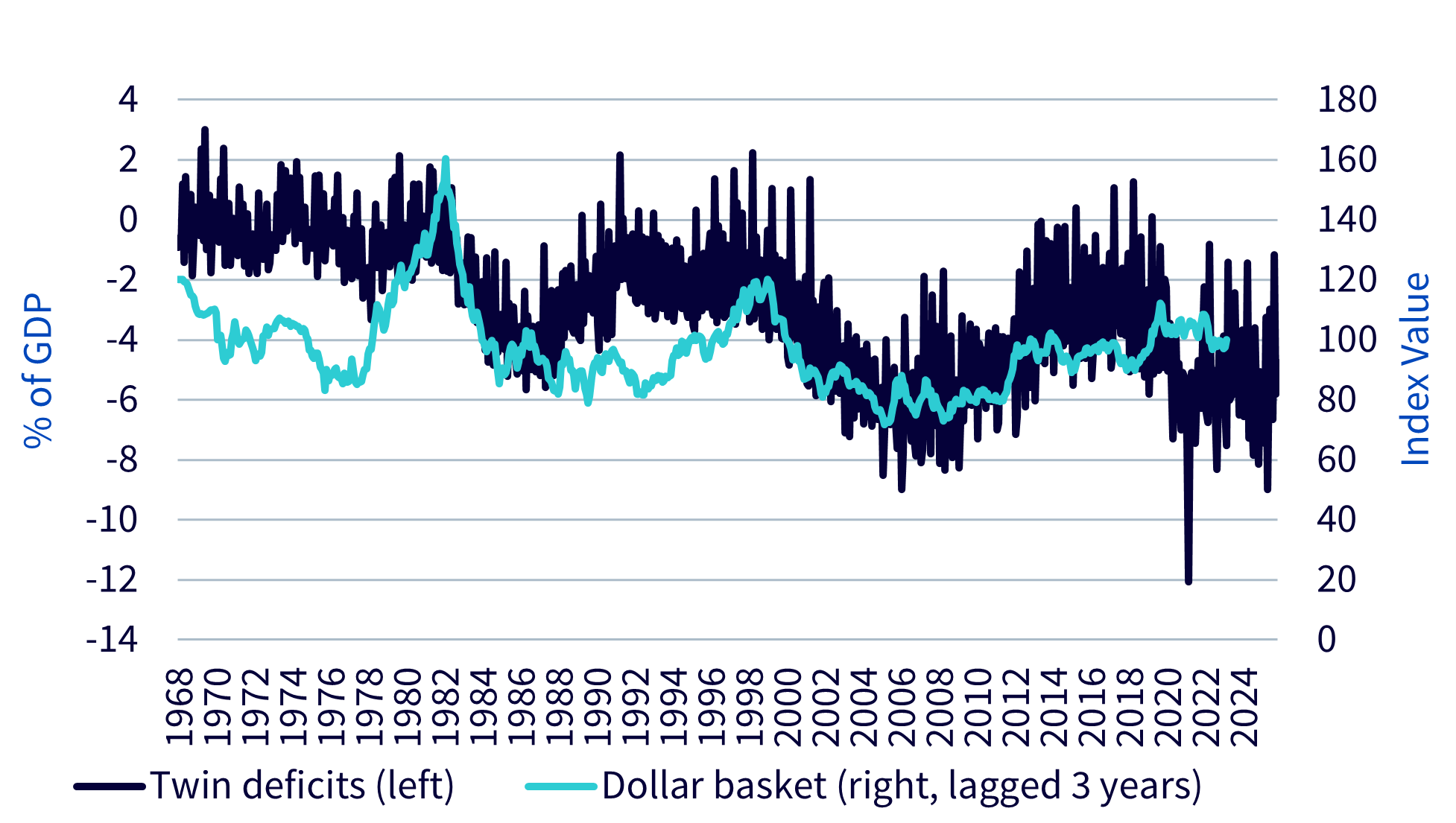
Source: WisdomTree, Bloomberg Finance L.P. January 1968 – March 2026. Twin Deficit = Current Account + Budget Deficit as a % of GDP. Dollar Basket (DXY). Historical performance is not an indication of future performance and any investments may go down in value.
ETP flows are mixed for now
Gold exchange-traded product (ETP) flows have remained volatile this year, reflecting the tension between safe-haven demand and rising opportunity costs from higher yields.
Following strong inflows in January and February, totalling 147 tonnes, March saw significant outflows of 84 tonnes, driven primarily by North American investors. This likely reflected profit-taking following gold’s strong rally earlier in the year, alongside liquidation pressures amid broader market volatility.
In April, inflows resumed across all major regions, with Europe accounting for the largest share. European demand may reflect heightened geopolitical concerns and growing stagflationary fears within the region.
Early May data suggest investor positioning remains cautious but stable, with modest inflows returning despite elevated yields and a strong dollar.
Table 1: Global gold ETP demand by region
Source: World Gold Council, 01 January 2026 – 15 May 2026. Historical performance is not an indication of future performance and any investments may go down in value.
Energy import pressures are reshaping gold demand
The Iran conflict is creating multiple layers of stress for energy-importing economies. Last month, we discussed how Turkey, heavily reliant on imported energy, sold and swapped gold to obtain dollar liquidity and stabilise the lira amid worsening trade pressures.
This month, similar strains are emerging in India. Faced with rising oil import costs and growing pressure on its external balance, India increased the effective import duty on gold from 6% to 15%, effective 13 May 2026. Prime Minister Modi also publicly encouraged citizens to reduce discretionary gold purchases for the next year.
These measures suggest policymakers are increasingly focused on conserving foreign exchange reserves and limiting non-essential imports during a period of geopolitical stress and elevated energy prices.
India’s actions are particularly notable because the country remains one of the world’s largest consumers of physical gold. Jewellery demand had already softened due to higher gold prices, while investment demand had been running exceptionally strong. Higher import duties are therefore likely to dampen domestic demand further in the near term.
More broadly, the episode highlights how elevated energy prices can indirectly influence gold demand patterns through balance-of-payments pressures and currency management considerations in emerging markets.
Gold’s reserve appeal extends beyond central banks
Tether’s Q1 2026 attestation report indicated that the stablecoin issuer holds close to US$20bn in gold reserves, equivalent to approximately 133 tonnes of gold. If accurate, this would place Tether’s gold holdings above those of several sovereign central banks, including South Africa and Mexico.
We estimate that Tether added approximately 6 tonnes of gold during Q1 2026. While this represents a slower pace of accumulation than previous quarters (we estimate purchases of roughly 27 tonnes in Q4 2025), the continued buying is notable given the significant volatility observed across financial markets during the quarter.
The moderation in purchases likely reflects broader liquidity pressures and profit-taking behaviour seen across the gold market during the period. Nevertheless, continued reserve diversification into gold by a major digital asset issuer suggests ongoing conviction in gold’s role as a strategic reserve asset beyond traditional central bank demand.
Short-term pressures, long-term support
Although higher bond yields and a resilient US dollar may continue to generate volatility in the near term, we believe the broader macroeconomic backdrop remains supportive for gold over the medium term. Persistent geopolitical tensions, structurally higher inflation risks, rising fiscal deficits and ongoing reserve diversification all reinforce gold’s role as a strategic portfolio hedge and store of value. Near-term weakness may therefore prove temporary within a broader constructive cycle for the metal.