




 Print Page
Rare earths, trade leverage and a new era in US supply chains


Key Takeaways
- China’s dominance in rare earth supply highlights a strategic vulnerability for the US, particularly in artificial intelligence (AI) and defence sectors.
- The $500M MP Materials–Apple deal signals accelerating US efforts to build sustainable, onshore rare earth capabilities.
- The WisdomTree Strategic Metals and Rare Earths Miners UCITS ETF offers investors access to one of the most geopolitically relevant growth themes of the decade.
China dominates the global rare earth ecosystem
China’s rare earth elements (REEs) have been elevated from niche industrial inputs to powerful geopolitical levers. As the US leads global advancement in artificial intelligence (AI), it remains dependent on these critical inputs, especially the rare earth magnets essential to AI chips, which China has long used as strategic bargaining chips. Export curbs, such as the 2010 ban on shipments to Japan, have shown how quickly Beijing can weaponise REEs in response to geopolitical pressure. In April 2025, China added seven rare earths to its “dual‑use” export control list to counter US tariffs on Chinese tech, clearly signalling REEs as a top-tier negotiating card. But recent developments signal a turning point.
These controls are no minor inconvenience. AI innovation runs on specialised semiconductors that depend heavily on REE magnets, especially neodymium and praseodymium, which power chip performance and data centre reliability. The US’s growing dominance in generative AI and edge computing is remarkable, yet it leans heavily on China’s REE supply chain. With limited immediate domestic options, the US relies on 70% of its REE imports from China. This creates a strategic blind spot: if export controls tighten, it could imperil chip manufacturing, cloud infrastructure, and national competitiveness in AI. China knows this and has used its REE dominance to gain trade leverage.
MP Materials–Apple partnership: A watershed moment
This week’s $500 million MP Materials–Apple deal marks a transformative leap:
- MP Materials will produce recycled rare earth magnets at Fort Worth, Texas, using feedstock from its Mountain Pass operations in California. Magnet production will begin in 2027 and target Apple devices.
- The Fort Worth facility will be significantly expanded, and Apple will collaborate on magnet‐making innovations and end‑of‑life recycling, which will be an industrial first for large-scale domestic REE supply.
- MP’s shares jumped ~19.99%1, and the move follows the Department of Defence’s $400 million investment, plus a 10‑year guaranteed magnet‐purchase contract, demonstrating robust US public‑private support.
Collectively, these steps show the US on the offensive: shifting REE sourcing from a strategic vulnerability to burgeoning opportunity.
Growth outlook for the rare earths industry
While global rare earth demand is forecasted to grow at a 10–13% compound annual growth rate (CAGR) through the next decade2, China continues to command the lion’s share, responsible for about 69% of mining and 90% of refining today and expected to hold 52% and 76% of those capacities by 20353. China’s rare earth market alone is projected to increase from $2.8 billion in 2024 to $4.46 billion by 2030, growing at nearly 8.7% annually. This enduring dominance underscores how China remains the key gatekeeper in critical raw materials, reinforcing both its bargaining power and the urgency for Western diversification. As MP Materials scales magnet production at Fort Worth to supply Apple and others, investors can expect substantial earnings upside, structural growth across global clean-energy, automation, and national-security metal supply chains.
A thematic gateway to global resource realignment
These high-profile partnerships and government support are reshaping the landscape, and the WisdomTree Strategic Metals and Rare Earths Miners UCITS ETF (RARE) stands to benefit. MP Materials Corp is the top holding (7.1%) of the WisdomTree Strategic Metals and Rare Earths Miners UCITS ETF. MP Materials Corp stands out for operating the only major US rare-earth mine (Mountain Pass).
The WisdomTree Strategic Metals and Rare Earths Miners UCITS ETF seeks to track the price and yield performance of the WisdomTree Energy Transition Metals and Rare Earth Miners Index. The Index is designed to identify globally listed companies from developed and emerging markets involved in the Energy Transition Metals Value Chain (ETMVC). Companies that belong to the ETMVC are identified and classified into 10 metal categories - aluminium, cobalt, copper, lithium, nickel, platinum, silver, tin, zinc, and rare earth elements (REE) and within mining subsectors such as mining, refining, smelting, chemicals, conversions, industry.
Figure 1: Weight of stocks across critical minerals and rare earths spectrum
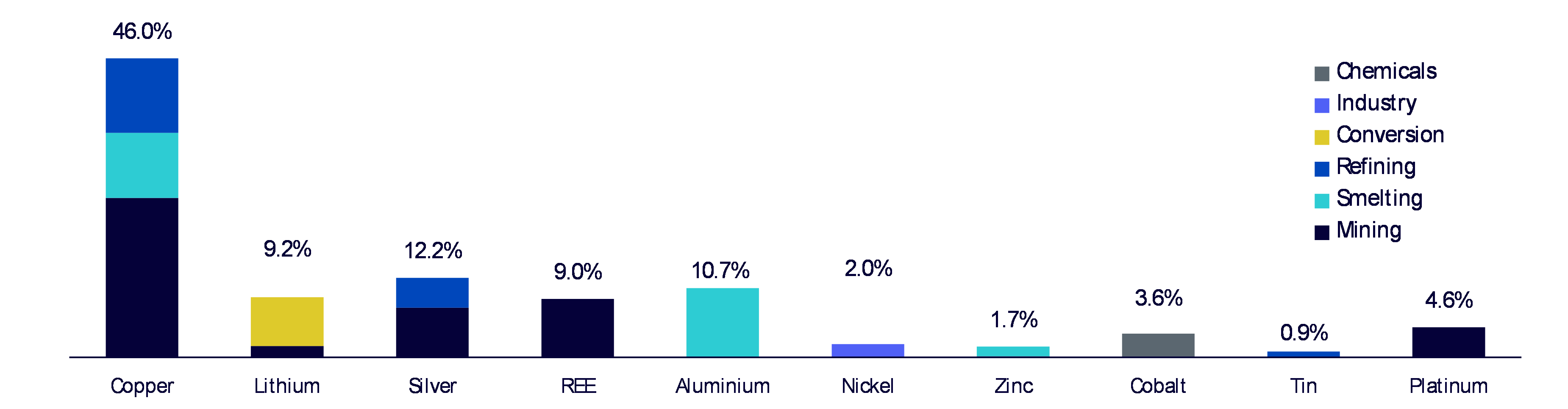
Source: FactSet, WisdomTree as of 30 June 2025. You cannot invest directly in an index. Historical performance is not an indication of future performance and any investments may go down in value.
While China drives a significant share, the rest of the world, particularly the US, Australia, Canada, Europe, and select emerging markets, is accelerating REE development through projects and policy support. RARE’s global diversification ensures investors benefit from this broadened growth narrative. The WisdomTree Energy Transition Metals and Rare Earth Miners Index is fairly diversified across size with its highest allocation at 55.3% in midcaps, 24.9% in large caps and 19.8% in small caps4.
Figure 2: Geographical revenue breakdown – across developed and emerging markets
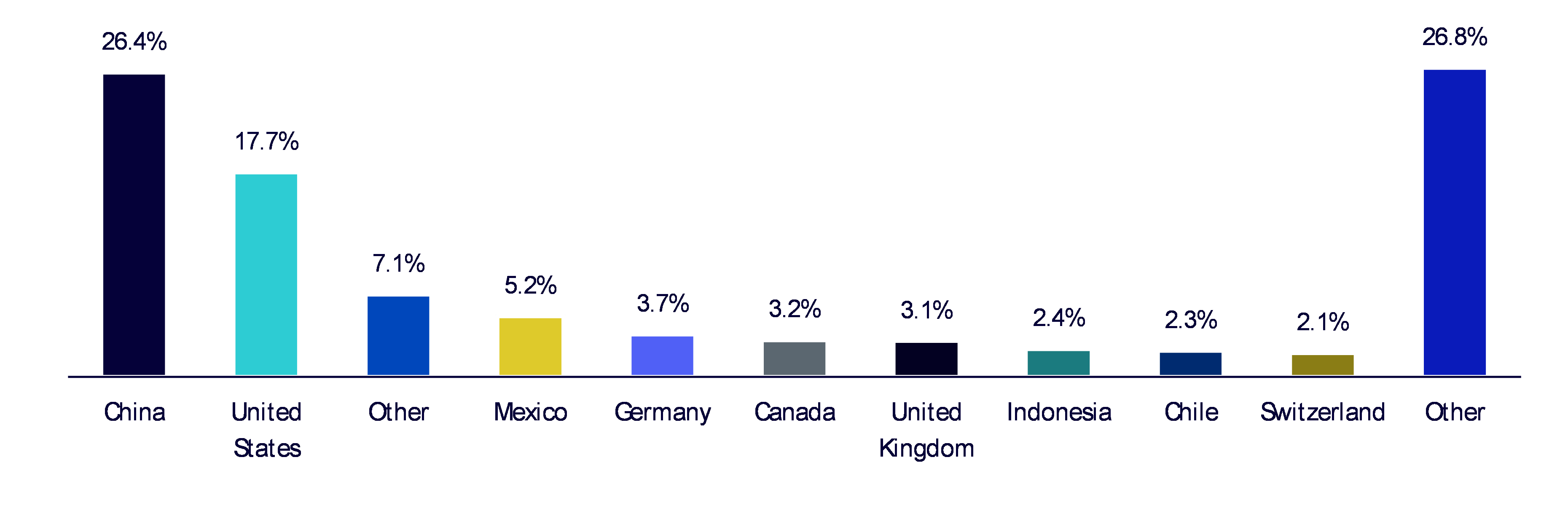
Source: WisdomTree, Wood Mackenzie, FactSet, Bloomberg as of 30 June 2025. You cannot invest directly in an index. Historical performance is not an indication of future performance and any investments may go down in value.
Valuation and performance edge
Notably, year-to-date (YTD), the WisdomTree Strategic Metals and Rare Earths Miners UCITS ETF (+33.1%) has outperformed the MSCI All Country World Index (10.10%) by over 21.69%5, underscoring the strength of the theme amid shifting macro and political currents.
The WisdomTree Energy Transition Metals and Rare Earth Miners Index currently trades at a lower price to earnings (P/E) and price-to-book (P/B) ratio and a higher forward growth multiple than the MSCI All Country World Index—reflecting both relative value and earnings momentum. In addition, quality metrics such as Return on Assets (ROA) are also higher than the benchmark.
Figure 3: Comparison of fundamental valuation
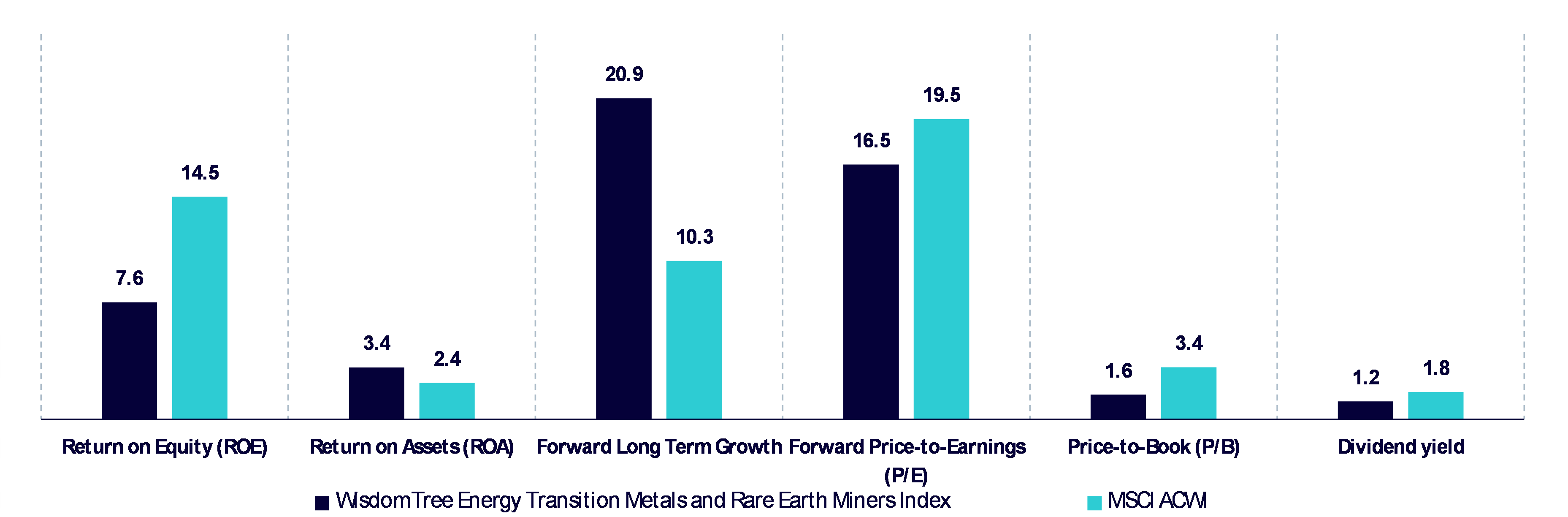
Source: WisdomTree, FactSet, Bloomberg. As of 31 March 2025. You cannot invest directly in an index. Historical performance is not an indication of future performance and any investments may go down in value.
Outlook: timing the rare-earth momentum
The race for rare earth dominance isn’t just technological – it’s strategic. As China increasingly uses REEs as diplomatic leverage while the US accelerates onshoring efforts, investors have a narrow window to position for both short-term policy momentum and long-term structural gains. The WisdomTree Strategic Metals and Rare Earths Miners UCITS ETF offers a clean, thematic vehicle to capitalize on this shift in global industrial power, and perhaps even flip dependencies on their head.
1 Bloomberg as of 15 July 2025
2 International Mining and Resources Conference + Expo (IMARC), Rare Earths Exchanges
3 Barrons as of 31 January 2025
4 WisdomTree, FactSet, Bloomberg as of 30 June 2025.
5 Bloomberg from 31 December 2024 to 17 July 2025.




 Previous Post
 All Posts