




WisdomTree Crypto ETPs | Q&A
April 2026
Custody & Security
The custodians for the WisdomTree Digital Assets ETPs (Exchange Traded Products) are Swissquote, a Swiss Bank regulated by the Swiss Financial Market Supervisory Authority (FINMA), Coinbase Custody Trust Company LLC, a New York limited purpose trust company which is authorised to provide fiduciary custodial services to institutional customers and BitGo, a US-regulated qualified custodian and one of the largest independent digital asset custodians globally
Swissquote is a highly reputable Swiss Bank regulated by FINMA. As such, it undergoes financial health reviews, policy and procedure reviews, and must maintain capital reserve requirements as defined by the Swiss Regulator. Swissquote has the largest online trading platform in Switzerland, and is also authorised by FINMA as a digital assets custodian. Swissquote was the first online bank in Europe to offer digital assets trading and has the most complete digital assets platform available to retail and institutional customers. They have developed an industry-leading, institutional-grade approach to digital asset security and have a long history of successfully acting as a custodian for traditional financial assets.
Coinbase Custody is an independent, NYDFS-regulated qualified custodian. They developed best-in-class security and operations to address the security, regulatory, and operational challenges unique to the crypto market. Dedicated on-chain addresses are secured by Coinbase’s battle-tested cold storage. Indeed, Coinbase Custody offers clients access to the secure, institutional-grade offline storage solution that has been used by Coinbase’s exchange business since 2012. All digital assets are segregated and held in trust for the benefit of our clients. In addition, Coinbase’s insurance policy is one of the largest crypto insurance facilities in the industry.
BitGo is a US-regulated qualified custodian and one of the longest-standing independent providers of institutional digital asset custody. It is known for pioneering multi-signature wallet technology and delivering an institutional-grade security architecture that reduces single points of failure. BitGo provides segregated custody, robust insurance coverage, and operates under a framework of strict compliance standards. Its track record of safeguarding billions of dollars in digital assets for institutional clients makes it a trusted partner in the evolving digital asset ecosystem.
WisdomTree has appointed multiple custodians to safeguard the digital currency held by WisdomTree Issuer X Limited (the “Issuer” of WisdomTree Digital Assets ETPs) on behalf of investors.
We consider the multi-custodian structure to provide the below added benefits:
- Diversification of assets to mitigate any single point of operational failure.
- Ability to take advantage of any one custodian strength and expertise in a particular digital currency.
- Ability to take advantage of any one custodian’s enhanced operational efficiency due to development within that custodian.
- Ability to utilise new or increased security measures and tools developed by any one custodian.
- Ability to continue to improve cost efficiency of the products, e.g. custody or transaction fees.
Allocations are reviewed, assessed and agreed by WisdomTree on behalf of our clients. The allocation process will be based on multiple factors such as industry landscape, operational efficiency, technology, etc. For more information, please see our Allocation Policy.
The custodians have developed an industry-leading, institutional-grade approaches to digital asset security. They combine institutional-grade hardware, software security, operational policies and procedures, to eliminate single points of failure and protect digital assets against attacks.
Cold Storage: Private keys1 are fully encrypted and kept offline. For any withdrawal / transaction out of the offline wallet2, human intervention is required.
Geographic Distribution of Redundancies: There is device, geographic, environmental and human redundancy allowing constant access. All locations are highly secure.
Robust Approval Process: The custodians use institutional-grade multi-approval technology, which significantly reduces the risk of losing a single approval key or approver and the effect this may have on accessing the digital assets. Multi-approval technology works by an “M-of-N” system, meaning that M approvers out of N known approvers must approve a transaction. The separation of duties for wallet configuration (e.g. setting and approving policies), client communication, transaction initiation, auditing functions is an inherent component of the custodial offering to provide robustness to the approval process.
Furthermore, redemptions can only be initiated to a predefined immutable set of whitelisted addresses.
1 A secret number that allows digital assets to be spent
2 System to store private keys
Legal & Regulation
1. Jersey is upheld as a jurisdiction that offers excellent, contemporary corporate laws.
2. Jersey has a strong regulatory environment. Jersey is also covered by the Organisation for Economic Co-operation and Development (OECD) Convention, please find the relevant announcement on the OECD website at: https://www.oecd.org/en/about/legal.html.
3. Jersey has a world-class professional infrastructure. Our legal advisor in Jersey is Mourant Ozannes who have offices in London, Hong Kong and in Jersey amongst other jurisdictions.
4. Jersey companies are subject to the ultimate supervision of the Jersey courts. The Jersey courts are independent, and impartial. Many of the judges sitting in the Jersey courts are English-trained lawyers. Moreover, the final court of appeal from the Jersey Court of Appeal is the English Privy Council.
5. The proximity and interconnectedness of Jersey to the UK is convenient for various operational reasons, for example, the CREST settlement system framework extends to securities issued in Jersey and we can use a Jersey based Registrar to interact directly with CREST.
6. WisdomTree has a long history of structuring Jersey-domiciled products that provide exposure to physically held assets. As such, products structured in this way have a proven track record (over 10 years) as being a suitable and efficient for investors on a pan European basis.
A prospectus in respect of the Issuer of WisdomTree Digital Assets ETPs, has been approved by the Swedish Financial Supervisory Authority (Sw. Finansinspektionen) (the “SFSA”), as competent authority under Regulation (EU) 2017/1129.
The prospectus permits offers of WisdomTree Digital Assets ETPs to the public and/or an admission to trading of WisdomTree Digital Assets ETPs on a regulated market in Sweden and in the markets to which the prospectus has been passported.
The Issuer has requested the SFSA to notify the approval of the Base Prospectus to Austria, Belgium, Denmark, Finland, France, Germany, Italy, Ireland, Luxembourg, Netherlands, Norway, Poland and Spain.
The Issuer is not supervised by the Jersey Financial Services Commission; however, a copy of the Prospectus has been delivered to the Registrar of Companies in Jersey in accordance with Article 5 of the Companies (General Provisions) (Jersey) Order 2002 (the CGPO), and the Registrar of Companies in Jersey has given his consent to its circulation.
Further, the Jersey Financial Services Commission has given its consent under Article 4 of the Control of Borrowing (Jersey) Order 1958 (the COBO) to the issue of securities by the Issuer. The WisdomTree Digital Assets ETPs do not constitute a collective investment fund under the Collective Investment Funds (Jersey) Law 1988 on the basis that they are investment products designed for financially sophisticated investors with specialist knowledge of, and experience in, making such investments and who have an asset base sufficiently substantial as to enable them to sustain any loss that they may suffer as a result of making such investment.
A separate prospectus in respect of WisdomTree Digital Assets ETPs3 has been approved by the UK Financial Conduct Authority (the “FCA”) as competent authority under Regulation (EU) 2017/1129 (the “Prospectus Regulation”), as it forms part of UK domestic law by virtue of the European Union (Withdrawal) Act 2018.
3 Currently limited to WisdomTree Physical Bitcoin (BTCW) and WisdomTree Physical Ethereum (ETHW)
The products are permitted to be offered to the public and/or to be admitted to trading on a regulated market in the following countries:
Austria, Belgium, Denmark, Finland, France, Germany, Italy, Ireland, Luxembourg, Netherlands, Norway, Poland, Spain, Sweden, Switzerland and the United Kingdom4.
The products are currently tradeable on the Swiss Stock Exchange (SIX), Deutsche Börse Xetra, the London Stock Exchange (LSE)5, Nasdaq Stockholm6, Euronext Paris and Euronext Amsterdam, Borsa Italiana7, or via a broker for those clients with the appropriate market access. For further information, please contact WisdomTree.
These products are available for institutional and professional investors in the following countries:
- Israel
- Some Latin America countries
This list is not exhaustive. If your region is not in the above list, please contact us.
These products are only available to informed and advanced or expert retail investors in certain circumstances, please speak to your advisor or broker for further information. Furthermore, availability can be restricted in some regions.
4 United Kingdom only applies for WisdomTree Physical Bitcoin (BTCW) and WisdomTree Physical Ethereum (ETHW)
5 At the moment, only WisdomTree Physical Bitcoin ETP (BTCW) and WisdomTree Physical Ethereum ETP (ETHW) are listed on LSE.
6 At the moment, only WisdomTree Physical Solana ETP (SOLW) is listed on Nasdaq Stockholm.
7 At the moment, only WisdomTree Physical Bitcoin ETP (BTCW), WisdomTree Physical Ethereum ETP (ETHW), WisdomTree Physical XRP ETP (XRPW), WisdomTree Physical Solana ETP (SOLW), WisdomTree Physical Stellar Lumens ETP (XLMW), WisdomTree Physical Lido Staked Ether (LIST), WisdomTree Physical Crypto Altcoins (WALT), and WisdomTree Physical CoinDesk 20 ETP (WCRP) are listed on Borsa Italiana.
The Issuer has appointed three highly regarded institutional cryptocurrency custodians, Coinbase Custody, Swissquote and BitGo. Each of the custodians have adopted robust custody controls of the coins received and strictly monitor the transactions within the custody network, adhering to anti-money laundering (AML) regulations.
Coinbase Custody:
As part of their AML programme, Coinbase Custody has built a bespoke transaction monitoring system integrated into their proprietary Coinbase Analytics blockchain monitoring solution. This enables Coinbase to analyse crypto asset transactions on the blockchain. This infrastructure allows Coinbase to quickly adapt to emerging threats in the crypto-economy, build scenarios and typologies around specific transaction types, and gives them flexibility to support new products and services.
SwissQuote:
Swissquote performs compliance checks and forensic blockchain analysis on all crypto transfers using a non-proprietary system to identify and ensure that the crypto assets do not originate from illegal activities.
BitGo:
BitGo applies a multi-layered compliance framework that combines proprietary risk controls with third-party blockchain intelligence providers. Its AML programme includes transaction monitoring, wallet-level risk scoring, and real-time alerts to identify suspicious activity. Policy-based approvals and segregation of duties are built into its custody platform, embedding compliance directly into operations. This structure enables BitGo to manage illicit finance risks while maintaining operational efficiency for institutional clients.
Structure
This is generally opposed to synthetic replication, by which a financial instrument like an ETP or an Exchange Traded Fund (ETF) does not actually hold the underlying asset which it is supposed to represent, but achieves representation by other means, usually through holding derivative instruments.
Alternatively there are offerings structured as a note or structured product, where the issuing entity essentially guarantees the performance. However, this introduces counterparty risk to the product with investors taking solvency risk to the issuing entity.
The total coin entitlement refers to the number of digital assets the ETPs are entitled to.
The coin entitlement per share can be calculated by dividing the total coin entitlement by the number of shares outstanding.
The exact coin entitlement is published daily and can be found on our website.
Since the products are completely physically backed, the primary way we value the shares is in digital asset terms (for example, bitcoin), i.e. the coin entitlement per share. However, in order to provide clients with a cash equivalent valuation, we also publish a per-share indicative USD value (‘NAV’) which is calculated using the relevant price index, for example the CoinDesk Bitcoin Benchmark London Settlement Rate. This is obtained daily simply by multiplying the per-share coin entitlement (available on the website) by the reference price for that day.
WisdomTree use CoinDesk indices for all of its crypto ETPs because they are trusted, transparent, and designed for institutions. CoinDesk aggregates data from leading exchanges and applies strict rules to ensure fair pricing that reflects the true state of the market. As one of the most established names in digital asset benchmarks, CoinDesk provides the credibility and reliability that investors expect when accessing crypto through WisdomTree’s products.
The ETPs use “in-kind” redemption/creation process in the primary market between the Issuer and the APs. This means the APs deliver/take delivery of digital assets for shares based on a per-share coin entitlement which is available daily on the website. At launch of the bitcoin ETP, each share was worth approximately 0.01 bitcoins so in order to create 100 shares, the AP needed to deliver approximately 1 bitcoin to the ETP.
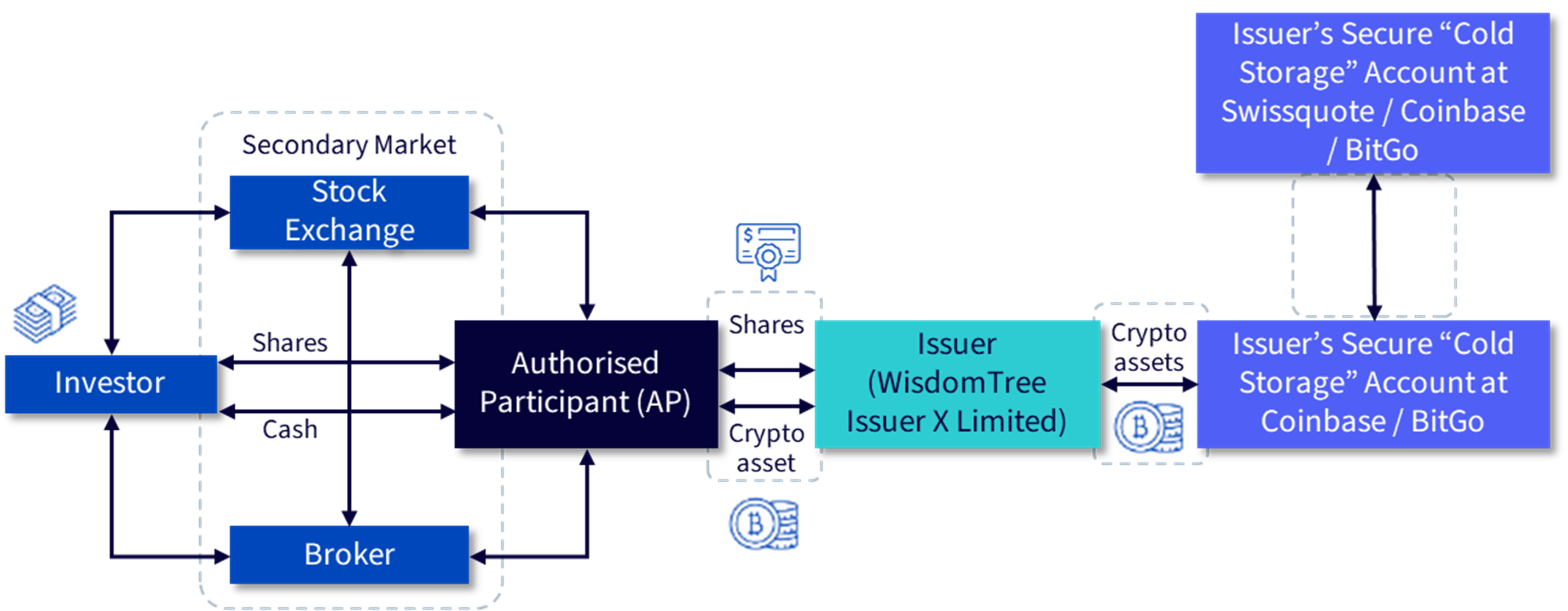
The WisdomTree Digital Asset ETPs do not trade digital assets in the creation/redemption process, thus avoiding the use of cash, as well as avoiding transaction costs from being incurred inside the product as part of the creation/redemption process.
The exact coin entitlement can be found on our website on a daily basis. The coin entitlement per share can be calculated by dividing the Total Coin Entitlement by the Shares Outstanding.
Investors transact in the secondary market, buying or selling shares on an exchange or directly with their broker.
Investors in most WisdomTree crypto ETPs have an option of physical delivery. Please see Physical Crypto Redemption for further detail.
Safekeeping of assets and accessibility are WisdomTree’s primary goal in creating digital asset ETPs. In developing the program, we have gone to great lengths to ensure that the direct holdings are secured using industry leading storage solutions taking in to account the operational and cyber-security considerations, which are of key important to investors entering this asset class. The products offer a simple and cost-efficient way to invest in digital assets with confidence.
The WisdomTree Digital Asset ETPs directly hold the underlying assets in segregated wallets managed through an institutional custody set-up. The custodians we work with are leaders in the field and offer best-in-class storage solutions for digital assets ensuring that we have transparency and control over our holdings in a highly secure, reliable environment. The amount held is monitored and reconciled daily basis between our custodians, the Issuer and the administrator.
Fork not supported by custodian:
In the event that a fork is not supported by the custodian, this will be clearly notified to WisdomTree. There will be no further action required. The existing digital currency will continue to exist with no impact.
Fork supported by custodian:
If in the event a fork occurs and the custodian is able to support the fork, and allocate any forked assets to WisdomTree, the Issuer will designate a record date for the affected WisdomTree ETPs as of the date of the hard fork (the “Record Date”).
The Issuer will closely monitor the impact of the hard fork and assess the options available to it after the hard fork with an aim to enable holders of the affected WisdomTree ETPs as at the Record Date to receive the benefit of the affected WisdomTree ETPs. These options may depend on options made available by related third parties such as Custodians, Exchanges and Authorised Participants.
The Issuer notes that if the fork occurs, it will not impact the security or structure of the affected WisdomTree ETPs and that it can give no guarantee that it will be able to identify a way of providing the benefit of the forked assets to the holders of the affected WisdomTree ETPs as of the Record Date. Any holder of the affected WisdomTree ETPs who acquires affected WisdomTree ETPs after the Record Date will not receive any benefit from the forked asset.
Trading
Investors in the WisdomTree Digital Asset ETPs can buy or sell as little as one share on exchange or directly with their broker over the counter (OTC). The products are currently listing on the SIX, Xetra , LSE8 , Borsa Italiana9, Nasdaq Stockholm10, Euronext Paris and Euronext Amsterdam exchanges.
8 LSE only applies for WisdomTree Physical Bitcoin (BTCW) and WisdomTree Physical Ethereum (ETHW).
9 At the moment, only WisdomTree Physical Bitcoin ETP (BTCW), WisdomTree Physical Ethereum ETP (ETHW), WisdomTree Physical XRP ETP (XRPW), WisdomTree Physical Solana ETP (SOLW), WisdomTree Physical Stellar Lumens ETP (XLMW), WisdomTree Physical Lido Staked Ether (LIST), WisdomTree Physical Crypto Altcoins (WALT), and WisdomTree Physical CoinDesk 20 ETP (WCRP) are listed on Borsa Italiana.
10 Nasdaq Stockholm only applies for WisdomTree Physical Solana (SOLW).
Here is an example for the WisdomTree Physical Bitcoin ETP.
The daily NAV is calculated using per-share coin entitlement and the CoinDesk Bitcoin Benchmark London Settlement Rate.
The CoinDesk Bitcoin Benchmark London Settlement Rate is calculated based on the relevant bitcoin transactions on eligible constituent exchanges between 3:00 p.m. and 4:00 p.m. London time. The price and size of each relevant transaction is recorded and added to a list which is portioned into 12 equally weighted time intervals of 5 minutes each.
This means that any cost associated with sourcing the digital assets, including any market impact, will affect the pricing of a given WisdomTree Digital Assets ETP trade and therefore the efficient max size.
Whilst market conditions vary and must always be considered when trading, the efficient trade size is typically in the 4-5mn USD range but trades in the 10+mn USD can be accommodated (conditions permitting).
All investors purchase shares in the secondary market (usually on exchange) with two-way liquidity provided by market makers throughout the trading day. The liquidity that market makers are able provide is directly linked to the underlying digital assets market as shares in the products can be created or redeemed on a given day in exchange for digital assets.
If we consider a scenario where an investor is looking to sell shares of the WisdomTree Digital Assets ETP, they would do so at the prevailing market price, either on exchange or via their broker, and will end up trading against an Authorised Participant who will in turn redeem the shares with the Issuer in exchange of digital assets. These can then be liquidated to facilitate payment for the shares being sold by the investor.
Bitcoin and some other digital asset networks use the ‘Proof-of-Work’ consensus mechanism. Although there is no ‘staking’ in Proof-of-Work consensus mechanism, we will describe Proof-of-Work just to highlight the differences in the two consensus mechanisms. In the Proof-of-Work consensus mechanism mining computers compete against each other using electricity to solve difficult math problems in order to create new blocks on the network. Nodes11 on the network check that this work has been done – that it is correct - then validate the new block. In return for doing this intensive computational work (‘Proof-of-Work’) the miners are rewarded with newly created (‘minted or ‘mined’) native cryptocurrency of the network. If the work is not correct, the nodes reject the false block and the miner incurs the cost of expended electricity.
By contrast, under ‘Proof-of-Stake, there is less computational work being done. Instead, validator nodes on the network (i.e. the nodes with a stake in the network) are chosen at random to create new blocks on the distributed database. The probability of being chosen is usually higher if more cryptocurrency has been staked. When selected to create a new block, the node compiles a set of transactions and signs them with a private key. Other validator nodes on the network check that this is all correct and, if so, the node is rewarded with newly minted cryptocurrency. If the work is not correct – then the node can incur a penalty, a low probability form of which is called slashing, which results in some or all of the staked cryptocurrency being lost. The more common penalty is what is termed ‘leaking’, which is a very gradual reduction in the amount of staked cryptocurrency so as to eventually remove the poorly performing validator node from the network.
11 A node is a computer that runs a cryptocurrency software
Different digital asset networks have different monetary policies (i.e. the incentive structure used to encourage or discourage certain behaviour on the network). For most networks, the new cryptocurrency created (i.e. the network inflation) is given to stakers. In some networks, this might be accompanied by the transaction fees paid by those transacting on the network.
The staking reward is a consequence of the way in which developers wrote the code for the network. This monetary policy is decided when the network is created and can be adjusted over time according to the governance rules of the network, hard forking the network or applying a soft fork upgrade. There may be other factors that lead to the staking reward varying over time, depending on the network, including transaction fees, number of validator nodes, amount of cryptocurrency burnt, etc.
Yes, it does. There are a number of variations of the Proof-of-Stake consensus mechanism, which makes staking different across networks. Staking also differs due to the way in which the monetary policy of the network (i.e. the conditions under which and the rate at which new cryptocurrency is created), which differs across networks. There are also some technical specifications, like the minimum staking amount or leakage/slashing rules, that differ across networks.
Different networks have different monetary policies, which in part determines the staking reward. The emission (i.e. inflation) rate follows a curve, which means that over time, as more and more nodes participate in staking, the new cryptocurrency is distributed across more and more nodes. This tends to reduce the yield for each individual node over time. In some networks the staking reward from inflation might be accompanied by the transaction fees paid by those transacting on the network. This again can vary as demand and willingness to pay for block space on the network, and the network’s block capacity, change over time.
Yes – though the rate varies across networks. For some networks, the emission (i.e. inflation) rate follows a curve, which means that over time, as more and more nodes participate in staking, the new cryptocurrency is distributed across more and more nodes. This tends to reduce the yield for each individual node over time.
Moreover, in some networks the staking reward from inflation might be accompanied by the transaction fees paid by those transacting on the network. The transaction fees can vary as demand and willingness to pay for block space on the network, and the network’s block capacity, change over time.
No. When running one’s own staking infrastructure the cryptocurrency remains with the party possessing the private keys (i.e. the custodian) at all times. Staking involves locking up cryptocurrency in a smart contract, which means that the private keys are still held by the custodian. This is subject to some risks including smart contract risk and the risk of slashing/penalties. Important to note that Coinbase provide an Ethereum slashing insurance.
By contrast, lending of digital assets can either be done via a centralised or decentralised entity. When done with centralised lending platforms, control of the private keys is given to the centralised entity, which then lends out those assets in exchange for interest on the loan. This comes with various risks including counterparty risk.12
For the avoidance of any doubt, there is no lending within WisdomTree Physical Crypto ETPs.
12 https://www.figment.io/resources/misconceptions-about-staking-protocol-staking-vs-liquidity-lending
Beyond the risks that require management for all digital asset ETP products, staking presents a few additional risks to manage:
- Network outage: If there is a network outage, this would delay bonding/unbonding as well as the redemption settlement. WisdomTree would proactively communicate the issue if it were to arise.
- Liquidity: the unbonding period could cause a delay of the redemption settlement
- Leakage: For some digital asset networks, if the validator nodes do not respond for a sustained period of time when requested to validate new transactions, a small ‘leakage’ fee is imposed on the node’s stake. This is imposed so that, over time, if some nodes persistently fail to perform their validation role, then the distribution of staked cryptocurrency returns to a threshold required for the network to resist certain classes of attack.
- Slashing: Malicious validator behaviour such as dishonest validations, double signing and inactivity may be subject to a penalty called “slashing” depending on the specific protocol. Slashing is designed to incentivise validator responsibility and network collaboration. Slashing penalties vary depending on the protocol but can cause the reduction of the validator’s stake or in some instances the validator may be removed from the network. Important to note that Coinbase provide an Ethereum slashing insurance.
WisdomTree splits the total AUM across several wallets. The fund’s digital assets will be divided into liquid and staked assets. A WisdomTree working group monitors the staked levels and decides/changes the threshold and the number of required staked wallets as required.
If there is a large redemption on any cryptocurrency ETP, redemption settlement may incur a delay beyond the standard settlement cycle.
In addition to the general staking risks highlighted above, it is noteworthy to mention that staking requires ether to be locked on the protocol in order to earn staking rewards. It is not possible to trade or transfer the staked ether during this period. Also, the bonding and unbonding periods vary and the time taken depends on the number of validators in the activation and deactivation queue. Bonding is the time taken to lock the staked ether into the validator’s smart contract node. Unbonding is the time taken to unlock the staked ether from the validator’s smart contract node.
The estimate for Ethereum’s annual percentage yield is 3% and is dependent on many factors, including the way ether is staked, the amount of validators, the amount of transactions on the blockchain and whether maximum extractable value (MEV) technology is used.13
There are two types of rewards:
- Consensus layer rewards: rewards for participating in the Proof-of-Stake network by proposing or validating blocks
- Execution layer rewards: Ethereum network users can incentivise a validator to process transactions faster by paying an extra transactions fee. To earn this extra fee, a validator must make sure to add those specific transaction(s) to the block they propose. Execution layer rewards fluctuate based on network traffic volume
Ethereum Improvement Proposal EIP-1559 introduced the concept of ‘burning’, which means removing some ether permanently from token supply. As a result of this upgrade, at times the protocol can and has turned deflationary such as in November of 202214. After ‘the Merge’, an upgrade to the Ethereum network implemented in September 2022, more ether was removed from the token supply than the amount of new ether issued that year. This deflationary tendency is built into the software code of the Ethereum network but the amount of ‘burned’ ether depends on many factors, including the network activity and users’ willingness to pay transaction fees, which vary constantly.
It usually takes approximately 2-5 days to receive the reward depending on whether the validator has chosen to have its rewards withdrawn at the next epoch.
The unbonding period varies, it usually takes more than ten days and depends on the number of validators in the activation queue at any given time.
Staking ETH through Lido removes the need to operate a validator or lock ETH natively, but it introduces (list not exhaustive) smart-contract risk, validator-operator performance risk, slashing risk, market / liquidity risk, and Lido governance risk. Please also review WisdomTree prospectus, “Risk factors” section.
Lido passes through Ethereum’s staking yield minus a 10% protocol fee, with returns varying on daily basis.
stETH accrues both consensus-layer rewards for validation duties and execution-layer rewards from priority fees and MEV15 captured by Lido’s node operators, with all rewards automatically compounded into an increasing stETH balance each day. This mirrors native ETH staking economics but is aggregated and distributed across Lido’s set of professional validators.
15 MEV = Maximum Extractable Value
No minimum applies. Lido eliminates the 32 ETH validator requirements and allows users to stake any amount of ETH, receiving stETH on a 1:1 basis.
stETH rewards are distributed once per day via a rebase and automatically compounded into the holder’s balance, so users see their stETH holdings increase daily without needing to claim or take an action.
It is possible to exchange stETH to ETH in a few minutes on the secondary market but subject to market price, fees, liquidity, etc. The second option is to request withdrawal in Lido and it depends on available liquidity in the withdrawal vault or may require unstaking via the Ethereum exit queue, making withdrawal times variable.
Yes. Ethereum’s native slashing rules apply to Lido’s validators, with penalties possible for double-signing or extended downtime, though diversification across multiple professional operators reduces correlated risk. Lido also maintains a slashing coverage fund to help offset validator losses, providing partial but not guaranteed protection.
There are many different variants of proof of stake consensus mechanisms.
Solana uses a hybrid of proof of stake and what they term a ‘proof of history’ consensus mechanism. Being a hybrid, the proof of stake consensus mechanism involves the staking of SOL cryptocurrency to validator nodes, which in turn operate the network.
Where the proof of history hybrid element enters is in the way that different nodes keep track of the state (the current order of transactions on the distributed ledger) of the network. Solana adds a hashed timestamp of the prior ledger entry to each new entry on the distributed ledger. Due to some technical constraints around computation of hashes, this hash shows that the block was emitted during its slot and not at any other time, which can be easily and thus quickly verified by any validator. Each block contains the signature of the node (called a ‘leader’) who emitted it, allowing other validators to quickly prove that the block was indeed emitted by the proper ‘leader’ for that slot.
For a non-technical explanation of ‘proof of history’ see: https://solana.com/news/proof-of-history
For an extensive, more technical explanation of ‘proof of history’ and how it relates to proof of stake see: https://www.shinobi-systems.com/primer.html
For Cardano, there is no automatic slashing (i.e., no penalty if the validator behaves maliciously). However, there is potential for missing block penalties or a lack of pledged ADA penalties.16
- Missing blocks: the more block production missed by a stake pool, the lower the reward rate that epoch for the stake pool.
- Lack of pledged ADA: a stake pool at its stake cap with no pledged ADA earns only 77% of the rewards that a stake pool composed completely of pledged ADA earns.
For Cardano there is no (un-)bonding period.17
17 https://www.coinbase.com/cloud/discover/protocol-guides/guide-to-cardano#Rewards-on-Cardano
There are multiple steps involved in determining the amount of staking rewards that stakers receive for the Cardano network.
- The total possible reward amount is calculated each epoch (~5 days), which involves applying an Expansion Rate to the unissued Reserve. (The current Expansion rate is 0.3%). Transaction fees paid during the prior epoch are also added to this amount.18
- A proportion of the total possible reward amount is issued to the Treasury. This amount was 20% as of November 2020.
- The remainder of the total possible reward amount is issued to the network validators. From this amount the following adjustments may be made:
- Subtract penalties (if any);
- For those using a pool,
- Adjustment for those who have pledged tokens (the more pledged tokens, the higher the reward allocation);
- Subtract any pool fixed costs;
- Subtract any pool margin.
More detailed information on each of these steps can be found on the Coinbase website: https://www.coinbase.com/cloud/discover/protocol-guides/guide-to-cardano#Rewards-on-Cardano
Cardano is somewhat unique in that there is no (un)bonding period. Instead, it is possible to pledge tokens to a staking pool and, in return, receive higher staking rewards. Pledging involves contributing an amount of self‐bonded assets which remain staked to a pool for as long as it operates. It is optional and is a mechanism intended to reduce the risk of a Sybil attack (i.e. reducing the risk of one threat actor taking control of over half of the network’s staked voting power).19,20,21
19 https://docs.cardano.org/learn/pledging-rewards
20 https://www.coinbase.com/cloud/discover/protocol-guides/guide-to-cardano#Rewards-on-Cardano
21 https://www.coinbase.com/cloud/discover/solutions/cardano-stake-pledge-margin