




 Print Page
The real risk isn’t bitcoin volatility, it’s underexposure


Key Takeaways
- Despite historic drawdowns exceeding 50%, rolling annualised four-year returns have remained consistently positive, highlighting that time horizon, not volatility, determines realised outcomes.
- Bitcoin’s cumulative performance is heavily driven by a small number of trading days; missing them can erode returns, reinforcing that maintaining exposure matters more than entry precision.
- Even market cap neutral 1–2% bitcoin allocations have improved historic returns and Sharpe ratios in multi-asset portfolios, with only marginal increases in drawdowns.
Despite being the best-performing asset of the past decade, bitcoin remains structurally under-allocated in multi-asset portfolios.
Emotions may play a role in shaping investor decision-making. The result is persistent underexposure to an asset characterised by convex returns and low correlation with traditional assets.
Across cycles, the same behavioural pattern repeats:
- Risk is overstated
- Portfolio contribution is understated
- Timing is prioritised over exposure
The outcome is predictable: missed participation in a highly right-skewed return distribution.
This is not a bitcoin problem. It is a framework problem.
Myth 1: bitcoin is too volatile for long-term investors
Reality: volatility is the price of convexity.
Bitcoin’s drawdowns can be severe, frequently exceeding 50% peak-to-trough1. That is not in dispute.
What matters is whether those drawdowns impair long-term outcomes. While historical data2 suggests that long-term holding periods have mitigated the impact of drawdowns in some cases, there is no guarantee that future outcomes will follow similar patterns.
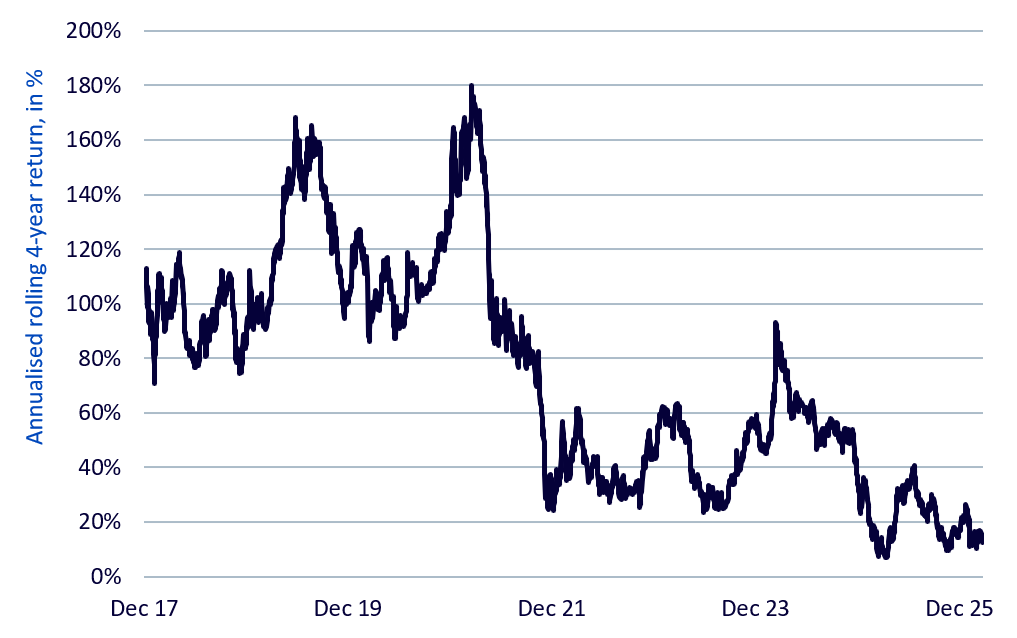
- Since the end of 2013, rolling 4-year returns have historically been positive across all observed periods.
- The median 4-year annualised rolling return has been 64%.
- The worst observed 4-year annualised rolling return has been 7%.
While short-term volatility has been high, long-term outcomes have remained positive. This disconnect comes from a time horizon mismatch:
- Short horizons expose volatility.
- Long horizons capture adoption-driven repricing.
Figure 1: Bitcoin has delivered positive 4-year annualised rolling returns across all observed periods
Source: WisdomTree, Artemis Terminal. 23 March 2026. You cannot invest directly in an index. Historical performance is not an indication of future performance, and any investment may go down in value.
The behaviours are consistent:
- Investors anchor to drawdowns.
- Exit during stress.
- Miss recovery phases.
Treating volatility as synonymous with risk leads to structurally suboptimal allocation decisions.
Myth 2: timing matters more than allocation size
Reality: exposure drives outcomes, timing refines them.
Investors often focus on entry points while underestimating the importance of maintaining exposure.
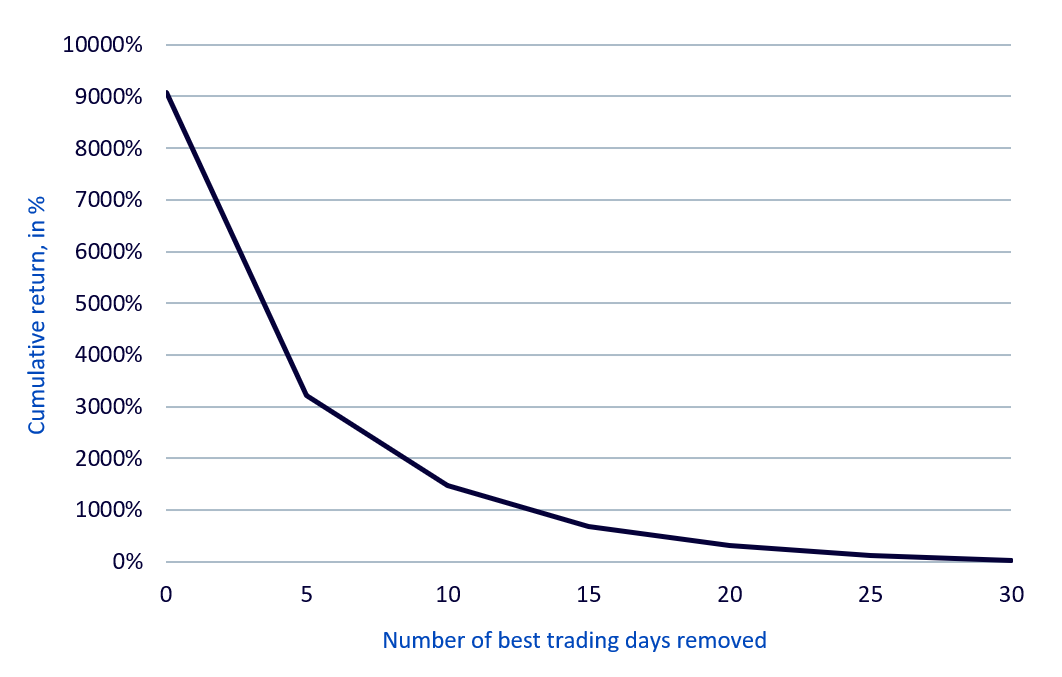
Bitcoin’s returns are highly concentrated. Missing just 30 best trading days reduces cumulative returns from over 9,000% to 26%3. This is because:
- Market timing requires precision twice: entry and exit.
- Missing upside is far more damaging than mistiming entry.
Figure 2: Missing bitcoin’s best trading days destroys returns
Source: WisdomTree, Artemis Terminal. 1 January 2014 to 23 March 2026. You cannot invest directly in an index. Historical performance is not an indication of future performance, and any investment may go down in value.
What can work in practice:
- Consistent market cap neutral allocation of approximately 1-2%.
- Periodic rebalancing.
- Optional dollar-cost averaging to reduce entry dispersion.
Consistency outweighs precision. Allocation decisions shape participation, while timing decisions merely fine-tune results.
Myth 3: volatility makes bitcoin unsuitable for portfolios
Reality: portfolio impact is driven by correlation and asymmetry.
Volatility in isolation is not a decision variable. Portfolio construction depends on interaction effects.
Historically, bitcoin has exhibited:
- High standalone volatility.
- Low correlation with traditional assets.
- Strong positive skew (asymmetric upside).
This combination is powerful and has historically contributed to diversification benefits, although it also introduces additional sources of risk, including elevated volatility and uncertainty.
The data shows that adding bitcoin into a traditional 60/40 global portfolio has historically:
- Increased returns.
- Improved Sharpe ratios.
- Marginally increased drawdowns.
Figure 3: Small bitcoin allocations have historically improved portfolio efficiency
Source: Bloomberg, WisdomTree. From 31 December 2013 to 31 December 2025. In USD. Based on daily returns. The 60/40 global portfolio is composed of 60% MSCI All Country World and 40% Bloomberg Multiverse. You cannot invest directly in an index. Historical performance is not an indication of future performance, and any investment may go down in value.
By way of example, historically4:
- 3% bitcoin allocation increased annualised returns by 1.8%.
- Improved Sharpe ratio by 0.18.
- Increased max drawdown by only 2%.
This is because risk is not driven by volatility alone. It is driven by how assets interact.
Bitcoin’s portfolio contribution comes from diversification and asymmetry, not stability.
From misconception to allocation discipline
The required shift is analytical, not ideological. Investors must reconsider three core assumptions:
- Reframe volatility. Volatility is a feature of adoption-driven assets, not a disqualifier.
- Prioritise allocation over timing. Exposure determines outcomes. Timing only refines them.
- Evaluate at the portfolio level. The relevant metric is contribution to portfolio efficiency, not standalone volatility.
In practice:
- Think in portfolios, not assets.
- Size positions appropriately.
- Extend the time horizon.
As always, there are a couple of important caveats:
- Forward returns are uncertain and likely lower than historical averages.
- Correlation structures may evolve as institutional adoption increases.
These caveats do not invalidate the thesis, but they do reinforce the need for disciplined allocation sizing.
Bottom line
Bitcoin is not failing investment tests. Investors are applying the wrong ones.
Investors could consider:
- Evaluating bitcoin in a portfolio context.
- Focusing on exposure over timing precision.
- Extending the investment horizon.
With these considerations, bitcoin can shift from a speculative trade to a strategic allocation.
The real risk is not volatility, but structural underexposure.
Bitcoin is a highly volatile asset and may experience significant price fluctuations over short periods. Investors may lose some or all of their investment. Its value can be affected by regulatory developments, technological changes, market sentiment and liquidity conditions. Digital assets may also be subject to operational and custody risks. Investments in digital assets such as bitcoin are speculative and may not be suitable for all investors. Investors should carefully consider their risk tolerance and consult relevant documentation, including the prospectus and KID/KIID, before investing.
1 Source: WisdomTree, Artemis Terminal. 23 March 2026.
2 Source: WisdomTree, Artemis Terminal. 23 March 2026.
3 Source: WisdomTree, Artemis Terminal. 01 January 2014 to 23 March 2026.
4 Source: Bloomberg, WisdomTree. From 31 December 2013 to 31 December 2025. In USD. Based on daily returns. The 60/40 global portfolio is composed of 60% MSCI All Country World and 40% Bloomberg Multiverse.





 Previous Post
 All Posts