




 Print Page
Two Shocks, One Direction: The Case for Agricultural Commodities in 2026


Key Takeaways
- The Iran war has turned the Strait of Hormuz into a food security issue. Nearly a third of global urea, half of seaborne sulphur, and a quarter of ammonia transit the Strait
- El Niño is developing on the hottest temperature baseline in recorded history.
- The worst of the supply impact has not yet shown up in the data. Fertilizer shortages take a full growing season to appear in yields, and El Niño's production damage typically peaks 6–12 months after the event itself, the market is still pricing in early innings.
- Soft commodities have the most direct historical sensitivity to El Niño
Agricultural commodity markets are experiencing a significant re-rating in 2026. The Bloomberg Commodity Agriculture Index has returned 13.4% Year to Date1, driven by a confluence of supply side shocks – a rising probability of an El Niño event disrupting growing conditions across three continents and the Iran war’s disruption to shipping through the Strait of Hormuz. These forces are not independent; they interact and reinforce each other and together they are reshaping the near term supply outlook across the agricultural commodity complex.
This year alone the WisdomTree Agriculture ETC (Ticker: AIGA) has attracted US$1.2bn in inflows, taking the assets under management to US$1.4bn underscoring the growing institutional interest in diversified agricultural commodity exposure. The WisdomTree Agriculture ETC (Ticker: AIGA) tracks the Bloomberg Agriculture Subindex Total Return (Ticker: BCOMAGTR Index) comprising futures on coffee, cocoa, corn, cotton, soybeans, soybean oil, soybean meal, sugar, and wheat. It reflects the return on fully collateralised futures positions, quoted in USD. The fund's diversified basket construction means investors gain access to the broad agricultural commodity complex, capturing the notable gains in soybean oil (+56.6%), cotton (+21.5%), and wheat (+31.2%)2, while spreading risk across eight commodities rather than concentrating in any single position.
Agricultural commodities can be highly volatile and may be affected by weather events, geopolitical developments, currency movements, regulatory changes and fluctuations in global demand. Commodity ETCs may experience significant price swings and investors may lose some or all of their investment.
The Strait of Hormuz: A Key Chokepoint for Fertilizer Trade
Discussion of the Strait of Hormuz typically centres on oil. Less well understood is its parallel role in global fertilizer supply. The Persian Gulf nations — Iran, Qatar, Saudi Arabia, and the UAE — collectively represent one of the largest regional exporter of nitrogen fertilizers globally, a position reinforced after Russia's partial exit from normal trading channels following 2022. The Strait is the sole maritime exit for all of them. The scale of fertilizer exposure through the Strait is material:
- Urea (nitrogen): Approximately 30% of globally traded seaborne urea normally transits Hormuz. Global urea prices rose around 26% in the weeks following the conflict3.
- Sulphur: An estimated 44%4 of globally traded seaborne sulphur, the primary feedstock for phosphate fertilizer, passes through Hormuz. Disruption here affects the entire phosphate supply chain from India to Sub-Saharan Africa.
- Ammonia: Over 25% of globally traded ammonia transits the Strait. Iranian producers halted urea and ammonia output at the conflict's onset. Ammonia is the feedstock for virtually all nitrogen fertilizers.
- LNG as fertilizer feedstock: Approximately 20% of global LNG transits Hormuz, with 83% going to Asian markets5. Elevated LNG prices directly raise the cost of ammonia synthesis, creating a cost-push effect that extends well beyond the Gulf.
Transmission to Agricultural Commodity Markets
The Food Agricultural Organisation (FAO) has confirmed a developing fertilizer shortage across Asia and the Global South, with India, Bangladesh, Egypt, Sudan, and parts of Sub-Saharan Africa among the most affected regions. The key analytical point is the lag between the disruption and its harvest impact. Shipping delays from the Gulf to the Indian subcontinent run approximately 30 days, meaning supply shortfalls in March affected April and May planting windows, with the full harvest consequences not expected to become visible in production data until Q3–Q4 2026. Four transmission channels are most relevant for AIGA's constituent commodities:
- US area reallocation: The United States Department of Agriculture (USDA) stated that US grain production is expected to decline as area shifts toward soybeans (known to be less fertiliser intensive) "given better expected returns and higher fertilizer costs."6 This is a direct result of elevated input costs and has the effect of tightening the corn balance while adding to soybean supply. US corn production is forecast down 26 Million Metric Tons (MMT) from the prior-year record, the largest single-country volume reduction in the World Agricultural Supply & Demand Estimates (WASDE)6.
- Wheat: India's government has lifted its wheat export ban on the back of ample stocks, but fertilizer availability ahead of the June monsoon planting season is being constrained by Hormuz-related supply shortfalls. The global wheat outlook is for declining production after a record 2025/267. Production is projected lower with reductions for most major exporters but increases for many importers. Ending stocks are forecast to decline, with reductions for the United States, the European Union, China, and Australia, tempered by growing stocks in India.
Figure 1:
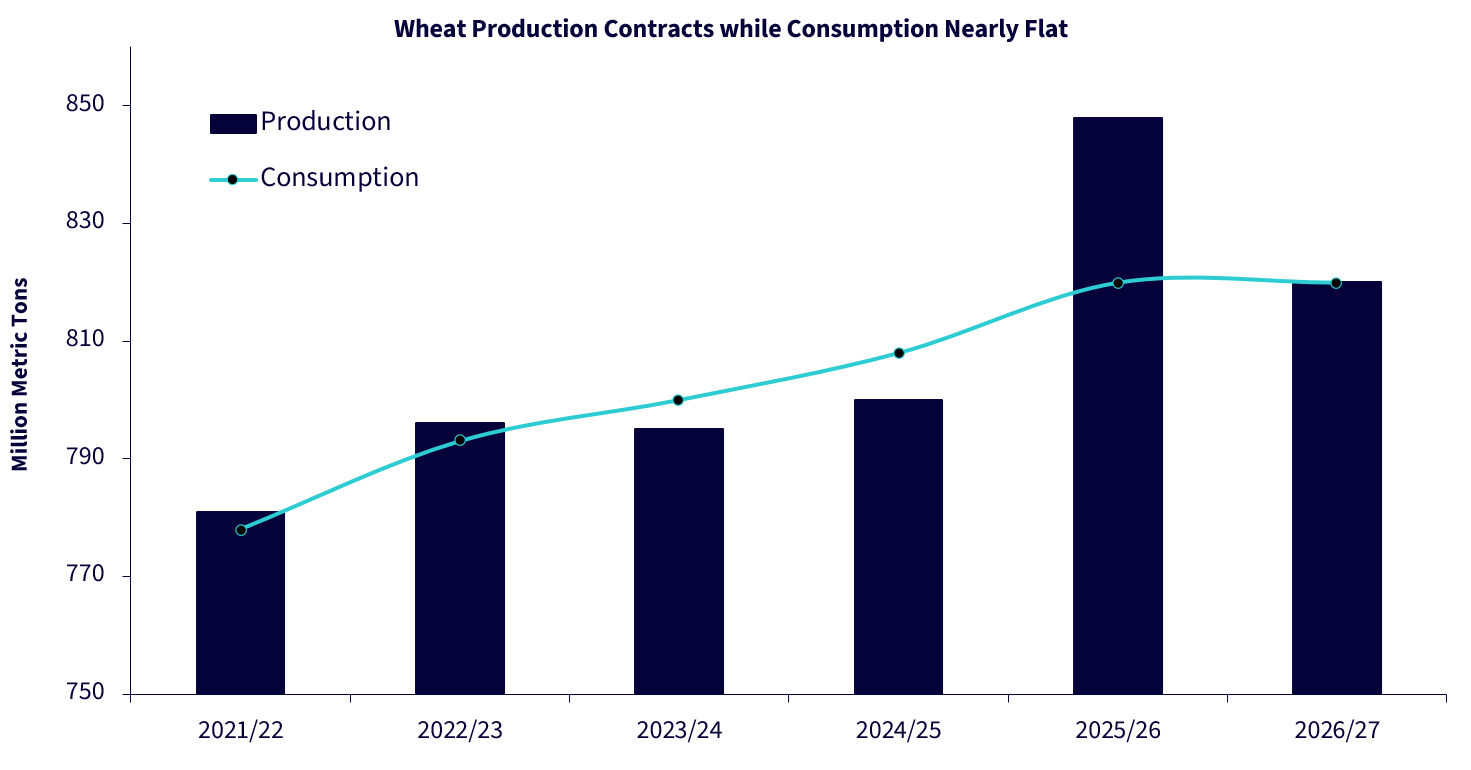
Source: USDA Grain: World Markets and Trade report as of May 2026.
- Soybean oil and biofuel demand: Higher energy prices associated with the Hormuz disruption are reinforcing the economics of soybean oil as a biofuel feedstock. The USDA projects a 32% rise in US industrial soybean and rapeseed oil consumption driven by biofuel production in 2026/27, a trend that has been present since 2023 but has gained further momentum from the energy price environment. Soybean oil's +56.6% YTD move is the single largest contributor to AIGA's 2026 performance, and the USDA data suggests that some of the demand drivers are structural rather than transient8.
Figure 2:
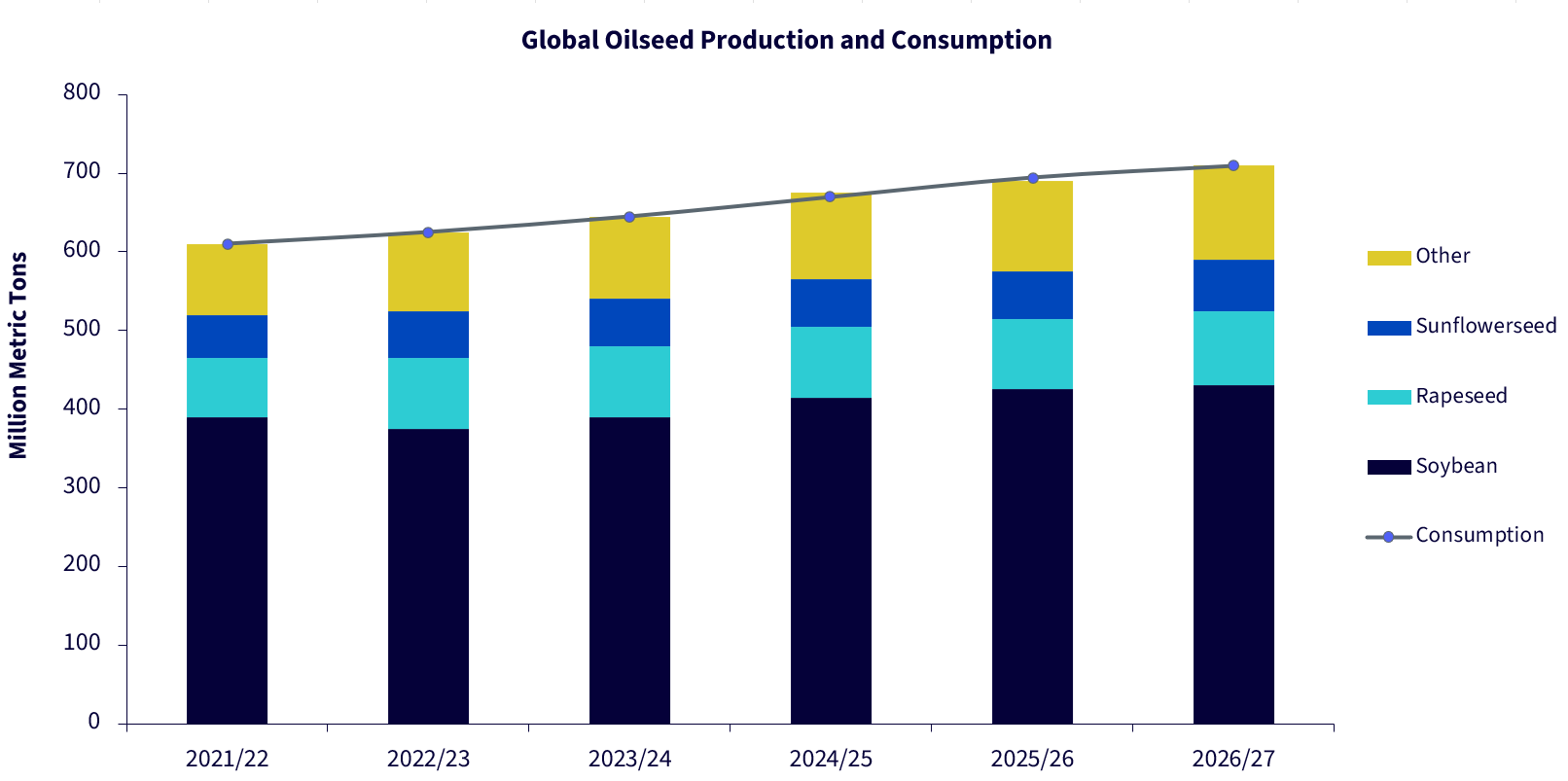
Source: USDA Oilseeds: World Markets and Trade report as of May 2026.
- Yield compression: Farmers in Sub-Saharan Africa, South Asia, and Latin America applying reduced fertilizer rates in the 2026 planting cycle will carry lower yields into the 2026/27 harvest. Unlike a spot price shock, yield compression takes more than one growing season to reverse. For annually planted row crops such as wheat and corn, sub-optimal fertilizer application in the 2026 planting cycle will compress yields in the 2026/27 harvest, a one-season impact that can recover if input supply normalises. For perennial crops such as coffee and cocoa, the damage is more persistent: nutrient and weather stress during flowering and fruit-set reduces yields across multiple subsequent harvests from the same plants, and new planting takes three to five years to reach productive maturity. It is in the soft commodity complex, therefore, where the supply impact of the current disruption is most likely to extend beyond a single marketing year.
Super El Niño: Compounding the Fertilizer Supply Picture
An El Niño event is widely expected to develop during mid-2026. An El Niño weather event is triggered by a warming of a region in the Pacific Ocean, which drives a change in trade wind patterns around the world. Some places become hotter than normal. Other places become cooler than normal. Some places become wetter than normal, while others become drier. The key issue is that a weather deviation from normal has the potential to adversely affect crop yields. The World Meteorological Organisation’s (WMO) April 2026 Global Seasonal Climate Update signals rapidly rising sea-surface temperatures in the Equatorial Pacific, with National Oceanic and Atmospheric Administration’s (NOAA) Climate Prediction Centre assigning a 82% probability to El Niño onset during May–July 2026 (vs 61% probability in their April report). Its significance in the current context is that it has the potential to reduce agricultural crop yields in the same producing regions that would otherwise have helped offset the input cost pressures arising from the Hormuz disruption. Both forces are pulling in the same direction at the same time.
What matters more is the timing and the baseline from which this event is developing. 2025 was cooler than 2024 due to a La Nina phase, despite being one of the warmest years on record overall. That La Niña induced cooling was always temporary. 2024 was the hottest year on record9 with global average surface temperatures 1.55 degrees above the 1850-1900 average, characterised by exceptional land and sea surface temperatures and ocean heat. Agricultural systems are already operating under stress from that elevated baseline and the return of El Niño layered on top of it compounds the risk materially.
Critically, the weather effects of El Niño tend to peak during December, but the impact typically takes time to spread across the globe. Much of the agricultural damage from an event that peaks in the northern hemisphere winter manifests in the following growing season, meaning stress that is already appearing in agricultural systems today is likely to intensify before it eases. Historical data shows there is typically a 6–12-month lag between the peak of an El Niño event and the peak of the production impact. Historically, agricultural commodity markets have often repriced ahead of confirmed production impacts, as markets tend to react in anticipation of tightening supply conditions.
Why AIGS and the El Niño backdrop are well-aligned
Historically, soft commodities have often shown heightened sensitivity. Soft commodities have consistently been the strongest performers during El Niño episodes, three of the five soft commodities (cotton, coffee, and sugar) moved to multi-year highs in 2022–23, and in late 2024 orange juice and cocoa reached record highs while coffee reached a record high in 202510. Every strong El Niño in the past 55 years has reduced global cocoa production, with Ecuador and Indonesia the most exposed origins and significant risks in West Africa (where most of the world’s production is now concentrated).
For investors who wish to access the soft commodity dimension of the El Niño thesis more directly, WisdomTree offers a complementary product to AIGA via the WisdomTree Softs ETC (Ticker: AIGS). WisdomTree Softs is a fully collateralised, UCITS-eligible Exchange Traded Commodity (ETC) designed to provide investors with total return exposure to a basket of softs futures contracts. The ETC aims to replicate the Bloomberg Commodity Softs Subindex 4W Total Return Index (Ticker: BCOMSO4T). The index is composed of futures contracts on coffee, cotton, and sugar.
Conclusion
The agricultural commodity complex in 2026 is being shaped by two supply-side forces that are unusual both in their scale and in the way they interact. The Hormuz fertilizer disruption is affecting input costs and planting decisions in real time, with consequences that will continue to emerge in harvest data through Q3–Q4 2026 and into 2027. The developing El Niño is adding a climate layer on top of a temperature baseline that is structurally higher than any previous episode — and its production impact, when it arrives, will follow with a 6–12-month lag from peak.
1Bloomberg Finance L.P. from 31 December 2025 to 13 May 2026
2Bloomberg Finance L.P. from 31 December 2025 to 13 May 2026
3CRU as of 15 March 2026
4Argus Media as of 31 March 2026
5Energy Information Administration, June 2025
6United States Department of Agriculture (USDA) May World Agriculture Supply and Demand Estimates (WASDE) Report as of 12 May 2026
7United Stated Department of Agriculture as of May 2026
8Bloomberg Finance L.P. from 31 December 2025 to 13 May 2026
9World Meteorological Organization (WMO)
10Bloomberg Finance L.P. as of 31 March 2024

 Previous Post
 All Posts