




Efficient Core - a new era
of smart investing
Investors often grapple with the decision between low-cost building blocks or improved risk-return profile. The WisdomTree Efficient Core approach is designed to provide both.
By leveraging the traditional 60/40 portfolio, we aim to offer a portfolio with equity-like volatility, but with the superior Sharpe ratio of a 60/40 portfolio.1 Historically and over the long term, this resulted in:
- Better long-term performance and a higher Sharpe ratio than a pure equity portfolio
- Improved diversification leading to smaller drawdowns during volatile markets

The results below demonstrate the performance of a leveraged 60/40 portfolio comprising Global Equities and Global Government Bonds. Similar results are observed across different geographies. A leveraged 60/40 portfolio with US Equities and US Treasuries would exhibit a comparable risk profile.
Better than 100% equities: leveraging the 60/40 portfolio
Boosting capital efficiency in the core
Investors often rely on the diversification potential of a 60% stock / 40% bond portfolio in their asset allocation. The WisdomTree Efficient Core ETFs incorporate this same logic to enhance the risk-return profile of a large-capitalisation equity portfolio.
They aim to deliver a 90% exposure to equities and 60% to relevant government bonds futures, effectively delivering a leveraged position to the traditional 60/40 portfolio. To do so the index invests 90% of its assets in equities and uses the remaining 10% as collateral to a 60% notional exposure in a basket of government bond futures.
Classic 60/40 Exposure
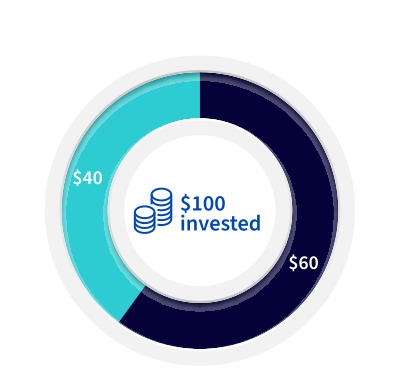
⬤ Equities ⬤ Bonds
Leveraged 60/40 Exposure
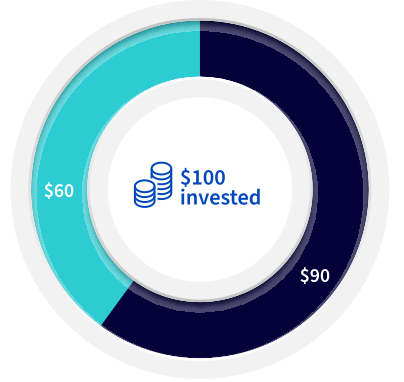
⬤ Equities ⬤ Bonds
For illustrative purposes only.
For a complete overview of the Efficient Core ETFs, please refer to the investment cases.
Efficient Core in a portfolio: improving asset allocation via capital efficiency
An equity replacement
A low fee, core equity solution designed to replace existing core equity exposures. By offering return enhancement, improved risk management and diversification potential compared to a 100% equity portfolio, this strategy could also be used to complement existing equity exposures.
WisdomTree US Efficient Core UCITS ETF and WisdomTree Global Efficient Core UCITS ETF represent a possible replacement solution for equities, aiming to maintain a similar level of risk but improved Sharpe ratio.
0.34
Sharpe ratio of Global Equities
0.43
Sharpe ratio of Global Leveraged 60/40
Source: WisdomTree, Bloomberg, from 16 Jan 2001 to 30 Jun 2024.
A higher Sharpe ratio indicates that an investment has generated a higher risk-adjusted return.
A capital efficiency tool
By delivering equity and bond exposure in a capital-efficient manner, the strategy can help free up space in the portfolio for alternatives and diversifiers.
In a classic 60/40 portfolio there is no space for diversifiers. If an investor wants to add broad commodities, gold or other alpha strategies, they would have to sell some bond or equity positions. However, in an enhanced portfolio, using WisdomTree Efficient Core strategies, only 66.7% of the capital is used to achieve the 60% equity and 40% bond exposure. This leaves one-third of the portfolio for diversifiers. The Sharpe ratio of the Enhanced portfolio can, therefore, be improved without missing out on potential returns.
Classic 60/40 Portfolio
⬤ Global Government Bonds ⬤ Global Equity
Enhanced 60/40 Portfolio
⬤ Global Efficient Core Strategy ⬤ US Efficient Core Strategy ⬤ Other Diversifier and Alpha Strategies ⬤ Broad Commodities ⬤ Gold
Source: WisdomTree. For illustration purposes only.
Why WisdomTree Efficient Core ETFs?
WisdomTree offers different geographical flavours to the efficient core strategy:
ETF Resources
For more information about the underlying indices tracked by our Efficient Core ETFs, please see our US Efficient Core Index Methodology, Global Efficient Core Index Methodology and Eurozone Efficient Core Index Methodology.
Latest insights
1 This is a concept first defined by Clifford S Asness in “Why Not 100% Equities: A Diversified Portfolio Provides More Expected Return per Unit of Risk”. 1996. The Sharpe ratio is a measure of risk-adjusted returns of an investment. A higher Sharpe ratio indicates that an investment has generated a higher risk-adjusted return.