





 Print Page
Making great portfolios greater


Key Takeaways
- Replacing part of the equity allocations in the All-Weather and Permanent Portfolios with WisdomTree Efficient Core allows investors to replicate the original exposures while freeing up capital to include more diversifiers.
- Redeploying that freed-up capital into diversifiers or proportionally across existing assets can add returns, with minimal increase in volatility.
- Efficient Core serves two roles—as an equity replacement tool and a capital efficiency tool—allowing investors to tailor portfolios that align with specific risk and return objectives.
Whether saving for retirement or a future home, investors typically seek strong returns without incurring excessive risk. To do that, the 60/40 portfolio has been a staple choice, but other robust portfolio proposals have also emerged over time. Ray Dalio’s All-Weather Portfolio and Harry Browne’s Permanent Portfolio stand out as particularly popular and effective examples, known for their resilience and adaptability.
WisdomTree has developed a unique range of Efficient Core exchange-traded funds (ETFs) that offers a unique investment tool. By allocating 90% to stocks for growth and 60% to bond futures for balance (in other words, a 60/40 leveraged by 150%), this tool allows investors to improve on a traditional portfolio that mixes equities and bonds by freeing up space in portfolios. The capital efficiency unlocks the ability to add diversifiers, without sacrificing core equity exposure (read more here ).
So, can WisdomTree Efficient Core also improve those other popular portfolios?
Using WisdomTree Efficient Core to improve all-weather portfolio
Dalio’s All-Weather Portfolio resembles a risk-parity portfolio and is designed to perform consistently across various economic scenarios, including inflation, deflation, accelerating growth, and slowing growth. Equities typically perform well during periods of economic growth, while long-term bonds offer protection during deflation and recessionary environments. Intermediate-term bonds provide stability during moderate economic fluctuations, commodities generally thrive in inflationary environments, and cash serves as a buffer during market volatility.
We first try to replicate the all-weather portfolio by using WisdomTree US Efficient Core (see the second column of Figure 1). We start by substituting the equity position in the all-weather portfolio with WisdomTree US Efficient Core. With this, investors effectively achieve a 27% equity exposure (30% * 90%). To maintain the original 30% allocation to equities, an additional 3% is allocated directly to the S&P 500. Since WisdomTree US Efficient Core also includes 15% exposure to intermediate-term Treasuries, investors can reduce this amount from their existing bond allocation. This adjustment frees up approximately 12% of capital, which can be allocated to T-bills.
Figure 1: Variations of the All-Weather Portfolio using US Efficient Core
Source: WisdomTree. The table shows different variations of the All-Weather Portfolio by introducing US Efficient Core.
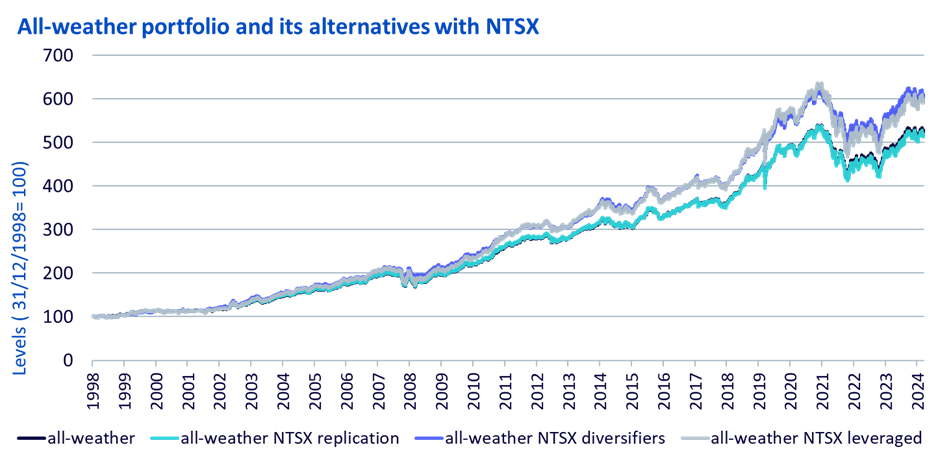
The dark blue line and the teal line in Figure 2 indicate that this Efficient Core-enhanced version of the All-Weather Portfolio closely mirrors the original portfolio’s performance. Minor discrepancies primarily arise from small differences in the fixed income leg durations but, overall, the replication remains precise for all practical purposes.
However, one major effect of integrating US Efficient Core in the portfolio is that this opens further opportunities for investors. The approximately 12% freed-up capital can be strategically deployed in two main ways.
- NTSX Diversifiers - first, investors might enhance diversification by incorporating additional asset classes or alternative strategies that typically have low correlations with traditional asset classes. In this case, we substitute the cash with a common trend-following index, namely the SG Managed Futures index.
- NTSX Leveraged - alternatively, investors might consider proportionally redistributing the freed capital across the existing asset classes.
The effects are the ones that we see in the purple and grey lines in Figure 2.
Figure 2: Historical performance and statistics of the All-Weather Portfolio using US Efficient Core
Source: WisdomTree, Bloomberg. Data from 1 January 1999 to 25 March 2025. You cannot invest in an index. Historical performance is not an indication of future performance, and any investments may go down in value.
We can see that:
- Both the options have a very similar performance: both add a 0.6% per annum (p.a.) return to the All-Weather Portfolio.
- In the first option (all-weather NTSX diversifiers), volatility only goes up slightly (by 0.3% compared to the “replicating” portfolio) and max drawdown improves. On the other hand, the second option’s (all-weather NTSX leveraged) return increase costs more in terms of volatility and maximum drawdown.
- The Sharpe ratio increases significantly in option 1 and stays stable in the case of option 2.
Using WisdomTree Efficient Core to improve Browne’s Permanent Portfolio
Browne’s Permanent Portfolio relies on equal allocations to stocks, long-term government bonds, gold, and cash, diversifying effectively across assets that react differently throughout economic cycles. Like the All-Weather Portfolio, it aims to perform well across different environments but stands out for its simplicity and objectively impressive risk-return profile.
Like before, we first replicate the permanent portfolio by integrating WisdomTree US Efficient Core and we subsequently redeploy the freed-up cash by:
- Adding a diversifier
- Adding, proportionally, the existing asset classes
Figure 3: Variations of the Permanent Portfolio using US Efficient Core
Source: WisdomTree. The table shows different variations of the Permanent Portfolio by introducing NTSX.
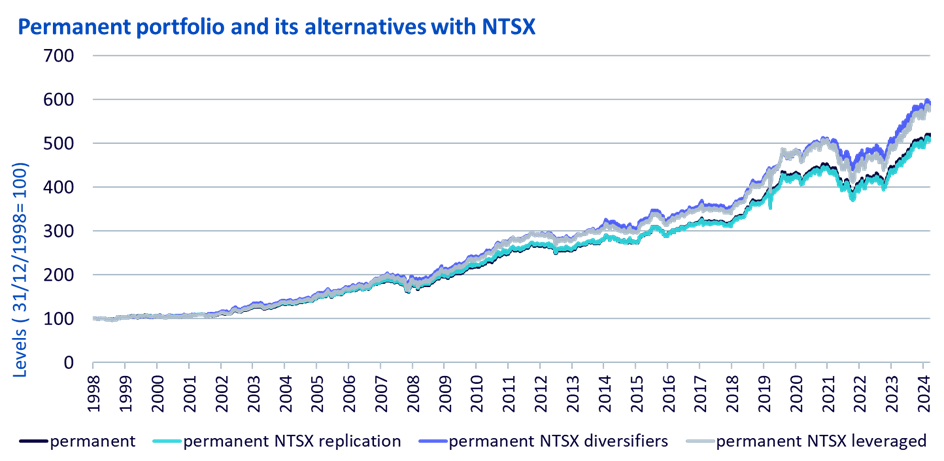
As in the previous example, we can see that adding a valid diversifier improves the portfolio in terms of performance and in terms of risk adjusted profile, while spreading the cash proportionally to the existing asset classes only adds in terms of performance but keeps the risk-return profile unaltered.
Figure 4: Historical performance and statistics of the Permanent Portfolio using US Efficient Core
Source: WisdomTree, Bloomberg. Data from 1 January 1999 to 25 March 2025. You cannot invest in an index. Historical performance is not an indication of future performance, and any investments may go down in value.
Conclusion
Efficient Core serves two critical purposes in portfolio design:
- Equity replacement: by offering equity-like returns with improved efficiency, it becomes a powerful substitute for traditional equity allocations—particularly for investors seeking enhanced risk-adjusted returns.
- Capital efficiency: it frees up portfolio real estate for diversifiers without compromising exposure to core growth assets. This is especially valuable in a world where macroeconomic volatility and inflation uncertainty heighten the need for robust risk management.
Efficient Core redefines what it means to be ‘core’ in a portfolio. It acknowledges the limitations of traditional allocations and offers a practical, data-driven pathway to better outcomes. As markets evolve and capital becomes scarcer, capital efficiency may well become the new frontier of portfolio construction.





 Previous Post
 All Posts