




 Print Page
Balancing tech growth and real estate stability in your portfolio


Key Takeaways
- WTRE targets real estate assets aligned with tech-driven structural trends like data centres, telecom infrastructure, and e-commerce logistics, differentiating it from traditional REIT benchmarks.
- Due to its tech-focused approach, WTRE has demonstrated higher year-to-date performance and estimated long-term earnings growth than traditional real estate indices.
- Compared with pure technology indices, WTRE offers comparatively lower volatility and higher dividend yields, providing a balanced risk-return profile.
- The strategic inclusion of next-generation digital infrastructure and telecom satellites further positions WTRE to benefit from emerging technological trends and supportive macroeconomic conditions.
- Related Products WisdomTree New Economy Real Estate UCITS ETF – USD Acc, WisdomTree New Economy Real Estate UCITS ETF – USD Find out more
When you think of real estate investing, traditional images of office towers, residential apartments, or shopping malls might spring to mind. Yet today, the real momentum is in assets that power the digital economy – data centres, logistics hubs, and telecom infrastructure. These new economy assets aren’t just reshaping landscapes but redefining the real estate investment opportunity.
Shifting away from traditional assets
The real estate landscape is evolving, with traditional sectors influenced by economic cycles and shifting consumer behaviours. However, tech-driven real estate, including logistics facilities underpinning e-commerce, telecom infrastructure, and data centres, benefits from robust long-term structural growth drivers such as digitalisation, cloud computing, and accelerating data consumption.
WisdomTree New Economy Real Estate UCITS ETF (WTRE)’s industry composition distinctly reflects this strategic orientation, with a substantial allocation to specialised REITs like data centres and telecom towers, industrial REITs supporting e-commerce logistics, and direct investments in software and related technology services. On the contrary, the global REITs benchmark FTSE EPRA/Nareit Developed Index allocates around 40% to segments that are less driven by tech, such as retail REITs, residential REITs etc. This intentional industry tilt away from less tech-driven real estate sectors ensures greater alignment with durable tech growth trends.
Figure 1: GICS breakdown – WisdomTree New Economy Real Estate UCITS Index vs Global REITs benchmark
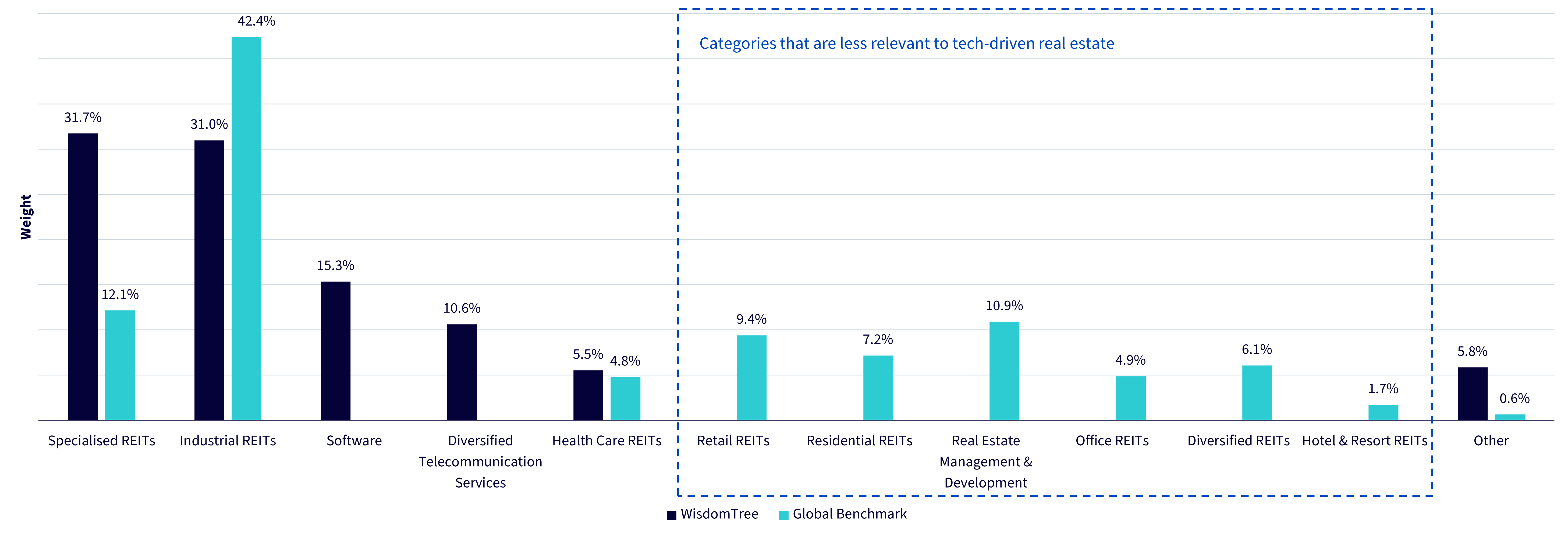
Source: WisdomTree, Bloomberg. As of 30 June 2025. WisdomTree refers to WisdomTree New Economy Real Estate UCITS Index, tracked by WTRE. The Global benchmark is the FTSE EPRA/Nareit Developed Index. GICS is the Global Industry Classification Standard. GICS Industry represent the third level classification in the Global Industry Classification Standard (GICS) hierarchy. You cannot invest directly in an index. Historical performance is not an indication of future performance, and any investments may go down in value.
Balancing growth, volatility, and income
WTRE's strategic emphasis on tech-driven assets has translated into significant comparative advantages. WTRE has notably higher estimated long-term growth than traditional real estate benchmarks, benefiting directly from the secular tech trends underpinning its portfolio. WTRE returned around 19% year-to-date1, more than double that of broad REIT benchmarks such as FTSE EPRA NAREIT Developed Index and FTSE NAREIT All Equity REITs Index.
Figure 2: YTD cumulative performance comparison: WTRE vs REITs benchmarks
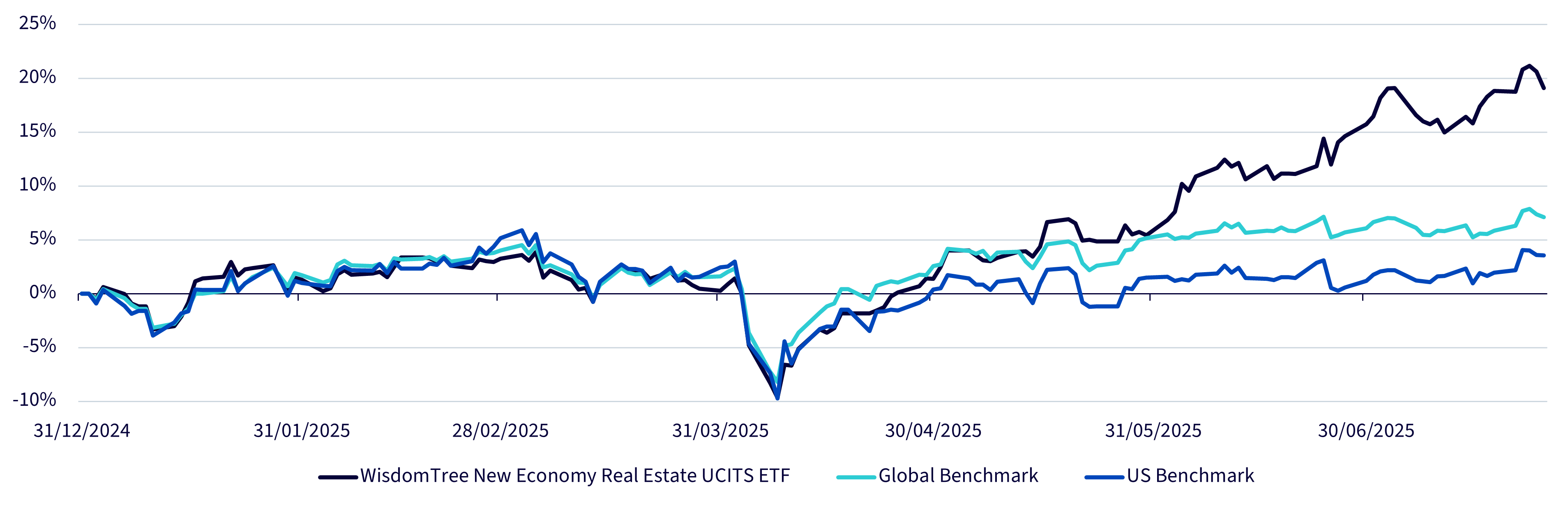
Source: WisdomTree, Bloomberg. Data from 31 December 2024 to 25 July 2025. The Global benchmark is the FTSE EPRA/Nareit Developed Index. The US benchmark is the FTSE Nareit All Equity REITs Index. The fund’s performance is based on the fund’s NAV in USD. You cannot invest directly in an index. Historical performance is not an indication of future performance, and any investments may go down in value.
Benefiting from its tech-driven portfolio, WTRE also exhibits higher forward-looking growth. Its estimated long-term earnings growth is approximately 10.6%2, surpassing both global and US real estate benchmarks. Additionally, compared to pure technology indices like the Nasdaq-100 or MSCI World IT, WTRE provides a superior balance by offering substantially higher dividend yields (2.7% vs. less than 0.7% for tech indices)3 And notably lower one-year volatility.
Figure 3: Balancing Growth, Volatility, and Dividend Yield: WTRE vs. Real Estate and Tech Benchmarks
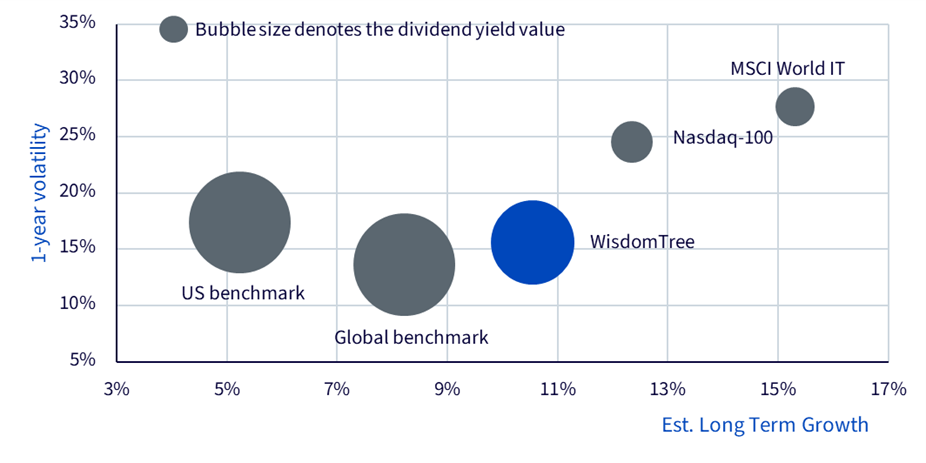
Source: WisdomTree, Bloomberg, as of 25 July 2025. The size of the bubble denotes trailing 12-month aggregate net dividend yields. WisdomTree denotes WisdomTree New Economy Real Estate UCITS ETF. The Global benchmark is the FTSE EPRA/Nareit Developed Index. The US benchmark is the FTSE Nareit All Equity REITs Index. Volatility of the fund is based on the fund’s NAV in USD. You cannot invest directly in an index. Historical performance is not an indication of future performance, and any investments may go down in value.
Thus, WTRE occupies a unique position, capturing tech-driven growth while maintaining real estate-like stability and income. Investors looking to harness the growth of technology with reduced volatility and steady dividends will find WTRE uniquely well-positioned.
Macro backdrop supports real assets
The macroeconomic environment has become increasingly favourable for tech-driven real estate. As of 25 July 2025, market expectations, derived from US Federal Funds Futures prices, indicate approximately 4 -5 rate cuts expected before the end of 2026, bringing the implied federal funds rate down to around 3.2%4. Historically, lower interest rates have enhanced the appeal of dividend-paying investments by reducing financing costs and increasing asset valuations.
Although the US Federal Reserve has not signalled further easing, employment and inflation have relatively stabilised. Once the Fed decides to adopt a more dovish policy, the real estate sector and WTRE will benefit from that catalyst.
Figure 4: Market-derived number of US Fed rate cuts and implied Fed policy rate
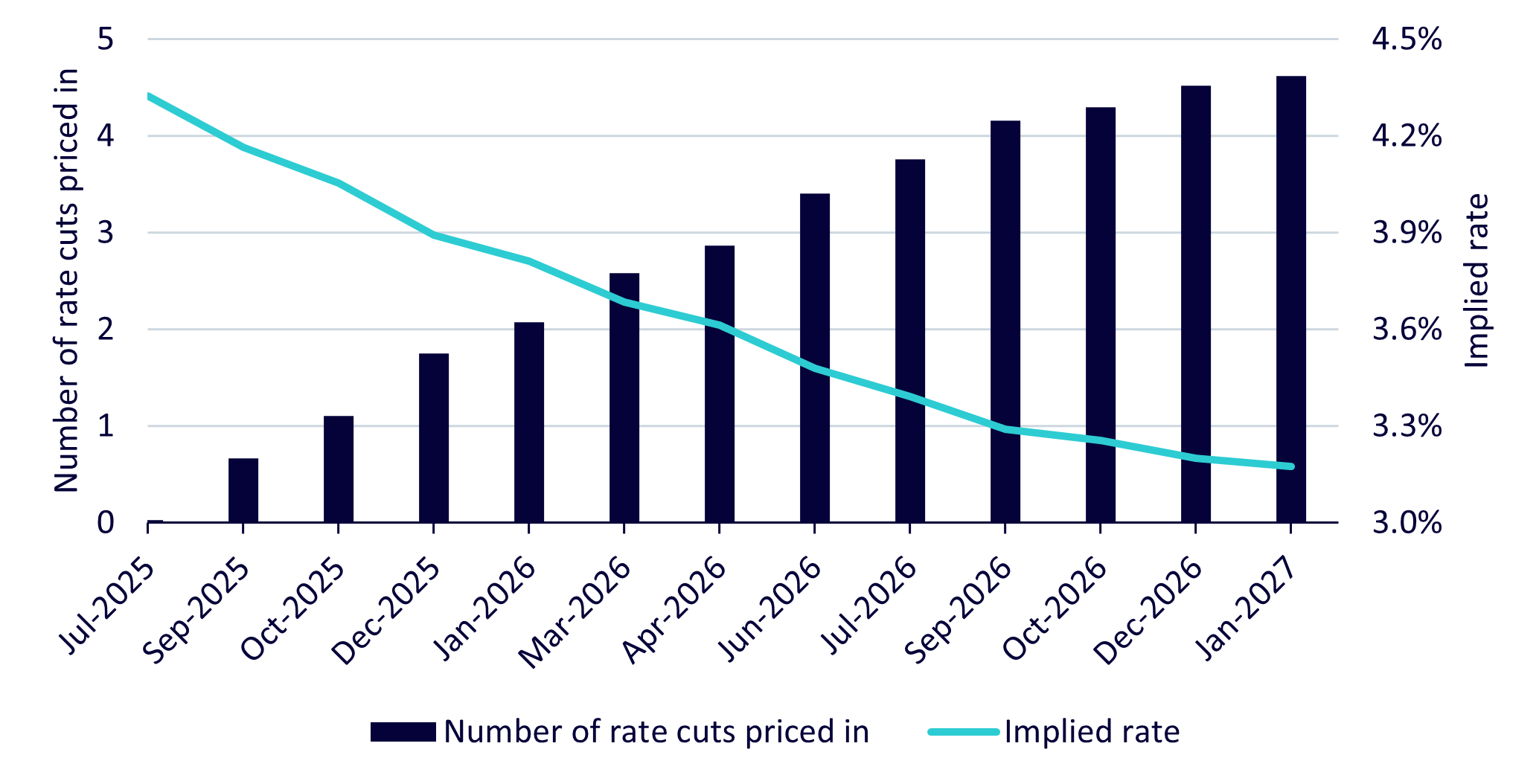
Source: Bloomberg, as of 25 June 2025. The number of rate cuts and implied rates are derived by US Fed funds future prices. Historical performance is not an indication of future performance, and any investments may go down in value.
Strategic index enhancement: telecom satellites take centre stage
To deepen thematic alignment with tech megatrends, WisdomTree switched WTRE’s underlying index early this year by introducing two new groups: next-generation digital infrastructure and telecom satellites. Next-generation digital infrastructure includes blockchain-enabled data centres, crypto-mining facilities, and other high-performance computing infrastructures, capitalising on rising digital asset adoption and blockchain technologies.
Meanwhile, telecom satellite infrastructure significantly enhances connectivity. While traditional telecom towers provide critical ground-based infrastructure, satellite telecom companies, such as AST SpaceMobile (ASTS), extend connectivity into space. Advances in direct-to-cell technology allow modern smartphones to receive signals directly from satellites, significantly broadening the potential customer base. Including these strategic new groups diversifies the fund and aligns it firmly with cutting-edge technological trends.
Figure 5: AST SpaceMobile one-year cumulative performance
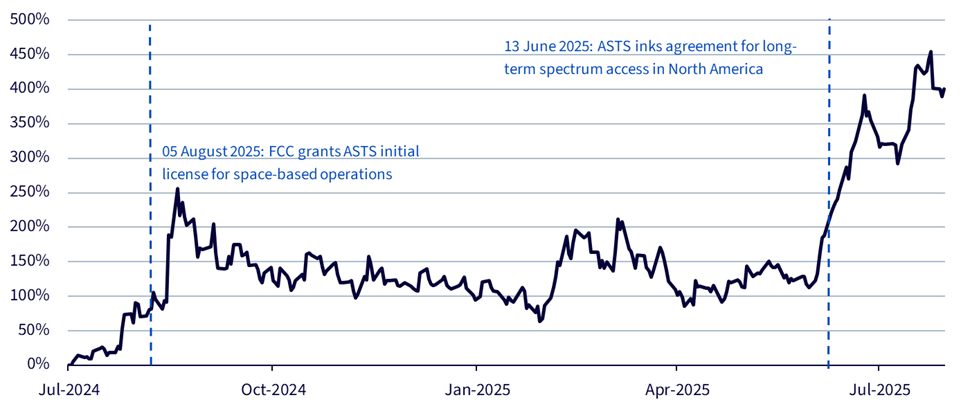
Source: WisdomTree, Bloomberg, as of 25 July 2025. FCC denotes Federal Communications Commission. ASTS denotes AST SpaceMobile. Historical performance is not an indication of future performance and any investments may go down in value.
Conclusion
As the real estate sector continues to evolve, tech-driven assets provide opportunities to access growth segments while offering dividend income and relatively lower volatility compared to pure technology strategies. WisdomTree New Economy Real Estate UCITS ETF (WTRE) stands uniquely positioned to capture these opportunities, providing targeted exposure to the infrastructure powering tomorrow’s new economy. Investors seeking a balance between long-term growth, dividend income, and reduced volatility relative to technology equities may consider WTRE as part of their portfolio strategy.
1Source: Bloomberg, as of 25 July.
2Source: Bloomberg, as of 25 July 2025.
3Source: Bloomberg, as of 25 July 2025.
4Source: Bloomberg, as of 25 July 2025.







 Previous Post
 All Posts