




 Print Page
Three game-changing energy technologies electrifying markets


Key Takeaways
- Bloom Energy: hydrogen fuel cells are gaining traction as AI-driven data centres seek cleaner, on-site power solutions.
- Joby Aviation: battery-powered air taxis are nearing FAA certification, bringing urban air mobility closer to reality.
- Oklo: small modular reactors (SMRs) are emerging as a key solution for powering data centres with reliable nuclear energy.
- Related Products WisdomTree Battery Solutions UCITS ETF - USD Acc, WisdomTree Uranium and Nuclear Energy UCITS ETF - USD Acc Find out more
It’s 17 December 1903. Brothers Wilbur and Orville Wright have just achieved the seemingly impossible. They’ve been airborne for a total of 59 seconds, covering 800 feet in a quiet field in Kitty Hawk, North Carolina. Yet, there are no spectators, and their monumental leap goes unnoticed. Worse still, the press ignores their claims, and the world remains sceptical. It’s not until August 1908, nearly five years later, that a live demonstration in France finally convinces the press, the public, and the world that they have conquered air travel.
Innovations that change the world often go unnoticed, until something brings them into the spotlight. But when that happens, excitement can surge almost overnight.
These days, stock market reaction serves as a gauge for measuring the world’s excitement about new technologies. This blog explores three emerging energy technologies that, like air travel after 1908, are now reaching the phase of acknowledgment and appreciation. The recent stock performance of these companies suggests this moment has arrived.
Bloom Energy Corp: hydrogen fuel cells
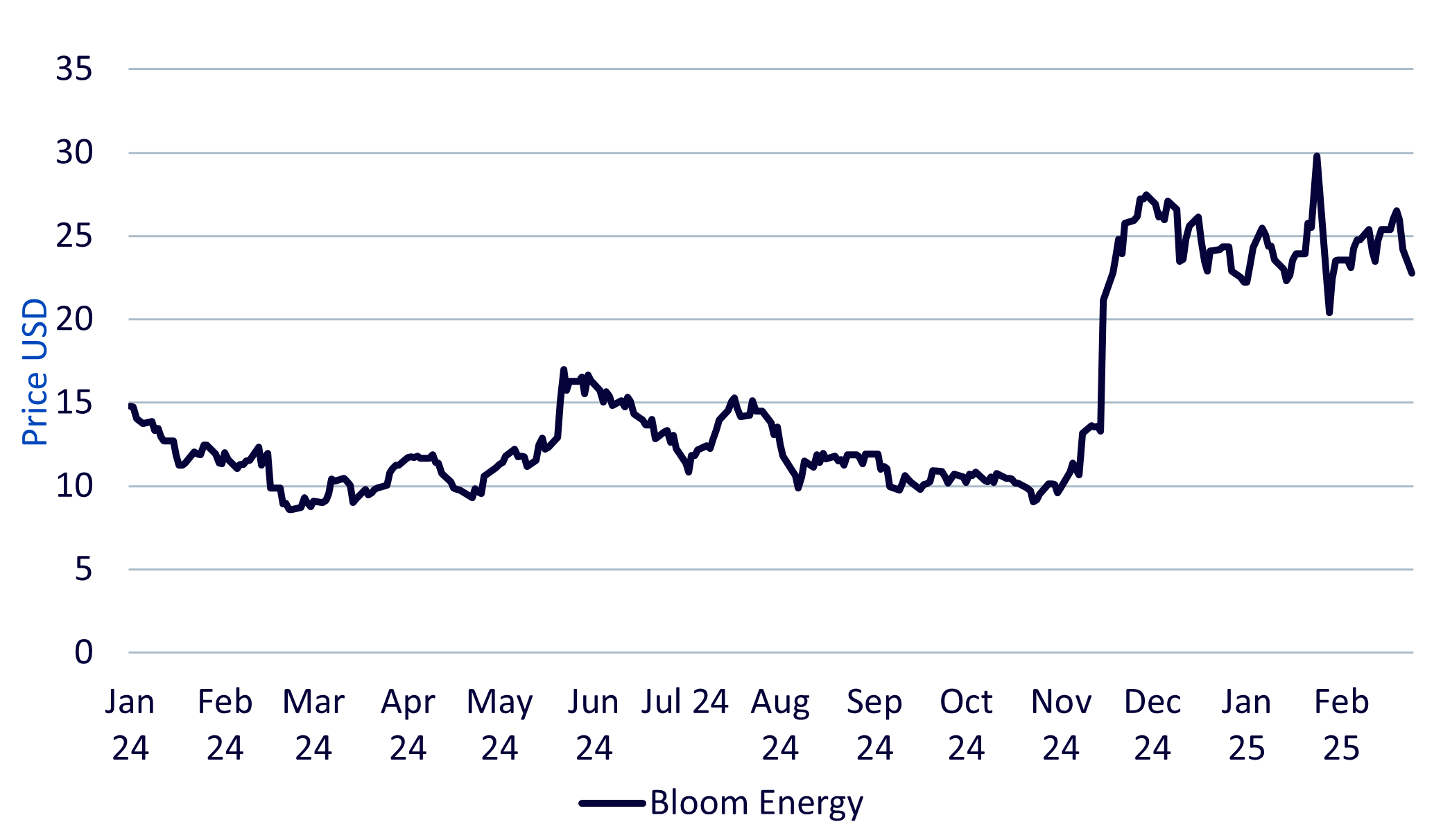
Figure 1: Bloom Energy stock price
 Source: Bloomberg, data as of 24 February 2025. Historical performance is not an indication of future performance and any investments may go down in value.
How the world meets the energy demands of artificial intelligence (AI)-driven data centres is one of the most pressing challenges today. A single large data centre can require 100 MW to over 1 GW, putting its energy consumption on par with a small to mid-sized city.
Bloom Energy has signed a 1 GW fuel cell supply agreement with American Electric Power (AEP), marking the largest commercial fuel cell deployment to date. This will help data centres meet surging AI energy demands with cleaner, more reliable power (Bloom, December 2024).
Unlike combustion-based power, fuel cells generate electricity through an electrochemical process, reducing emissions while providing efficient, on-site energy generation. As AI-driven data centres expand—with capacity expected to grow by 35 GW in five years (Bloom, January 2025)—traditional grids struggle to keep up, making fuel cells a scalable solution.
Bloom’s fuel cells can run on natural gas, hydrogen, or a blend, offering flexibility and lower carbon emissions—a crucial step toward a sustainable, AI-powered future.
For years, hydrogen fuel cells struggled to gain widespread market acceptance, much like the Wright brothers’ aircraft, which was initially overlooked despite its breakthrough potential. However, Bloom’s landmark 1 GW deal late last year has signalled a shift, marking a growing recognition of fuel cells as a viable energy solution.
Joby Aviation: electric vertical take-off and landing (eVTOL) aircraft
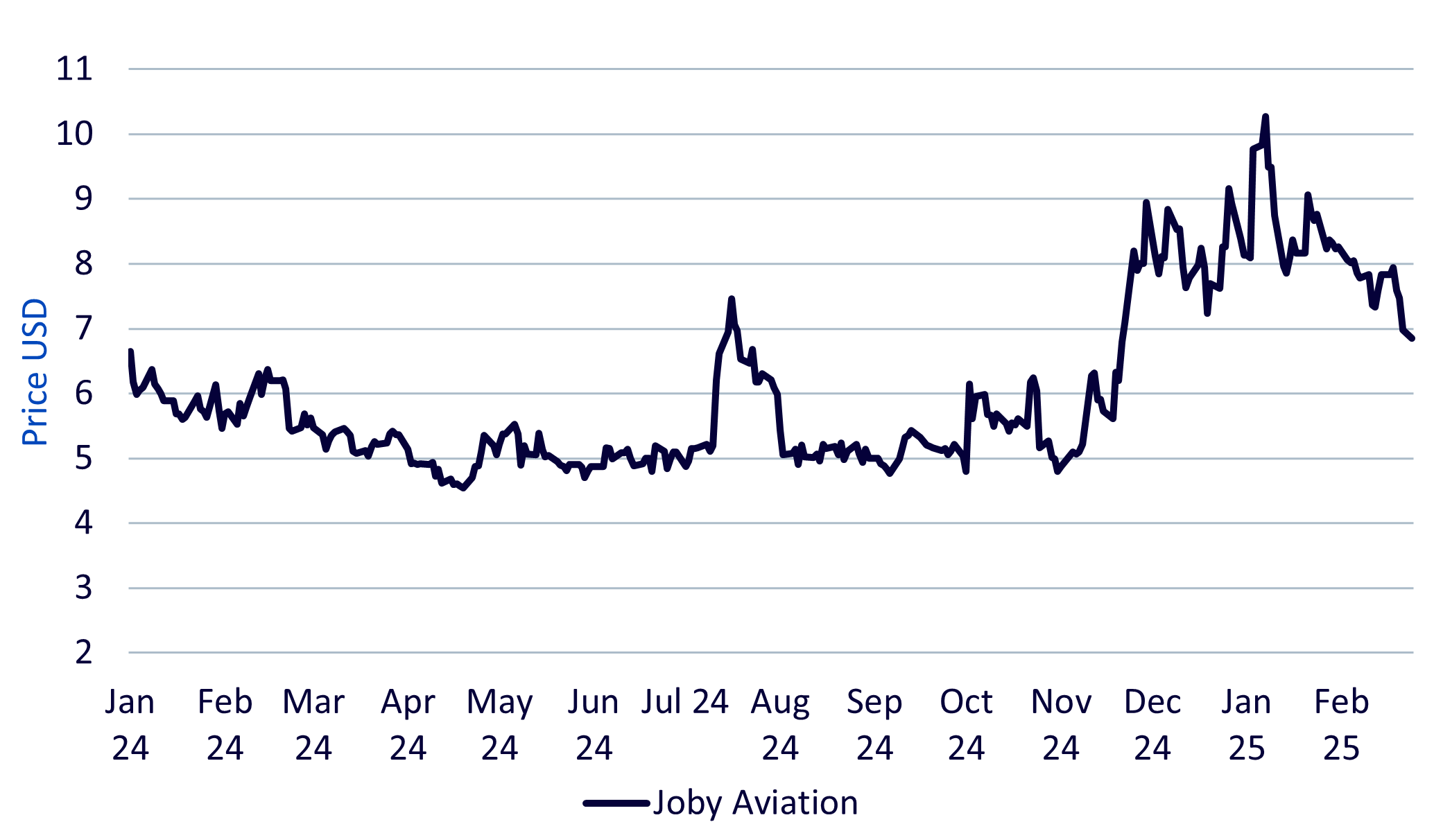
Figure 2: Joby Aviation stock price
 Source: Bloomberg, data as of 24 February 2025. Historical performance is not an indication of future performance and any investments may go down in value.
Joby Aviation has entered the final phase of certification from the US Federal Aviation Administration (FAA) for its battery-powered electric vertical take-off and landing (eVTOL) aircraft, a major milestone toward launching commercial air taxi services (Joby, December 2024). The company recently completed FAA Type Inspection Authorization (TIA) testing, validating flight safety and pilot workload with FAA test pilots.
Joby’s eVTOL is designed to carry one pilot and four passengers, reaching speeds of up to 200 mph with zero operating emissions. Powered by advanced lithium-ion batteries, it offers quiet, high-speed urban mobility while dramatically reducing noise and environmental impact compared to helicopters.
Markets are increasingly bullish on Joby as it leads the industry in FAA certification progress, having completed three of five approval stages. With full certification on the horizon, investors see battery-powered air taxis as a game-changer—offering faster, cleaner, and more efficient transportation in cities worldwide.
Oklo: small modular reactors
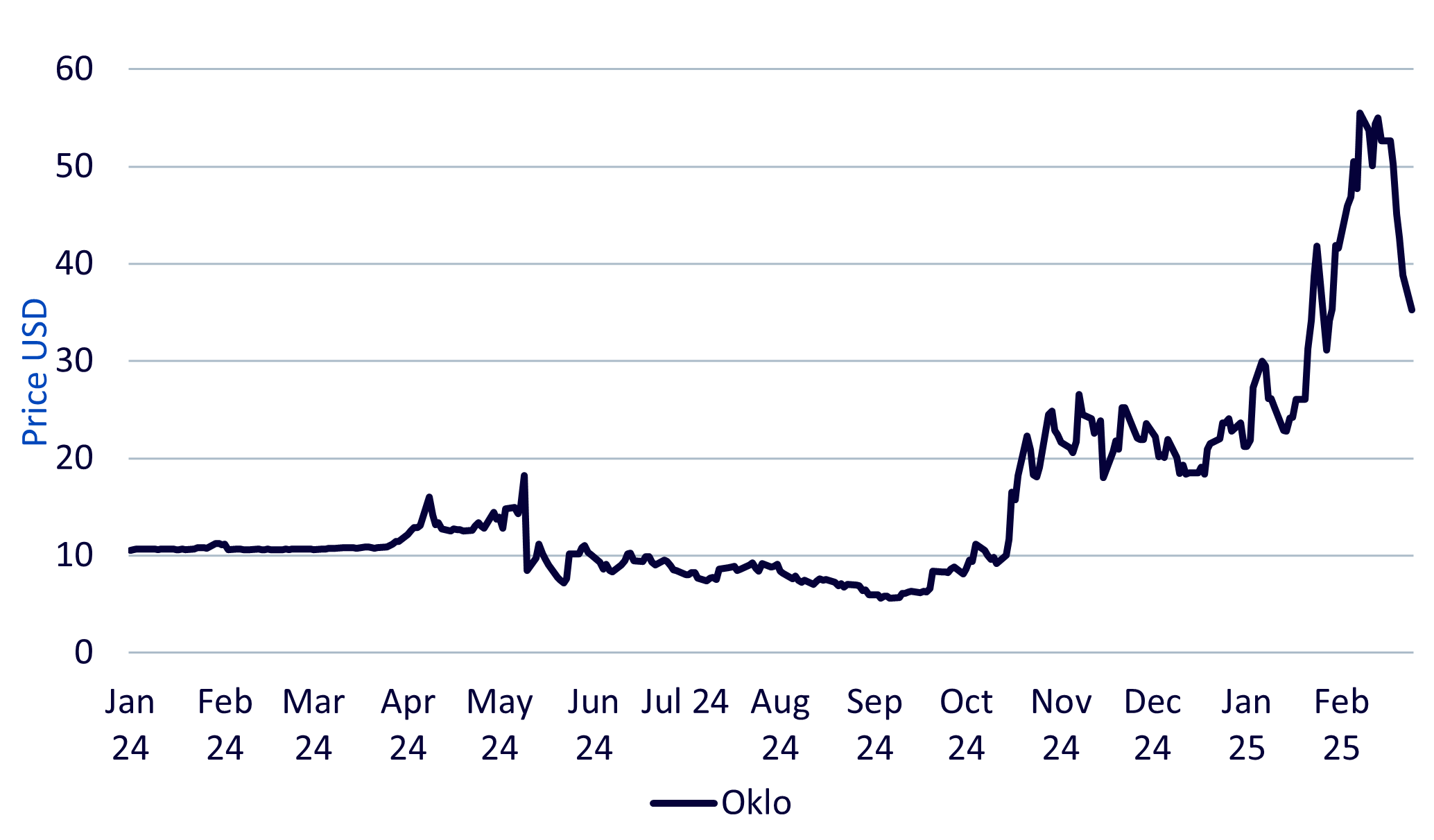
Figure 3: Oklo stock price
 Source: Bloomberg, data as of 24 February 2025. Historical performance is not an indication of future performance and any investments may go down in value.
Oklo has signed a 12 GW Master Power Agreement with data centre operator Switch, marking one of the largest corporate power agreements in history (Oklo, December 2024). Under this deal, Oklo will deploy, own, and operate Aurora powerhouse reactors, providing Switch with clean, reliable nuclear energy across the US through a series of power purchase agreements.
Small modular reactors (SMRs), like Oklo’s Aurora, have existed for decades, but rising energy demand from AI and data centres is now accelerating their adoption. These compact, factory-built reactors generate between 15 and 50 MWe, use advanced fuels like HALEU1, and can run for years without refuelling. Their small footprint, scalability, and grid independence make them an ideal solution for data centres seeking low-carbon, high-reliability power.
With Microsoft, Google, and Amazon also turning to nuclear, Oklo’s deal highlights how SMRs are emerging as a key technology in the future of clean, AI-driven energy infrastructure.
The implementation trade for investors
The WisdomTree Battery Solutions UCITS ETF (VOLT) offers investors exposure to the exciting potential of energy storage solutions and the emerging technologies shaping the industry. The exchange-traded fund (ETF) captures 37 subsectors across four key categories: raw materials, manufacturing, enablers, and emerging technologies.
Developed in partnership with energy experts Wood Mackenzie, the ETF benefits from industry insights that help identify the most promising areas of the battery value chain. It is rebalanced twice a year to reassess the attractiveness of both technologies and companies.
As of 24 February 2025, Bloom Energy Corp is the ETF’s top holding, driven by strong recent performance, while Joby Aviation ranks second. Both have been leading contributors of performance in recent months. The strategy allocates around a quarter of its weight to emerging technologies like hydrogen fuel cells, eVTOLs, and solid-state batteries.
Launched on 26 February 2020, the ETF has just celebrated its five-year anniversary.
The WisdomTree Uranium and Nuclear Energy UCITS ETF (NCLR) provides investors with exposure to uranium and nuclear energy growth. It invests across the most value-accretive parts of the value chain, including upstream (uranium miners), midstream (including conversion, enrichment, and nuclear components), and innovators (advanced nuclear technologies like small modular reactors). Innovators are allocated 15% of the portfolio, with Oklo among the key holdings. While innovators may not yet be generating revenues, they tend to excite markets with their upside potential as their innovations get adopted.
Conclusion
Emerging businesses that generate excitement often experience sharp rises in their share prices. Volatility along the way can be expected but, then again, the Wright brothers' journey was far from turbulence-free in the beginning. Yet, when the world took notice after 1908, their technology truly took off.
Similarly, these energy technologies now appear to be on the cusp of wider adoption, potentially creating exciting opportunities for investors.
1High-assay low-enriched uranium.





 Previous Post
 All Posts