




 Print Page
Strategic metals: from energy security to materials security


Key Takeaways
- Electrification is shifting energy security from hydrocarbons to critical metals such as copper, lithium and rare earth elements.
- Supply and processing remain geographically concentrated, increasing geopolitical risk.
- The US, China and the EU are expanding strategic metal stockpiles.
- Several key metals are already tight or moving into deficit.
- The WisdomTree Strategic Metals UCITS ETF (WENU) provides exposure to metals positioned to benefit from these structural trends.
For decades, energy security meant oil and gas. Oil shocks reshaped foreign policy. The Organization of the Petroleum Exporting Countries (OPEC) influenced global power balances. Gas pipelines defined diplomatic relationships. Control of hydrocarbons meant geopolitical leverage.
That framework is evolving.
The global shift towards electrification, including electric vehicles (EVs), renewable power generation, battery storage, grid expansion and digital infrastructure, is not reducing energy dependency. It is changing the nature of that dependency.
We are moving from a hydrocarbon-based system to a materials-intensive one and the strategic question is no longer simply: Who controls oil?
It is increasingly: Who controls the inputs into the new energy system?
Electrification is metal-intensive
Electrification requires significantly more metals than fossil fuel systems:
- EVs use multiple times the copper of internal combustion vehicles
- Batteries depend on lithium, nickel, cobalt and graphite
- Wind turbines rely on rare earth elements
- Grid expansion is copper- and aluminium-intensive
The term ‘energy transition’ is better described as an ‘energy addition.’ Legacy systems remain, while electrified systems are layered on top, increasing total materials demand.
Certain metals are therefore no longer just industrial inputs. They are becoming strategic assets.
What makes a metal strategic?
Strategic metals tend to share three characteristics:
-
Geographic concentration
Production is often concentrated in a few jurisdictions:
- Lithium: Chile and Australia
- Cobalt: Democratic Republic of Congo (DRC)
- Rare earth elements: China
Concentration increases exposure to geopolitical and regulatory risk.
-
Processing bottlenecks
Mining diversification does not guarantee refining diversification. China dominates midstream processing across many battery materials and rare earth elements. Processing control often translates into pricing power.
-
Low supply elasticity
New supply takes years to develop due to permitting, environmental scrutiny and capital intensity. In the short to medium term, supply is relatively inelastic.
Energy security is therefore increasingly about critical material supply chain security, measured in tonnes per year rather than barrels per day.
That recognition is beginning to shape policy.
The return of strategic stockpiling
Strategic reserves were historically associated with oil. The US Strategic Petroleum Reserve (SPR) was established after the 1970s oil shocks to buffer against supply disruptions. Today, major economies are applying similar logic to metals.
Across the United States, China and the European Union (EU), policymakers are either implementing or exploring strategic reserves of critical materials. This represents a structural shift: governments are becoming active participants in metal markets for security purposes.
United States: Project Vault
The United States has launched a critical minerals initiative, often referred to as Project Vault, with approximately $12 billion in financing.
The objective is to build strategic inventories of materials essential to EVs, defence systems, semiconductor manufacturing and grid infrastructure.
The programme blends public financing with private participation, enabling companies to secure access to materials under predefined terms.
The strategic goals are clear:
- Reduce reliance on China-dominated supply chains
- Protect domestic manufacturing
- Mitigate geopolitical risk
This marks a move toward more direct state involvement in materials security.
China: strategic inventory expansion
China has long maintained strategic commodity reserves and has signalled expanded stockpiling of industrial metals, including copper.
As the world’s largest consumer of many base and battery metals, China’s stockpile decisions can materially influence global balances.
Strategic inventories allow China to:
- Smooth domestic supply during disruptions
- Stabilise industrial input costs
- Increase leverage in global commodity markets
While the US approach is primarily defensive, China’s strategy also supports the consolidation of industrial advantage.
European Union: strategic autonomy
The EU is further along in implementation but is increasingly focused on coordinated stockpiling under the Critical Raw Materials Act.
Policy discussions include:
- Joint procurement mechanisms
- Coordinated strategic reserves
- Crisis-response frameworks
Given Europe’s reliance on imports for many critical materials, stockpiling is seen as part of a broader push toward strategic autonomy.
Stockpiling in a tight market
Strategic stockpiling is most impactful when supply and demand are already balanced.
Several metals central to electrification are either in deficit or moving toward it.
When governments enter these markets as incremental buyers, the effects can be nonlinear.
Copper: the electrification backbone
Copper underpins grid expansion, renewable generation, EVs and data centres, placing it at the centre of the global electrification build-out. Yet supply growth has struggled to keep pace with rising demand, constrained by declining ore grades, lengthy permitting timelines and years of underinvestment, while visible inventories remain low relative to consumption. With limited short-term supply elasticity and new mines taking years to develop, additional demand impulses such as stockpiling can tighten a market already flirting with a structural deficit.
Silver: industrial tightness
Silver demand from photovoltaics and electronics continues to expand, reinforcing its role in energy transition and advanced technology supply chains. At the same time, mine supply growth remains constrained and is often dependent on by-product production, limiting its responsiveness to rising demand. As a result, recurring supply-demand deficits have emerged in recent years, meaning that even incremental stockpiling could tighten available float relatively quickly.
Platinum: deficit conditions
Platinum is already in structural deficit. Supply constraints in South Africa and resilient demand from autocatalysts and hydrogen-related applications have drawn down inventories.
Platinum markets are relatively small in absolute terms, meaning even modest stockpiling volumes could have an outsized effect.
Aluminium: a deficit brought forward?
Aluminium production is highly energy-intensive. Energy volatility and decarbonisation pressures have constrained capacity growth in parts of Europe.
Many forecasts suggest aluminium could move into deficit later this decade, potentially around 2028.
However, aggressive stockpiling could pull forward that timeline by removing material from the tradable system before new supply is commissioned. Markets price marginal shifts, not base-case projections.
The Inventory Effect
Strategic stockpiles do not consume metal, but they reduce liquidity.
Commodity prices are set at the margin. When inventories fall relative to consumption:
- Volatility typically rises
- Risk premia expand
- Backwardation becomes more likely
- Producer pricing power strengthens
Stockpiling introduces a new class of buyer motivated by security rather than price. In tight markets, this can amplify scarcity dynamics.
Implications for Investors
The WisdomTree Strategic Metals UCITS ETF (WENU), WisdomTree Energy Transition Metals (WENT) and WisdomTree Battery Metals UCITS ETF (WATT) are designed to provide exposure to metals positioned to benefit from electrification and tightening market balances.
Following the 12 February 2026 rebalance, weights are determined by:
- Energy transition demand growth expectations (two-thirds influence)
- Market balance assessment, where undersupplied metals score higher (one-third influence)
Metals such as copper and aluminium, combining strong structural demand with tightening balances, receive higher weights.
By incorporating both forward-looking demand growth and current supply dynamics, the strategy seeks to capture metals where policy, electrification and supply constraints converge.
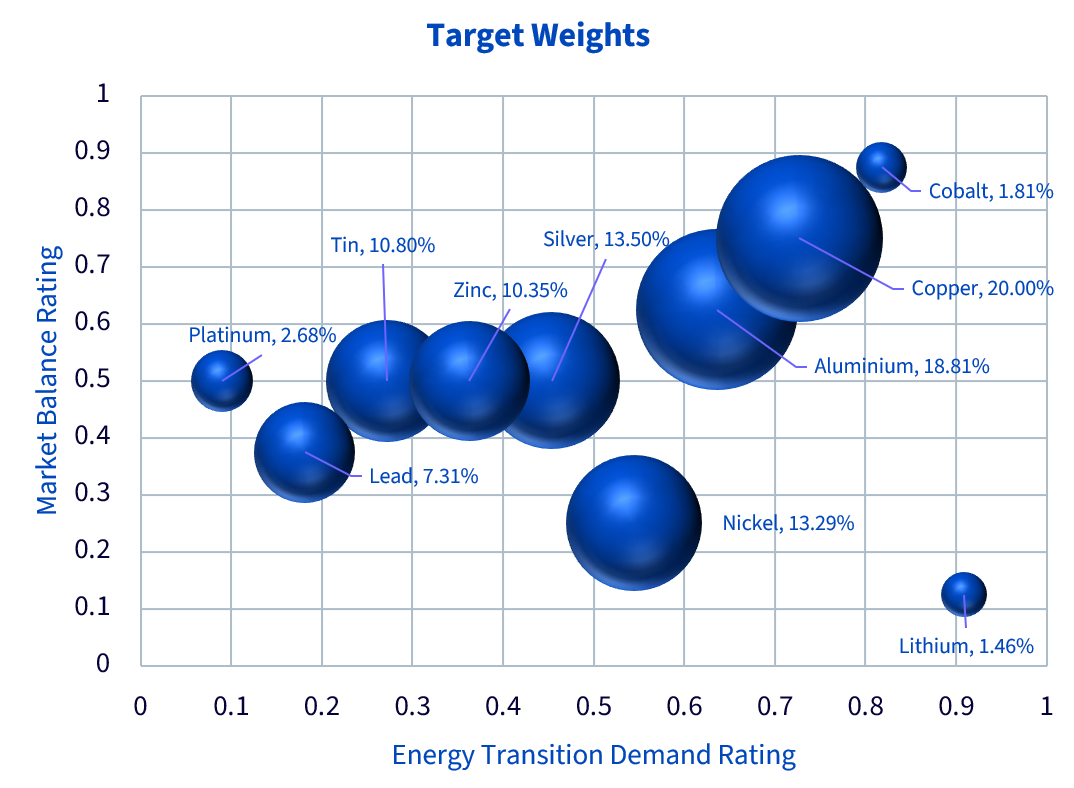
Source: WisdomTree, Wood Mackenzie, based on forecasts, February 2026. Bubble size represents the target weight. Market balance ratings not considered for precious metals and not available for tin. For the purpose of the chart construction, we set the market balance rating at the midpoint (0.5) for these metals. Cobalt and Lithium weights are capped by the methodology at 5% and 2% respectively, and in practice, they are constrained by a liquidity judgment based on market conditions. Index inception: 12 January 2024.
Conclusion
Energy security is evolving into materials security. Governments are responding by stockpiling critical metals. In surplus markets, the impact may be muted and in tightening markets, it may be material.
As electrification accelerates and policy-driven demand increases, understanding inventory dynamics and supply elasticity becomes increasingly important for investors. The geopolitics of the energy system are no longer defined solely by oil flows but by metal availability. And that shift is reshaping markets.






 Previous Post
 All Posts