




 Print Page
Inside the WisdomTree Strategic Metals and Rare Earths Miners Index rebalance


Key Takeaways
- Rare earths and strategic metals are now geopolitical assets, critical to AI, defence and electrification, not just the energy transition.
- The latest rebalance tilted the Index towards security of supply and processing capability, highlighted by a surge in conversion exposure.
- Geographic exposure broadened, with notable increases in Brazil, South Africa, Canada and the US, alongside evolving top holdings.
- The portfolio shifted meaningfully toward lithium and platinum, while copper weight fell, keeping rare earth exposure broadly steady.
Strategic metals beyond the energy transition
Rare earths and strategic metals have quietly become the market’s hard assets of competitiveness. They sit beneath secular themes such as artificial intelligence (AI) compute, defence modernisation, grid build out, electric vehicle (EV) and battery supply chains, industrial automation and next-generation manufacturing. While the energy transition remains a core demand driver, the investment case is now broader and more urgent since these materials increasingly function as policy instruments and geopolitical bargaining chips, not just commodities.
Rare earth elements (REEs) are the clearest example. They are essential to high performance magnets used in electric motors, wind turbines and precision defence applications. They are also in the broader digital economy that powers AI, robotics and data centres. In other words, the US may lead the AI innovation race, but advanced hardware still depends on highly constrained upstream inputs. That strategic dependency is precisely why governments are pushing to diversify supply chains and why markets have started to reprice miners' and processors' positions to benefit.
Equity gateway to the strategic metals value chain
Investor attention has followed. The WisdomTree Strategic Metals and Rare Earths Miners UCITS ETF (Ticker: RARE) has become a focal point for investors seeking diversified equity exposure to the Energy Transition Metal Value Chain (ETMVC) supporting these themes. Companies that belong to the ETMVC are identified and classified into 10 metal categories: aluminium, cobalt, copper, lithium, nickel, platinum, silver, tin, zinc, and rare earth elements (REE) and within mining subsectors such as mining, refining, smelting, chemicals, conversions, industry. Assets under management for the fund are now US $428mn , reflecting strong demand since launch alongside performance-driven asset growth.
Against this backdrop, the latest rebalance of the WisdomTree Strategic Metals and Rare Earths Miners Index (Ticker: WTMRAREN Index) provides some interesting insights. The portfolio is not static; it evolves as the investable universe shifts through acquisitions, new listings, revenue mix changes and WisdomTree’s environmental, social and governance (ESG) screens.
Rebalance signals a bigger strategic metal lens
The headline of this rebalance is not one single name, it’s a portfolio rotation toward where the market is paying for security of supply, scalability and processing capability. This shows up clearly in five sections:
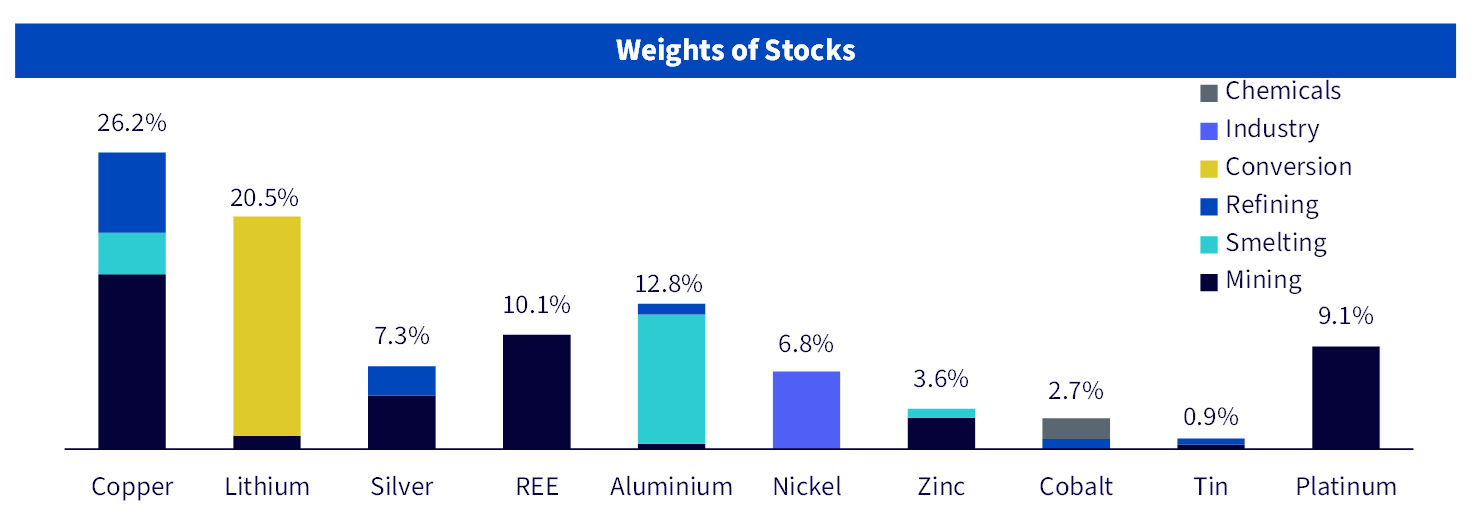
1. Metal category weights: A higher shift towards lithium and platinum metal categories while maintaining the positioning in copper and rare earth elements. This reflects a market increasingly rewarding companies tied to battery supply growth, processing bottlenecks and supply constrained metals, even as copper remains a fundamental electrification input.
Source: WisdomTree, Wood Mackenzie as of 24 November 2025. You cannot invest directly in an index. Historical performance is not an indication of future performance and any investments may go down in value.
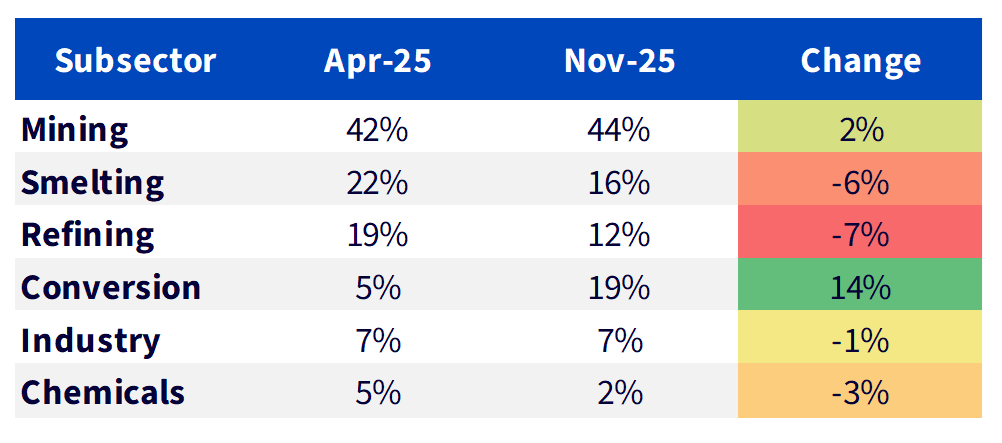
2. Subsector weights: The rebalance shows a major rotation into conversion funded largely by reduction in refining and smelting.
Source: WisdomTree, Wood Mackenzie as of 24 November 2025. You cannot invest directly in an index. Historical performance is not an indication of future performance and any investments may go down in value.
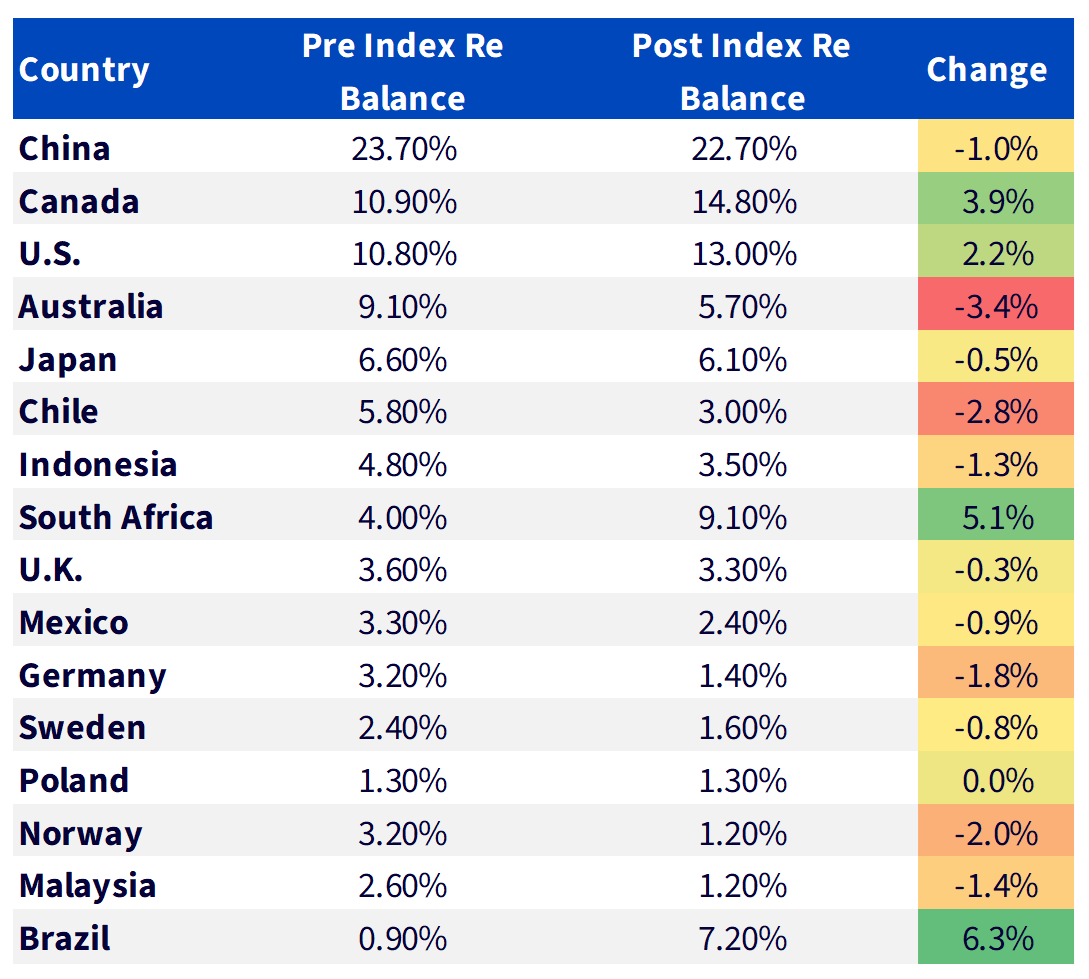
3. Geographic shifts: Geographic weights moved meaningfully with Brazil (+6.3%), South Africa (+5.1%) and the US (+2.2%) among the notable increases.
Source: WisdomTree, Wood Mackenzie as of 24 November 2025. You cannot invest directly in an index. Historical performance is not an indication of future performance and any investments may go down in value.
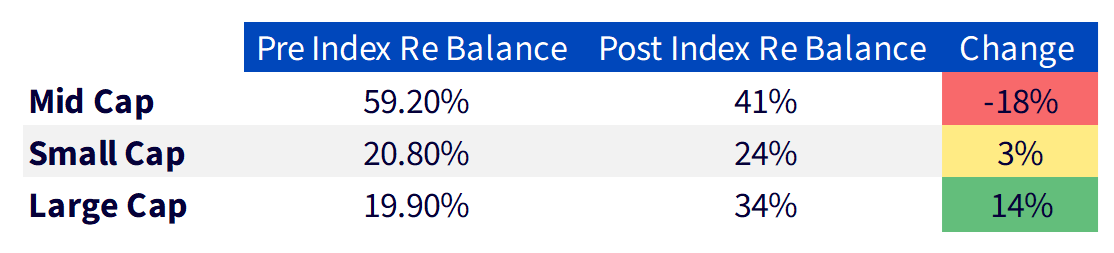
4. Market Capitalisation: RARE has a meaningful mid and small cap exposure. The latest rebalance shows the WTMRAREN Index has become more anchored by larger, more liquid companies while still maintaining upside opportunity in smaller growth and development stories.
Source: WisdomTree, Wood Mackenzie as of 24 November 2025. You cannot invest directly in an index. Historical performance is not an indication of future performance and any investments may go down in value.
5. Valuations: The index looks materially more growth-tilted, evident from the jump in forward long-term growth. Price to Earnings (P/E) moved in line with the MSCI All Country World Index and the dividend yield declined, which is consistent with the big rotation into higher growth metals exposure evident in the rebalance.
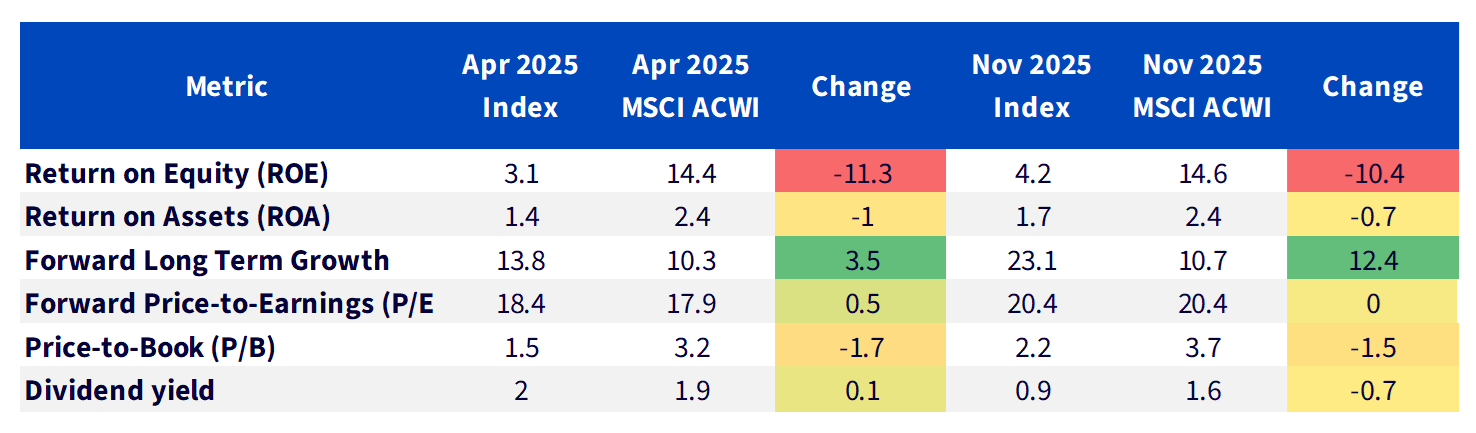
Source: WisdomTree, FactSet, Bloomberg, MSCI. WisdomTree Strategic Metals and Rare Earth Miners Index as of 24 November 2025, MSCI ACWI as of 31 October 2025. You cannot invest directly in an index. Historical performance is not an indication of future performance and any investments may go down in value.
Top holdings: lithium leaders take the top spots
The top 10 holdings also changed substantially:
- Sigma Lithium (6%) and Lithium Americas (3.7%) rose into leadership positions, consistent with the sharp lithium weight increase across the index. The focus remains on capturing the US-aligned lithium buildout and companies with clearer funding scale pathways2.
- MP Materials remained in the top 10 but its weight declined from 5.1% to 3.6%2
- Lynas Rare Earths holdings increased from 3.3% to 3.7%2
- Anglo American edged lower from 3.6% to 3.3%2
Rare earths as a national capability
Within rare earths, the key change was the removal of Jangsu Huahong Technology alongside the addition of USA Rare Earths. USA Rare Earth’s inclusion reflects a market hungry for US-aligned, ‘outside China’ supply chain development, especially after China’s export controls increased geopolitical risk premium for the sector.
MP Materials (3.6%) remains a core public–private buildout exposure as the US works to onshore the mine-to-magnet supply chain. This effort is supported by Department of Defence (DoD) involvement, long-dated offtake agreements and price-floor mechanisms, alongside plans to expand processing capacity beyond Mountain Pass. This aligns closely with the index’s objective of maintaining strategically relevant, policy-supported holdings linked to supply-chain resilience.
Heavy rare earth bottleneck exposure
Lynas Rare Earths (3.7%) complements MP Materials by providing scale and credibility in a segment of the supply chain that markets increasingly view as a bottleneck, namely separation capacity, particularly for heavier rare earths. Its expansion in Malaysia directly addresses the West’s vulnerability resulting from limited rare-earth separation capacity outside China.
Lithium takes the lead
Sigma Lithium (6%), currently the top holding, signals the portfolio’s tilt toward companies viewed as scalable, high-momentum suppliers as sentiment improved into late 2025. Lithium Americas (3.7%) adds a policy-linked US development pathway, benefiting from the market's renewed focus on domestic critical minerals capacity. The Department of Energy (DOE) took a 5% equity stake in the company tied to a US $2.2bn loan for Thacker pass, which helped drive a sharp rerating in the stock3.
Arcadium Lithium was removed following its acquisition by Rio Tinto for US $6.7bn in March 2025 as the company looks to diversify into energy transition metals. Albermarle (2.7%) provides the incumbent heavyweight exposure offering scale, diversified assets and balance sheet depth across cycle
Aluminium from a bulk metal to strategic material for lightweighting and recycling
Aluminium exposure in the WisdomTree Strategic Metals and Rare Earths Miners UCITS ETF has been refreshed to better reflect where the strategic value is increasingly being created across lightweighting, advanced alloys and circular supply chains. While aluminium still plays a clear role in the energy transition, the more investable equity story is shifting toward manufacturers and processors that can deliver high-specification products with a lower carbon footprint, supported by higher recycled content and proprietary alloy know-how.
That shift is evident in the new additions to the WisdomTree Strategic Metals and Rare Earths Miners UCITS ETF. Constellium SE (1.5%) in France strengthens the Index’s tilt toward aluminium with a focus on lightweighting solutions for transport and packaging, alongside advanced recycling and alloy innovation. Granges AB (0.32%) in Sweden adds exposure to rolled aluminium products and recycling-driven manufacturing, aligning with the push to scale secondary aluminium supply as a carbon efficient alternative to primary production. UACJ (0.97%) in Japan brings a large globally relevant producer with investment in advanced material technologies that support EV adoption and lightweight trends. While Kaiser Aluminium (1.37%) in the US adds a more specialised profile tied to aerospace and automotive end markets, where high performance alloys and qualification barriers can create more durable pricing power than standard aluminium output.
On the removal side, the Index is also evolving with corporate actions and screening discipline. Alumina Ltd exited following its acquisition by Alcoa, which is a reminder that consolidation continues as companies seek scale across energy transition materials.
Platinum adds a second scarcity theme
The Index’s platinum exposure is now a meaningful pillar, led by Northam Platinum (3.4%), Impala Platinum (3.4%) and Sibanye-Stillwater (2.2%). Together, these holdings broaden the portfolio beyond batteries into a different scarcity complex linked to industrial demand, catalytic applications and constrained supply dynamics. PT Merdeka Copper Gold (2.4%) provides differentiated exposure through the nickel channel, aligning with the broader theme of Southeast Asia’s growing role in EV supply chains and downstream processing.
Copper and multi-metal optionality
Anglo American (3.3%) anchors the portfolio’s exposure to large-scale copper supply, which is vital to grid expansion, electrification, and industrial investment, while providing the index with diversified optionality across strategic metals.
Conclusion
The WisdomTree Strategic Metals and Rare Earths Miners Index is leaning into policy-backed supply chains (rare earths), scalable growth and conversion capacity (lithium), and a broader strategic materials basket (copper, nickel and platinum) that extends well beyond a pure ‘energy transition’ framing.
1 AUM as at 15 January 2026.
2 WisdomTree, FactSet, Wood Mackenzie as of 24 November 2025
3 Reuters as of 1 October 2025
4 Rio Tinto as of 6 March 2025







 Previous Post
 All Posts