




 Print Page
The art of coin selection: building resilient crypto baskets


Key Takeaways
- Not all crypto basket ETPs are created equal. Investors must prioritise liquidity, regulatory compliance, and security to avoid exposure to volatile, illiquid, or legally uncertain assets.
- A robust coin selection process should emphasise real-world utility, developer ecosystem strength, and governance transparency to ensure long-term viability beyond short-term hype.
- As crypto markets evolve, enforceable guardrails—like liquidity thresholds, regulatory alignment, and security audits—are essential to constructing resilient investment products that withstand market cycles.
The rise of crypto basket exchange-traded products (ETPs) has provided investors with an efficient way to gain diversified exposure to digital assets. However, not all crypto basket ETPs are created equal. The best ones empower investors with efficient and diversified exposure to crypto markets, without the headache of chasing single-coin narratives.
In traditional finance, index inclusion follows strict criteria to ensure that only assets with sufficient liquidity, market depth, and regulatory clarity make the cut. Crypto should be no different. A robust coin selection process must incorporate key parameters that enhance investor protection while capturing market opportunities.
Liquidity is king
A large market cap means nothing if an asset lacks liquidity. Illiquid assets create unnecessary volatility, widen bid-ask spreads, and compromise the integrity of an investment product. A robust selection process should prioritise assets with deep trading volume, minimal slippage, and strong institutional participation to ensure a seamless trade execution.
Figure 1: 30-day trading volume of $1.5 trillion

Source: Artemis Terminal, WisdomTree. 24 March 2025. Historical performance is not an indication of future performance and any investment may go down in value.
Nowadays, stablecoin Tether (USDT) dominates overall trading liquidity, and bitcoin remains the undisputed leader among non-stablecoin cryptocurrencies. In contrast, speculative projects, such as meme coins or newly launched tokens with uncertain longevity, often suffer from erratic liquidity.
Stay on the right side of regulation
Regulatory uncertainty is a dealbreaker. Any coin facing legal challenges, securities classification risks, or a history of compliance failures should be under intense scrutiny. Privacy coins, for example, have been delisted from major exchanges due to regulatory pressure, making them inaccessible to institutional investors. Recent examples include:
- In 2022, cryptocurrency exchange Huobi delisted seven different privacy coins: Dash (DASH), Decred (DCR), Firo (FIRO), Horizen (ZEN), Monero (XMR), Verge (XVG), Zcash (ZEC).1
- In 2023, cryptocurrency exchange Binance delisted twelve different privacy coins: Beam (BEAM), Dash (DASH), Decred (DCR), Firo (FIRO), Horizen (ZEN), MobileCoin (MOB), Monero (XMR), Navcoin (NAV), PIVX (PIVX), Secret (SCRT), Verge (XVG), Zcash (ZEC).2
A well-designed selection framework does not just account for today’s regulations, it anticipates tomorrow’s. From the Securities and Exchange Commission’s crackdown on certain altcoins to the European Union’s sweeping Markets in Crypto Assets (MiCA) framework, the pace of regulatory evolution is accelerating. Crypto basket ETPs that prioritise assets aligned with emerging global standards are not only more resilient, but they are also positioned to lead as institutional adoption grows and regulatory clarity unlocks broader market access.
Survival of the fittest: security and network resilience
Not all blockchains are built to last. Assets that have suffered major security breaches, 51% attacks3, or weak consensus mechanisms introduce unnecessary risk into a portfolio. A technical audit should be a non-negotiable prerequisite for any asset’s inclusion.
For example, Ethereum Classic suffered multiple 51% attacks in 2020, exposing vulnerabilities that led to doubts about its long-term security. In contrast, networks with strong developer communities, robust consensus mechanisms, and well-audited smart contracts significantly lower investor risk.
Hype fades, utility lasts
A coin’s inclusion should not be driven by speculation alone. Assets with strong developer ecosystems, real-world applications, and active user bases tend to have more sustainable long-term value.
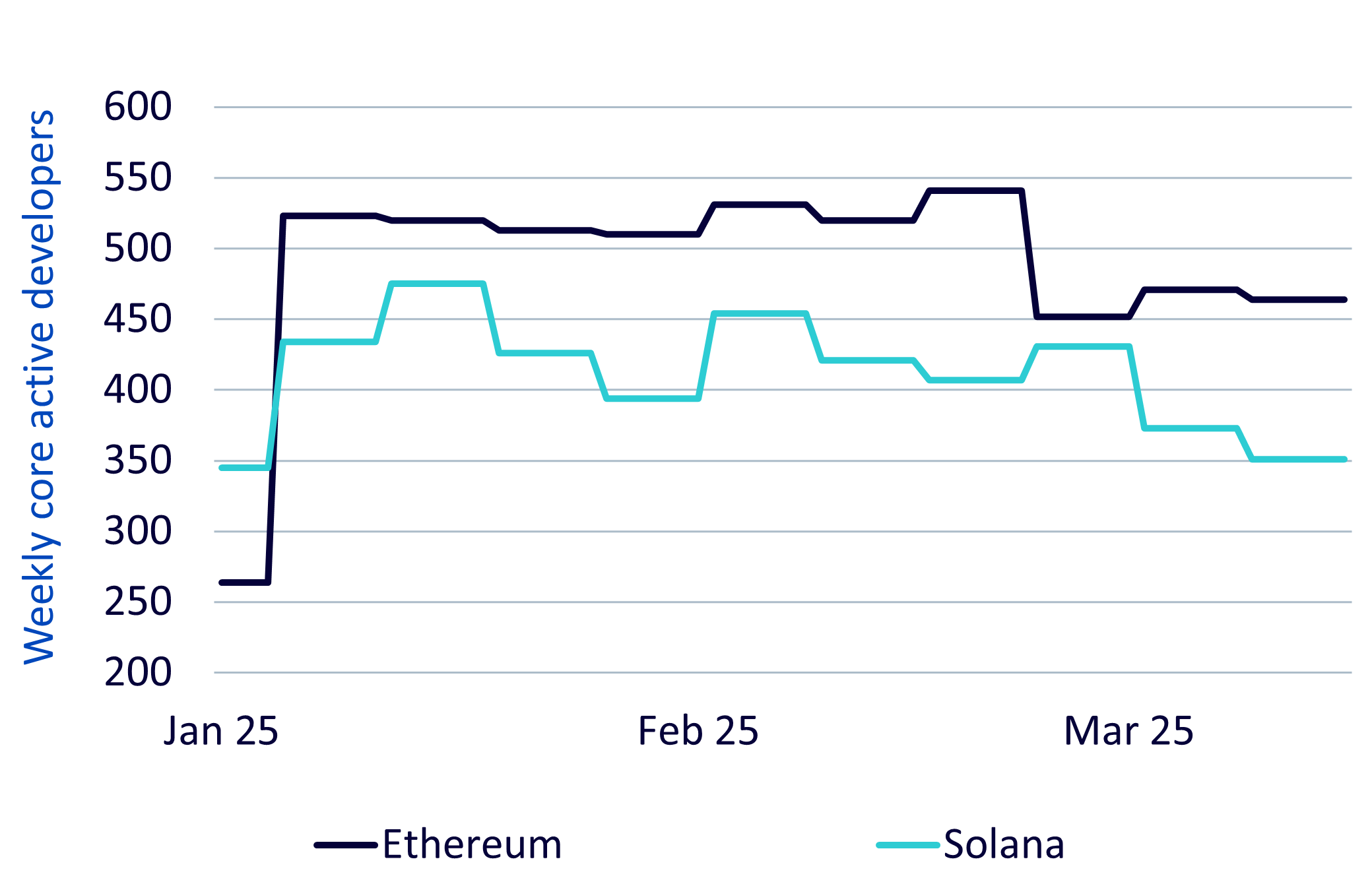
Consider the speculative decentralised finance (DeFi) boom of 2021, where many projects skyrocketed in value only to fade into irrelevance. By contrast, platforms such as Ethereum and Solana continue to innovate and attract developers, reinforcing their long-term viability. Investors should seek assets that provide tangible value beyond mere price speculation.
Figure 2: Weekly core active developers
Source: Artemis Terminal. 24 March 2025. Historical performance is not an indication of future performance and any investment may go down in value.
Transparency matters: governance and control
Opaque governance structures are a red flag. Crypto baskets should prioritise assets with transparent governance models, whether through decentralised protocols or clear corporate frameworks. Coins with arbitrary rule changes, concentrated ownership, or opaque tokenomics introduce instability.
Decentralised governance mechanisms, such as those seen in Polkadot’s on-chain governance model, offer investors greater predictability and control. Selection frameworks should favour assets with clear voting structures, predictable decision-making processes, and robust protocol audits.
Building resilient crypto baskets
Constructing a high-quality crypto basket requires balancing inclusivity with risk management. Guardrails ensure that investors are not exposed to assets with weak fundamentals, poor security, or regulatory uncertainty.
As the crypto landscape evolves, these guardrails must adapt. Firms that implement clear, data-driven selection frameworks will be best positioned to offer products that withstand market cycles and regulatory shifts. Investors should demand transparency: if an ETP provider does not disclose its selection criteria, ask why.
An example of ‘best practice’
The CoinDesk 20 index sets a high standard for inclusion, purpose-built to optimise for liquidity, diversification, and real-world implementation. The eligible universe starts with the top 250 digital assets by market capitalisation, then rigorously excludes:
- Meme coins
- Stablecoins
- Privacy tokens
- Wrapped assets
- Staked assets
- Gas tokens
From there, constituents are screened further using strict filters:
- Minimum 90-day trading history
- Market depth relative to turnover over the past 90 days
- Listings on at least three eligible exchanges
It is no surprise that CoinDesk 20 has become the most traded crypto index, anchoring a growing ecosystem of products and strategies around it.
A well-structured selection process is not just advisable, it is essential. By prioritising liquidity, regulatory clarity, security, utility, and governance, investors can gain exposure to a high-quality selection of digital assets while mitigating risks inherent in this rapidly growing market.
1CoinTelegraph. 12 September 2022.
2CoinTelegraph. 31 May 2023.
3A 51% attack is an attack on a cryptocurrency blockchain by a group that control more than 50% of the network.




 Previous Post
 All Posts