




 Print Page
What’s Hot: bitcoin is priced in leverage


Key Takeaways
- Futures and options, not spot, drive short-term bitcoin price discovery. Ignoring positioning leads to systematic misreads, especially in volatile regimes.
- Leverage, funding, and dealer hedging flows increasingly dictate moves. Markets react to positioning dynamics as much as to new information.
- Large moves can emerge without new catalysts. Positioning imbalances and forced hedging flows are sufficient to generate outsized price swings.
What’s Hot: bitcoin is priced in leverage
Bitcoin’s price discovery has decisively migrated to derivatives markets. Futures, funding, and options positioning now set the marginal price; spot follows.
This is not a cyclical shift. It is structural. Ignoring derivatives today means systematically misreading bitcoin’s behaviour, particularly in periods of volatility, macro stress, or positioning extremes.
Bitcoin’s market structure has flipped
The dominant driver of bitcoin is no longer outright buying and selling. It is positioning expressed through leverage.
Bitcoin has evolved into a derivatives-led market, where perpetual futures drive price discovery, leverage cycles amplify moves via elevated open interest, and an increasingly relevant options complex introduces episodic dealer-driven flows around key strikes and expiries.
Price is no longer purely informational. It is mechanical.
From niche tool to core infrastructure
The evolution of bitcoin derivatives is well understood, but the implication is often missed.
- Early crypto-native venues (BitMEX era) introduced leverage.
- CME legitimised access for institutions.
- Options markets (Deribit-led) added volatility expression.
- Basis trading embedded yield strategies into the ecosystem.
The key shift is not growth. It is dominance.
Derivatives are no longer an overlay. They are the primary venue of price formation.
Options now shape the path of price
Option markets provide the clearest window into positioning, and increasingly, into future price behaviour.
The options strike map is effectively a distribution of risk:
- Where investors are hedged: puts.
- Where they are positioned for upside: calls.
Figure 1: Options strike map
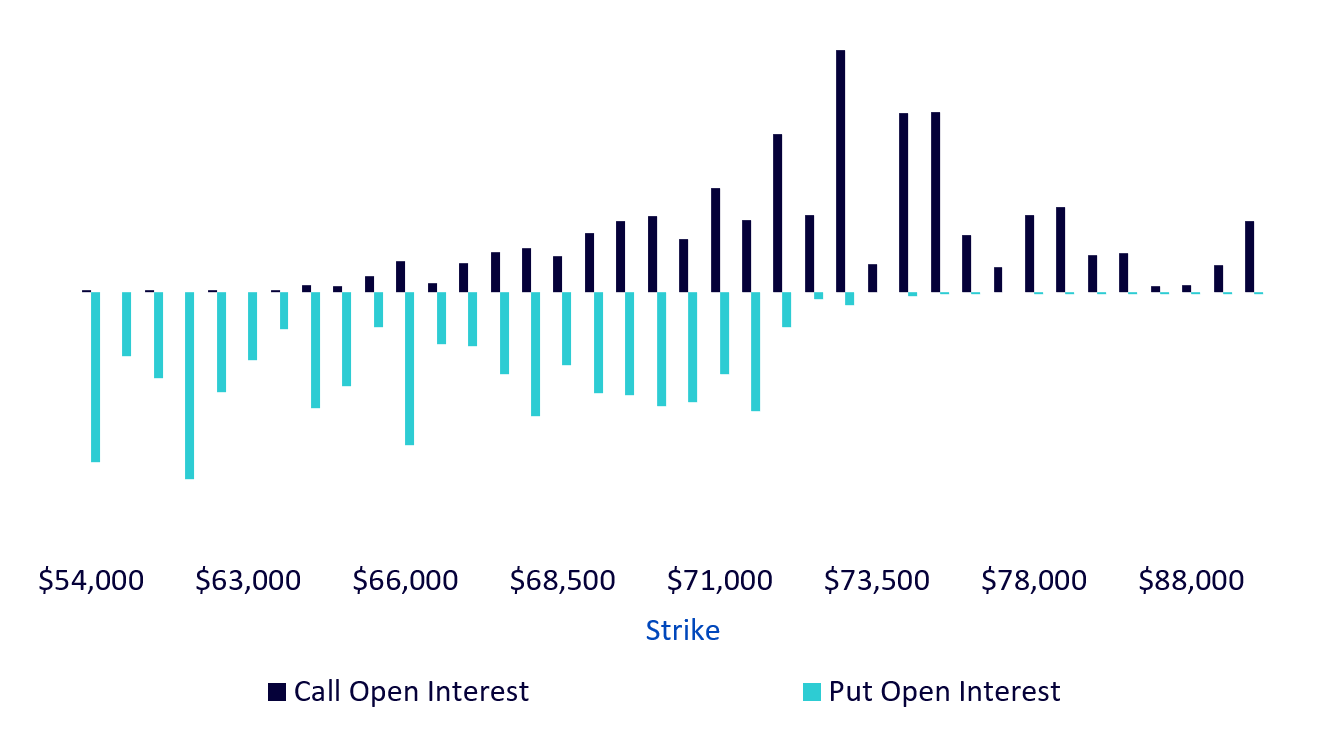
Source: Bybit V5 Option Tickers. From 28 February 2026 to 07 April 2026. Historical performance is not an indication of future performance, and any investment may go down in value.
In the graph above, three zones matter:
- Downside protection pocket: ~$59k-$61k:
- Concentrated put open interest.
- Implies strong demand for hedging.
- Typically acts as support via dealer buying.
- Pinning zone: ~$73k:
- Highest aggregate open interest.
- Price gravitates towards this level into expiry.
- Reflects maximum gamma sensitivity.
- Call wall: ~$72k-$74k:
- Dense upside positioning.
- Dealer hedging can suppress rallies.
- Creates friction near highs.
At the same time, the spot bitcoin price sits at $71,519.
Gamma, flows and macro
What matters is not just where positions sit, but how they translate into flows. That mechanism is dealer gamma:
- In long gamma regimes, dealers sell rallies and buy dips, suppressing volatility and anchoring price.
- In short gamma regimes, they are forced to chase moves, amplifying volatility and accelerating trends.
The same positioning can therefore stabilise or destabilise the market depending on the underlying gamma profile.
Figure 2: Net gamma proxy
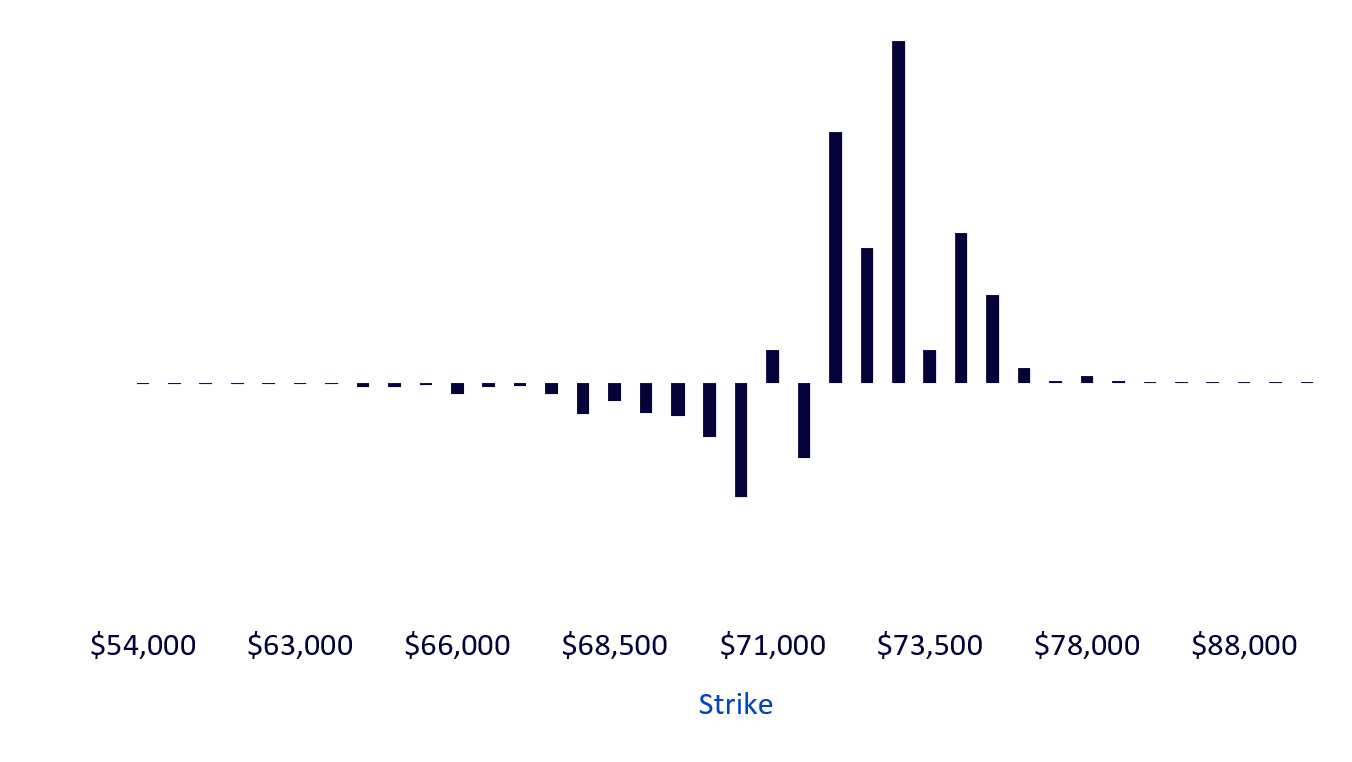
Source: Bybit V5 Option Tickers. From 28 February 2026 to 07 April 2026. Net gamma (calculated as long gamma minus short gamma) is shown as a strike-level proxy inferred from public option open interest and implied volatility, not observed dealer inventory. Historical performance is not an indication of future performance, and any investment may go down in value.
This is where derivatives link directly into macro.
Liquidity conditions, exchange traded product (ETP) flows and rates do not impact bitcoin in isolation. They reshape leverage, positioning, and ultimately dealer hedging behaviour:
- Tight liquidity reduces leverage and pressures funding; loose conditions do the opposite.
- ETP inflows introduce one-way spot demand that can trigger squeezes or break through call-heavy resistance.
- Meanwhile, higher rates compress basis trades, increasing the risk of unwinds and forced selling.
The result is a tightly coupled system where macro inputs flow through derivatives positioning into price. Bitcoin is no longer just reacting to fundamentals. It is reacting to how capital is positioned against them.
What this means for investors
Short-term price is positioning-driven. Bitcoin moves are increasingly:
- Triggered by positioning imbalances.
- Amplified by forced hedging.
- Detached from fundamentals in the short run.
Volatility is structurally endogenous. Large moves no longer require new information as positioning alone can generate volatility. This is a fundamental shift from earlier market regimes.
“Technical levels” are now capital-backed. Levels like $59k-$61k or ~$73k are not abstract chart points:
- They represent real capital concentration.
- They drive real hedging flows.
Crowding risk is the dominant risk. When positioning becomes one-sided:
- Small catalysts trigger outsized reversals.
- Liquidations cascade through the system.
Monitoring funding rates, open interest, options skew is now core risk management, not optional analysis.
Bottom line
There is a counterpoint worth acknowledging:
- Long-term price still anchors to fundamentals such as adoption, scarcity, macro regime.
- Derivatives primarily distort path, not destination.
But for any investors operating on tactical horizons or risk-managed portfolios, the distinction is academic. Path dependency is now the game.



 Previous Post
 All Posts