




 Print Page
Institutional alpha in crypto


Key Takeaways
- As retail investors chase moonshots, institutions are increasingly turning to basis trading – buying spot and shorting futures – for repeatable, low-risk yield in bitcoin, Ether, Solana, and XRP.
- Physically backed crypto ETPs provide a secure and familiar way for institutions to gain spot crypto exposure – the critical first leg of a basis trade.
- CME-listed futures are emerging as the preferred instrument for institutional basis strategies, offering regulatory clarity, lower counterparty risk, and more predictable returns than offshore perpetuals.
- With staking yields enhancing returns and CME futures expanding across altcoins, basis trading is fast becoming the institutional pathway to delta-neutral crypto exposure.
In a market addicted to hype and volatility, institutional players are quietly milking a structural inefficiency: basis trading. It is not sexy, but it is repeatable and that is exactly why it is winning.
What is the basis trade?
The basis refers to the difference between the price of a crypto asset in the spot market and its futures market. A positive basis (futures trading above spot) implies a contango structure, common in bullish or highly speculative environments. This creates an opportunity to:
- Buy spot crypto (or a physically backed crypto ETP),
- Short crypto futures, and
- Capture the yield as the futures converge toward spot at expiry.
Physically backed exchange-traded products (ETPs) enable institutions to go long spot exposure in a secure and familiar wrapper. Unlike exchange wallets vulnerable to hacks and counterparty risk, physically backed crypto ETPs provide cold wallet custody and daily net asset value transparency – everything a chief investment officer wants, and retail ignores.
With respect to shorting futures, front-month contracts matter most. This is primarily due to:
- High liquidity: Front-month contracts typically have the most trading volume and tightest bid-ask spreads, making them ideal for executing basis trades efficiently.
- Convergence to spot: As expiry approaches, futures prices converge to spot prices. This convergence enables the realisation of profits in a basis trade.
- Roll management: For rolling basis trades month to month, institutions often close out expiring contracts and enter the next month’s contract, known as rolling the position.
- Volatility and basis premium: Front-month premiums (or discounts) reflect current leverage demand, funding costs, and sentiment. A high premium suggests bullish sentiment or leverage demand.
Perpetual futures are crypto’s endlessly rolling bet – contracts that never expire, but mimic expiry through a clever funding mechanism:
- When perpetuals trade above spot, longs pay shorts.
- When they are below, shorts pay longs.
This incentivises convergence to spot and opens the door for continuous basis trades. By shorting perpetuals against spot or ETP holdings, investors can earn a rolling yield – harvesting the funding premium day after day.
Figure 1: Current funding rates of perpetual futures
Source: Coinglass. 13:22 (London time) on 30 July 2025. Historical performance is not an indication of future performance and any investment may go down in value.
Funding rates are notoriously volatile, swinging sharply with market events and sentiment shifts. This makes active monitoring essential. Moreover, these rates can vary wildly across exchanges due to differences in how premium indices are calculated, interest rate assumptions, and trader positioning.
Offshore venues love perpetuals for their flexibility and leverage, but they come with strings attached: heightened counterparty risk, shallow liquidity in times of stress, and none of the regulatory safeguards offered by Chicago Mercantile Exchange (CME) futures.
Basis trades across major assets
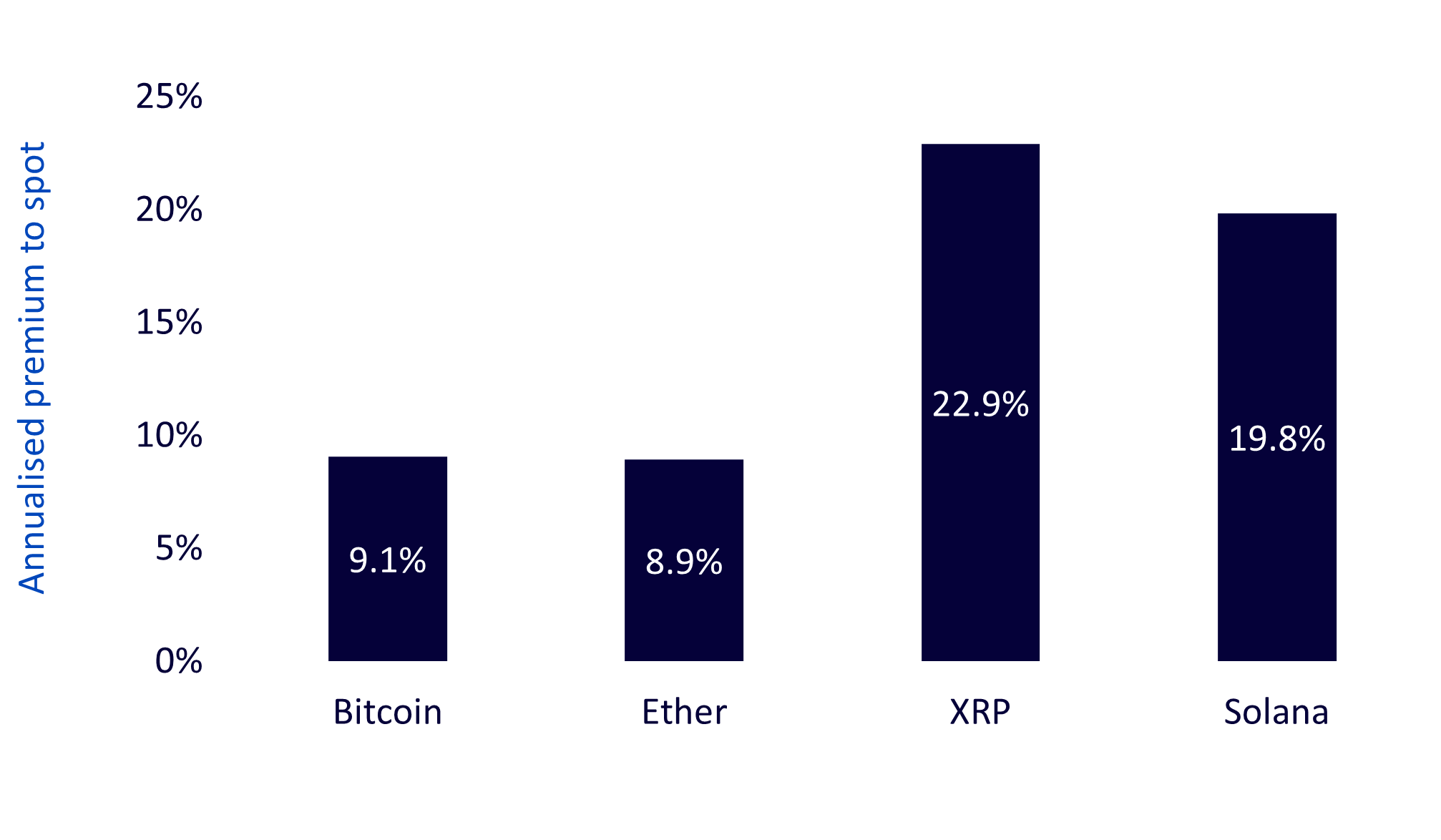
Basis trading opportunities vary meaningfully across cryptocurrencies, offering a spectrum of yield and risk characteristics that cater to different investor profiles.
Figure 2: Annualised premium to spot
Source: Artemis Terminal, CME, WisdomTree. At 14:20 (London time) on 30 July 2025. Historical performance is not an indication of future performance and any investment may go down in value.
- Bitcoin sets the institutional gold standard: CME Bitcoin futures remain the deepest and most liquid crypto derivatives, commanding dominant open interest among institutions. They consistently trade at an annualised premium to spot, making them the cleanest and most scalable vehicle for harvesting basis yield.
- Ether is the smart beta to bitcoin’s benchmark: CME Ether futures are well-established and gaining institutional traction. When paired with staked Ether holdings, the basis trade becomes more compelling, layering in protocol-native staking yields for an enhanced total return.
- Solana is the high-octane yield enhancer: CME Solana futures are still in their early innings, with liquidity yet to mature. But for those holding spot Solana, staking rewards can meaningfully boost basis trade returns, replicating the Ether playbook with higher upside and volatility.
- XRP is the tactical onshore play: with CME-listed XRP futures now live, institutional traders can tap into basis opportunities without touching offshore venues. Fully onshore access makes XRP a viable instrument for tactical basis yield harvesting, particularly in fast-moving market regimes.
While basis trading captures structural yield from futures mispricing, staking adds an additional layer of return. The table below highlights current protocol-native yields that can be layered into basis strategies to enhance total return potential.
Figure 3: Solana and Ether staking rewards
Source: Staking Rewards. 30 July 2025. Historical performance is not an indication of future performance and any investment may go down in value.
For investors seeking to retain liquidity while earning staking rewards, liquid staking tokens such as stETH (Lido) and JitoSOL (Jito) offer a capital-efficient way to participate. They enable the basis trade to be executed without sacrificing yield or flexibility. Of course, protocol-level risk and smart contract exposures remain with liquid staking tokens. This is worth pricing in when calculating basis-adjusted returns.
CME vs perpetual futures: risk breakdown
When choosing instruments for basis trading, the risk differential between CME futures and perpetual futures is non-trivial. CME futures are regulated, centrally cleared, and subject to robust margining frameworks, making them far more suitable for institutional mandates. Their expiry structure adds predictability and mitigates the tail risk of unpredictable funding costs.
In contrast, perpetual futures – popular on offshore exchanges – rely on dynamic funding rates to track spot. These rates can flip rapidly in volatile markets, leading to unstable and sometimes negative carry. Moreover, perpetuals are exposed to platform-specific risks such as auto-deleveraging, forced liquidations, and operational outages. Counterparty risk is also significantly higher due to lack of central clearing.
For institutional players managing risk-adjusted returns, CME futures are the clear choice for structured basis strategies. They offer not only regulatory certainty and central clearing but also more predictable and transparent liquidity profiles, particularly in bitcoin and Ether contracts. While liquidity in CME futures is narrower for altcoins, it is growing steadily as institutional adoption widens.
In contrast, perpetual futures boast deeper liquidity and tighter spreads across a wider range of assets, but mostly on offshore platforms. This liquidity is often propped up by retail leverage and can disappear rapidly in periods of stress. Combined with unpredictable funding costs and elevated counterparty risk, perpetuals are better suited to tactical or high-frequency arbitrage trades than to long-horizon, risk-controlled basis strategies.
Perpetuals still have their place – for short-term basis arbitrage, latency-sensitive desks, or when CME liquidity is lacking. But for strategic, size-able, capital-efficient exposure, CME remains king.
Final thought
In crypto, nearly everyone chases the next 10x token. Few focus on boring, repeatable yield. But basis trading – especially using listed, institutional-grade products – is becoming the go-to strategy for hedge funds, family offices, and treasury desks seeking low-risk, non-directional crypto exposure.




 Previous Post
 All Posts