




 Print Page
The rise of ‘intelligent’ defence: cybersecurity and beyond


Key Takeaways
- European defence is multifaceted, with cybersecurity now central to national security strategies.
- Companies like Thales and Leonardo are leading in digital defence, fuelling sector growth and ETF opportunities.
- The WisdomTree Europe Defence UCITS ETF (WDEF) offers concentrated exposure to Europe’s top defence innovators, benefiting from a targeted weighting strategy that prioritises high defence revenue.
Modern defence is complex and multifaceted. Cybersecurity, defence electronics, and next-generation systems are front and centre in Europe’s defence resurgence. This is a “critical megatrend” of Europe’s defence upgrade and one that is deeply intertwined with technological innovation.
Thales: Europe’s cyber-defence leader
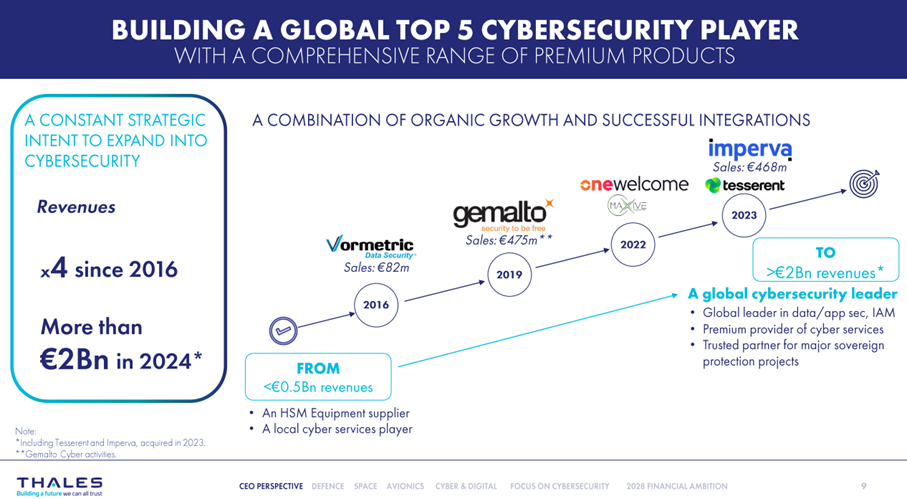
For example, Thales SA, Europe’s largest defence electronics firm, has spent the past decade expanding into digital security and aerospace tech. Thales has quadrupled its cybersecurity revenues via acquisitions and now ranks among the global top five cyber providers1. The company’s investments in encryption, cyber defence platforms, and satellite security give it a strategic edge as governments and corporations race to harden their networks. Thales expects 5–7% annual sales growth through 2028, topping €25 billion revenue2, fuelled partly by cyber demand. Its diverse portfolio, from military avionics to digital identity solutions, illustrates the convergence of defence and IT.
Figure 1: Cyber & digital: 2024 key figures
Source: Thales investor presentation as of 14 November 2024. Historical performance is not an indication of future performance and any investments may go down in value.
Leonardo’s digital transformation
Leonardo SpA, Italy’s defence champion (and the WisdomTree Europe Defence UCITS ETF (WDEF)’s second-largest weight), is known for helicopters and defence electronics. But Leonardo is “investing in digitalisation” and rapidly growing its cybersecurity division. The firm forecasts double-digit growth in cyber revenues over the next five years3. In October 2024, Leonardo’s CEO outlined plans to acquire smaller cyber firms and boost orders in its Cyber & Security division. This focus reflects Leonardo’s strategic evolution from a traditional aerospace manufacturer into a broader “Aerospace, Defence and Security” player.
Saab and Hensoldt: advancing electronic warfare
With Sweden and Finland joining NATO4, Saab’s order backlog in areas like air defence and electronic warfare5 is poised to grow. The company’s expertise in sensors and networked defence systems complements its traditional platforms, underscoring the fund’s tilt toward innovation. Germany’s Hensoldt AG is another. Spun off from Airbus in 2017, Hensoldt supplies high-end radar, surveillance, and electronic intelligence gear—the “eyes and ears” of modern militaries. Critically, it also develops secure communications and cyber protection for those sensor networks. Hensoldt’s exposure to “new battlefield” domains like information superiority and cyber defence is critical to modern militaries.
Broader ecosystem of cyber-tech defence players
There are others too. Kongsberg Gruppen punches above its weight in defence tech. Kongsberg’s ongoing projects in maritime cybersecurity and aerospace digitalisation ensure it remains at the vanguard of defence innovation. France’s Safran SA and Britain’s Rolls-Royce Holdings are deeply involved in next-gen defence research and development (like drone engines, high-efficiency sensors, and secure engine control software). Others—like QinetiQ Group (UK defence technology labs), Dassault Aviation (stealth aircraft), Fincantieri (advanced naval vessels), Indra Sistemas (Spain’s cyber-defence and IT integrator), and Babcock International (defence services)—each contribute a piece to the advanced defence technology mosaic. In many ways, these firms capture the full spectrum of modern defence capabilities, with cybersecurity woven throughout.
Europe’s rearmament is not a short-term movement but a strategic realignment. That long-term approach, coupled with macro tailwinds and innovation, bodes well for these companies.
Exclusive focus on European defence with WisdomTree
Investors looking to capitalise on this strategic realignment in European defence, especially the fusion of traditional platforms with cyber and digital capabilities, can do so through the WisdomTree Europe Defence UCITS ETF (WDEF). As the first exchange-traded fund (ETF) dedicated exclusively to European-listed defence companies, WDEF is uniquely positioned to benefit from the multi-decade rearmament cycle underway across the continent.
The WisdomTree Europe Defence UCITS ETF (WDEF) methodology targets companies with a revenue exposure to defence, giving investors undiluted access to pure-play names driving both hardware innovation and digital resilience. WDEF prioritises companies with a higher exposure to the defence industry by assigning an exposure score:
- Exposure Score 3: companies with > 50% exposure to defence activities
- Exposure Score 2: companies with 25% to 50% exposure to defence activities
- Exposure Score 1: companies with 10% to 25% exposure to defence activities
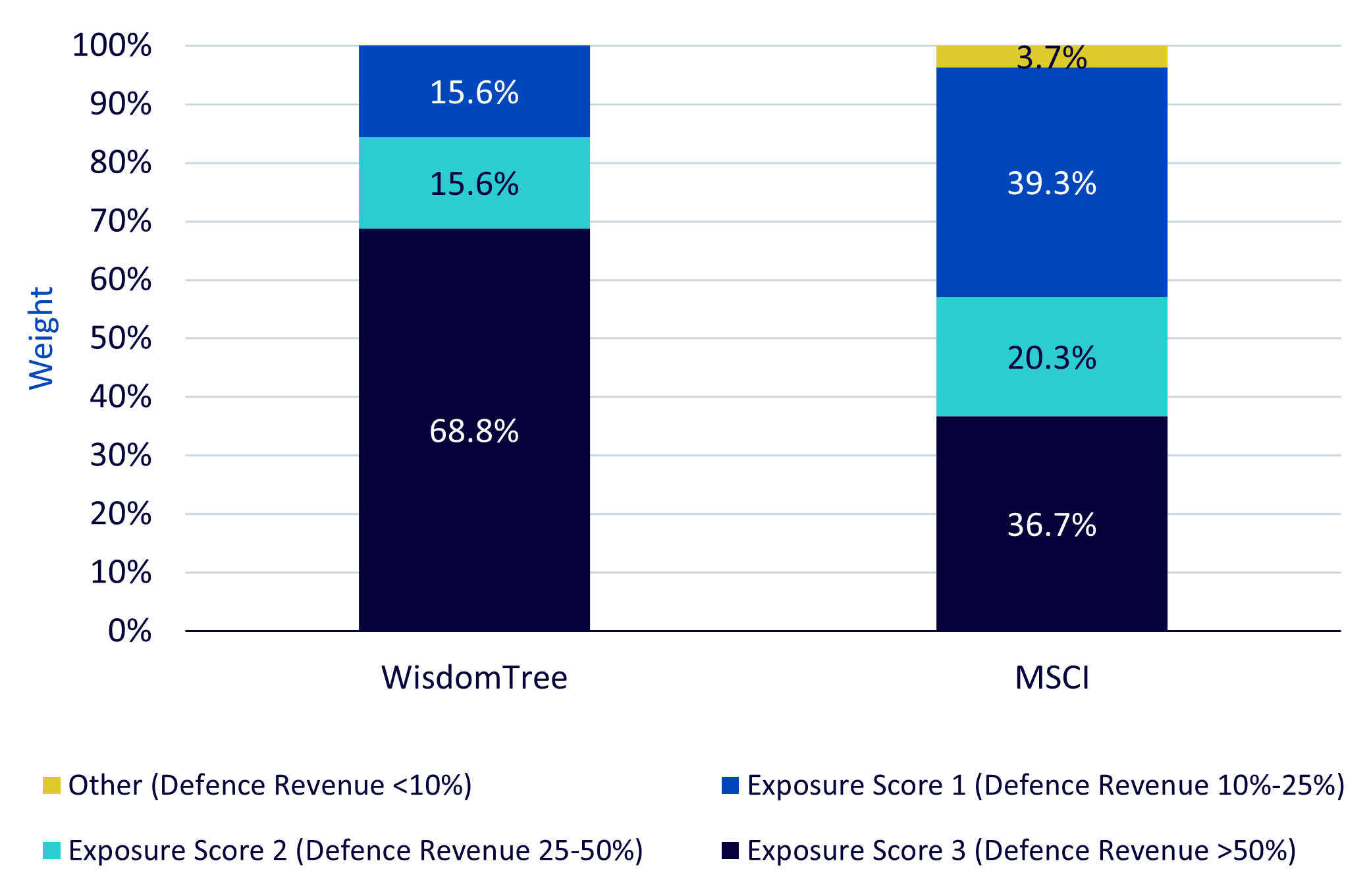
Companies will then be weighted by free-float market capitalisation adjusted by the Exposure Score. Unlike the MSCI Europe Aerospace and Defence Index which follows a market cap-weighted approach based on GICS classification, WisdomTree’s differentiated approach of adjusting the free float market capitalisation by the exposure score, allows the portfolio to be tilted towards companies generating a higher revenue exposure from the defence sector. Currently, 68.8% of the WisdomTree Europe Defence UCITS Index is allocated to companies with > 50% defence revenue, compared to only 36.7% in the MSCI index6.
Figure 2: WisdomTree’s strategy tilts towards companies with a higher revenue exposure to defence
Source: WisdomTree, Bloomberg, FactSet. Holdings as of 31 March 2025. Defence revenue exposure is sourced from multiple in-house and external sources. WisdomTree / WTEUDEFN denotes Wisdom Europe Defence UCITS Index (NTR). MSCI/ MXEU0AD denotes MSCI Europe Aerospace & Defence Index. You cannot invest directly in an index. Historical performance is not an indication of future performance and any investments may go down in value.
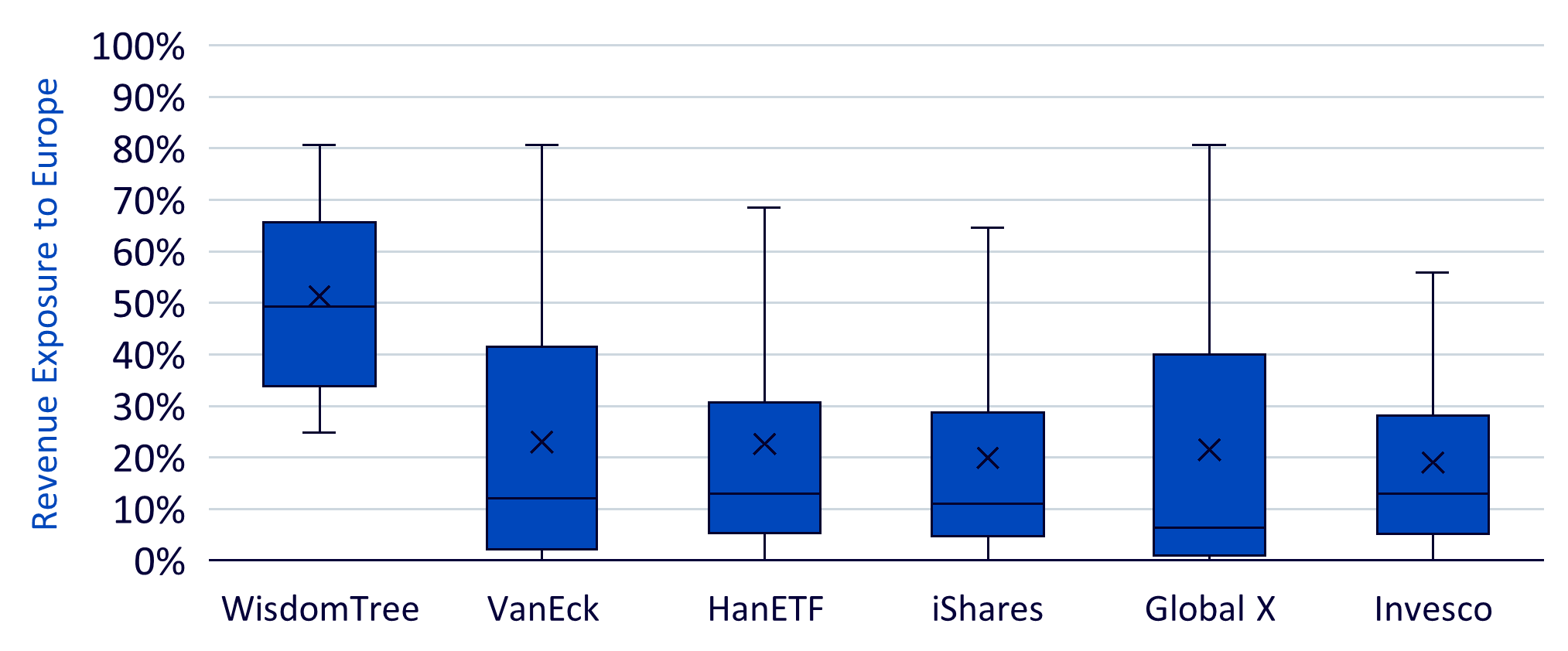
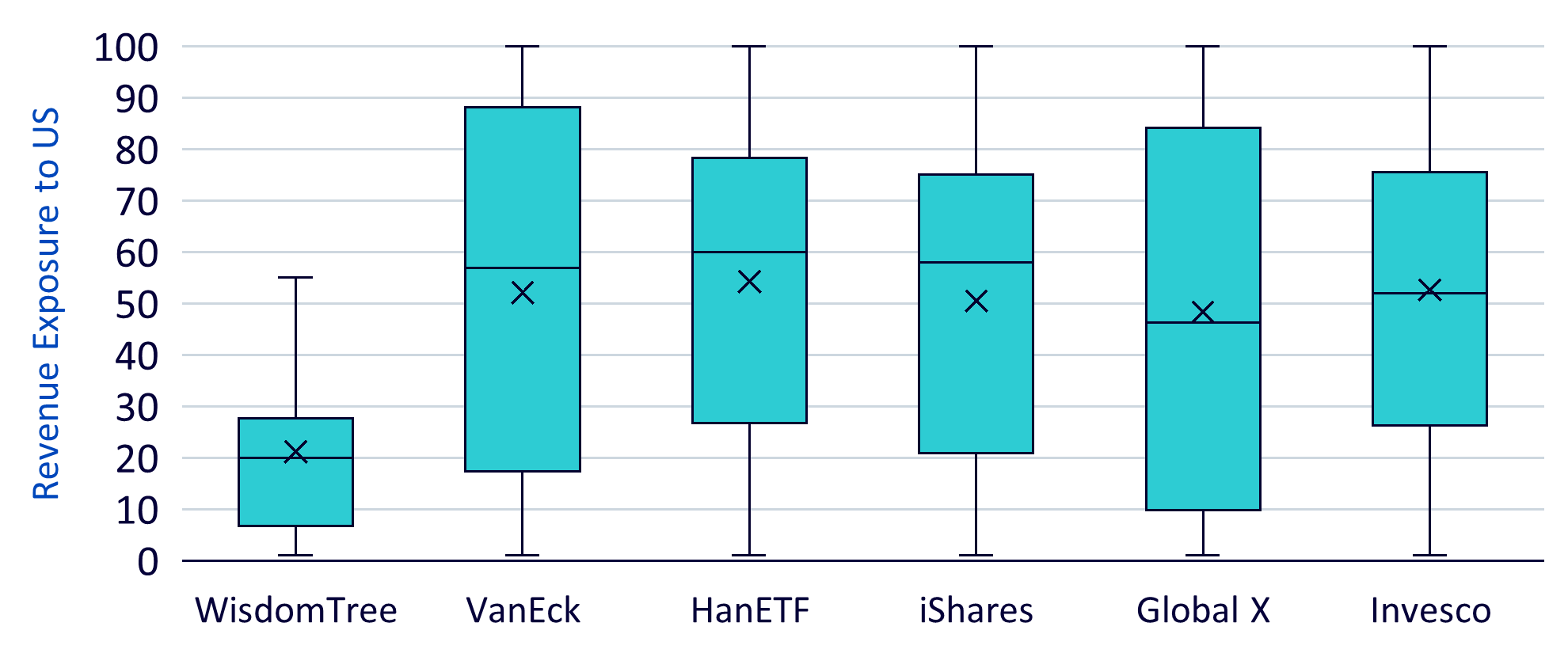
The WisdomTree Europe Defence UCITS ETF (WDEF) has around 50% median exposure to Europe, much higher than peers (around 12-15%)7. With a median US revenue exposure of around 20%, WisdomTree’s strategy is notably lower than the peer range of ~50-55%1.
Figure 3: WisdomTree’s strategy offers a higher revenue exposure to Europe
Source: WisdomTree, FactSet, as of 31 March 2025. "X" sign denotes the arithmetic average of the revenue exposure of the holdings. You cannot invest directly in an index. Historical performance is not an indication of future performance and any investments may go down in value.
Since going live on 31 October 2024, the WisdomTree Europe Defence UCITS Index has outperformed the competitive landscape by a wide margin, illustrated in the chart below.
Figure 4: Performance comparison since Live calculation
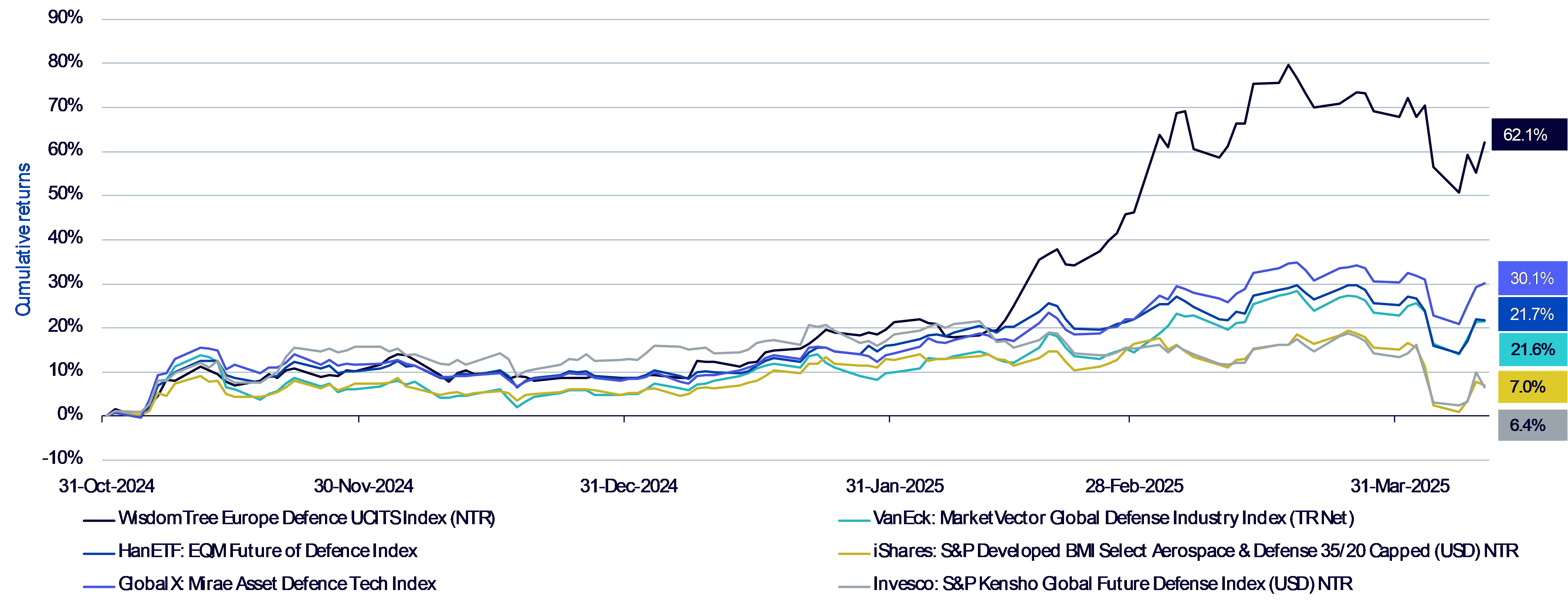 Source: WisdomTree, Bloomberg, from 31 October 2024 to 10 April 2025. WisdomTree Europe Defence UCITS Index (WTEUDEFN) calculations include back tested data and are computed in the EUR. Historical returns of other indices are also calculated in EUR. You cannot invest directly in an index. Historical performance is not an indication of future performance and any investments may go down in value.
Conclusion
In an era where defence is increasingly localised and policy-driven, the WisdomTree Europe Defence UCITS ETF (WDEF) offers a timely, efficient, and forward-looking vehicle for exposure to the firms shaping Europe’s security future.
1https://www.thalesgroup.com/sites/default/files/database/document/2024-11/CMD%202024%20-%20Presentation%20-%20VFweb2_1.pdf
2Ibid.
3https://www.leonardo.com/documents/15646808/28608810/20250311_Leonardo+IndustrialPlan25-29_vSent.pdf?t=1741709587968 (slide 61).
4NATO = The North Atlantic Treaty Organization, an intergovernmental transnational military alliance of 32 member states.
5Electronic warfare involves using the electromagnetic spectrum to take control of/impede adversaries’ ability to use these signals (like radio, infrared or radar).
6WisdomTree, Bloomberg, FactSet as of 31 March 2025.
7WisdomTree, FactSet, as of 31 March 2025.








 Previous Post
 All Posts