




 Print Page
Charting new safe havens amid rising protectionism


Key Takeaways
- Amid intensifying US trade tensions and a weakening dollar, gold continues to reaffirm its role as a reliable inflation hedge and geopolitical risk buffer.
- Bitcoin has outpaced equities during tariff-induced selloffs, reinforcing its role as a politically neutral, supply-capped macro hedge in a deglobalizing world.
- The euro is emerging as a favoured safe haven, driven by fiscal stimulus and growing investor preference for European political and economic resilience.
- Bank-issued CoCo bonds and the appreciating euro offer attractive alternatives, combining yield and stability.
As the global market confronts heightened uncertainty from escalating US trade tensions, investors are gravitating toward non-traditional safe havens. While gold remains a traditional refuge, newer alternatives like bitcoin, the euro and bank-issued CoCo bonds are increasingly attractive amidst this volatility. Each asset offers a distinct blend of resilience, stability and growth potential that conventional investments currently struggle to match.
Gold shines amid trade war turbulence
Gold has emerged as a standout performer during the ongoing trade war. As a traditionally defensive asset, it has benefited significantly from rising fears of an economic slowdown triggered by escalating trade tensions. Unlike cyclical assets such as equities, gold has consistently offered stability.
Trade conflicts have led to inflationary pressures by pushing up prices of tariffed goods in the US and among retaliatory countries. Historically, gold thrives during inflationary periods, further boosting its appeal. Geopolitical tensions have added to gold’s strength, exacerbated by strained international alliances and intermittent peace efforts in the Middle East and Russia. Such uncertainty typically favours gold.
Further supporting gold, the US dollar has weakened substantially, dropping nearly 10% year-to-date, enhancing gold’s attractiveness in dollar terms. Despite recent spikes in US Treasury yields, gold has retained its upward momentum, reaffirming its safe-haven status.
Investor anxiety rose further following President Trump’s criticisms of Federal Reserve (Fed) independence, briefly propelling gold to an intraday high of $3,500/oz on April 22, 2025. Though prices moderated slightly, concerns over unpredictable US monetary policy sustain gold demand. Our recent Gold Outlook for Q1 2026 forecasts a base-case gold price of $3,610/oz. However, this consensus was formed prior to Liberation Day. In a more bullish scenario characterised by deeper dollar depreciation and falling bond yields (potentially driven by Fed rate cuts in response to labour market pressures), we see the potential for gold to surpass $4,210/oz.
Bitcoin: digital gold for a digital age
Bitcoin has demonstrated remarkable resilience amidst market volatility triggered by trade-related uncertainties. Despite the sharp sell-off following tariff announcements on 2 April, bitcoin stabilised near $83,000 even as equities plunged. After briefly dipping to $75,000, bitcoin swiftly rebounded past $90,000 by 22 April — a robust 10% gain from the initial tariff shock, significantly outperforming the Nasdaq1.
With Trump pressuring Fed Chair Powell, bitcoin’s role as a politically neutral, supply-capped macro hedge — akin to digital gold — seems to be gaining further traction. As deglobalisation and political uncertainty reshape markets, bitcoin, as a dynamic alternative to gold, may attract investors seeking a resilient macro hedge as we undergo these regime shifts. The current environment, marked by falling bond prices and a weakening dollar, recalls the classic 'bond vigilante' scenario, further enhancing bitcoin’s allure.
Furthermore, broader crypto tailwinds strengthen this outlook. Institutional adoption, including bitcoin ETFs and increased corporate treasury allocations, reinforces this trend. Additionally, the confirmation of Paul Atkins, a pro-crypto SEC2 chair, and initiatives like the Strategic Bitcoin Reserve signal a favourable US regulatory environment under the Trump administration, set the stage for sustained growth in the crypto asset class.
Banking resilience: CoCos in a tariff-heavy environment
Amid tariff-driven market volatility, contingent convertible bonds (CoCos) from the banking sector stand out as compelling investment options. Currently offering widened spreads close to 400 basis points, CoCos represent attractive yield opportunities3.
Figure 1: CoCo’s represent attractive yield opportunities
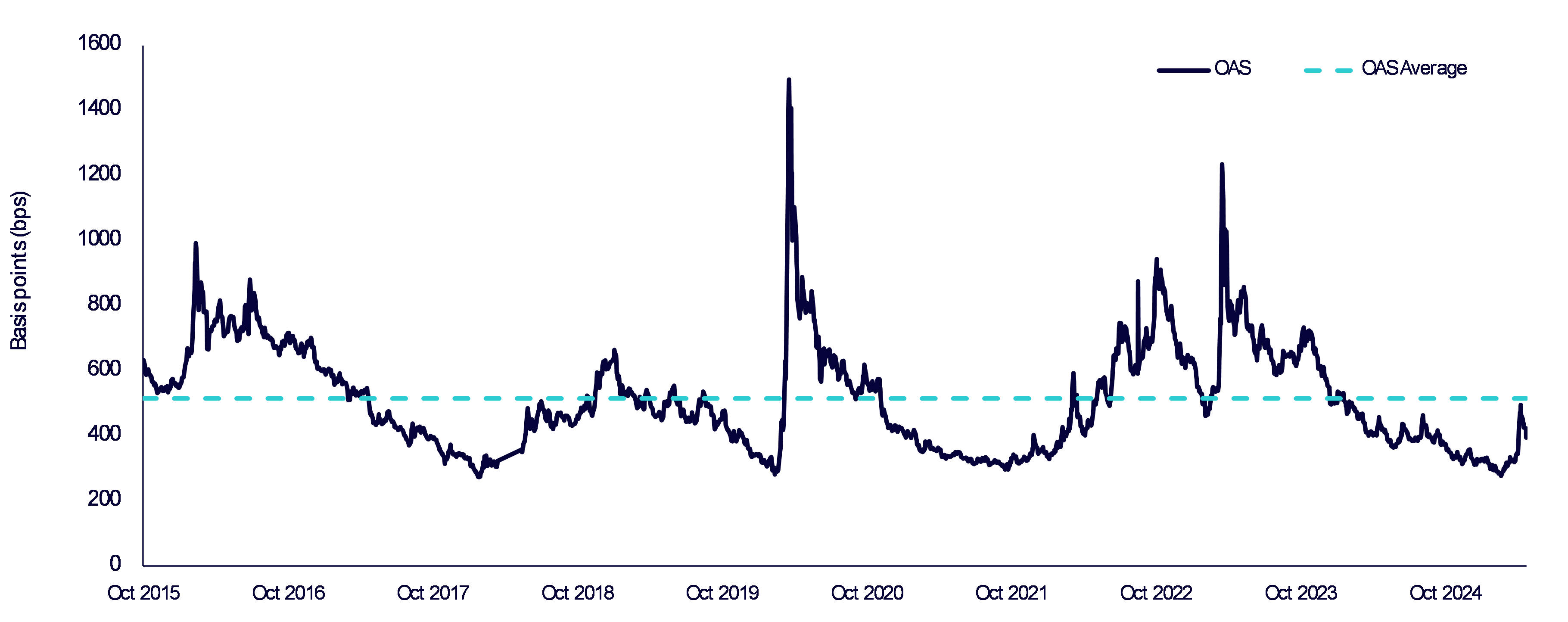
Source: WisdomTree, Markit. Period from 01 October 2015 to 23 April 2025. Calculations include backtested data. OAS is the option-adjusted spread reported by Markit and is based on the effective duration-adjusted market value weighting. Workout dates used in the OAS calculation of individual bonds are reset at the end of the month in case the bonds are not called. This calculation approach impacts the OAS figures for the index intramonth until the workout dates are reset. The strategy is represented by the iBoxx Contingent Convertible Liquid Developed Europe AT1 Index. Historical performance is not an indication of future performance and any investments may go down in value.
Banks today boast their strongest financial positions in decades, highlighted by record-high Common Equity Tier 1 (CET1) capital ratios and historically low non-performing loan (NPL) levels. These robust capital buffers equip banks exceptionally well to withstand potential economic shocks, differentiating them from more vulnerable sectors such as manufacturing or agriculture.
Importantly, banks face no direct impact from tariff hikes. Their exposure is indirect and delayed, occurring later in the economic cycle through client distress if unemployment rises substantially. This inherent delay offers banks crucial time for adaptation, providing investors with a defensive yet high-yielding instrument amid prevailing uncertainty.
Euro: stability amid US policy uncertainty
Traditionally, investors seeking stability favoured the US dollar, but recent US policy unpredictability has shifted this dynamic. The euro has rallied notably, rising 11% against the dollar since January4. This appreciation signals a broader shift in market psychology toward Europe, driven by declining confidence in US economic policy predictability.
Europe’s economic outlook, though modest, shows resilience, with 0.8% growth last year and a forecasted expansion of 1.3% for 20255. Confidence has further strengthened due to Germany’s €1 trillion stimulus package focused on defence, infrastructure and climate initiatives. This ambitious fiscal plan, financed through new bond issuance, enhances market liquidity and attracts foreign capital seeking alternatives to US Treasuries.
Additionally, monetary policy divergence — characterised by lower European Central Bank (ECB) interest rates relative to the Fed’s higher rates — would typically favour a stronger US dollar, however, investors are currently prioritising Europe's perceived political and economic stability over yield advantages. This shift has reinforced investor appetite for euro-denominated assets despite traditional interest rate dynamics.
Figure 2: EUR/USD currency breaks link with short-term yield spread
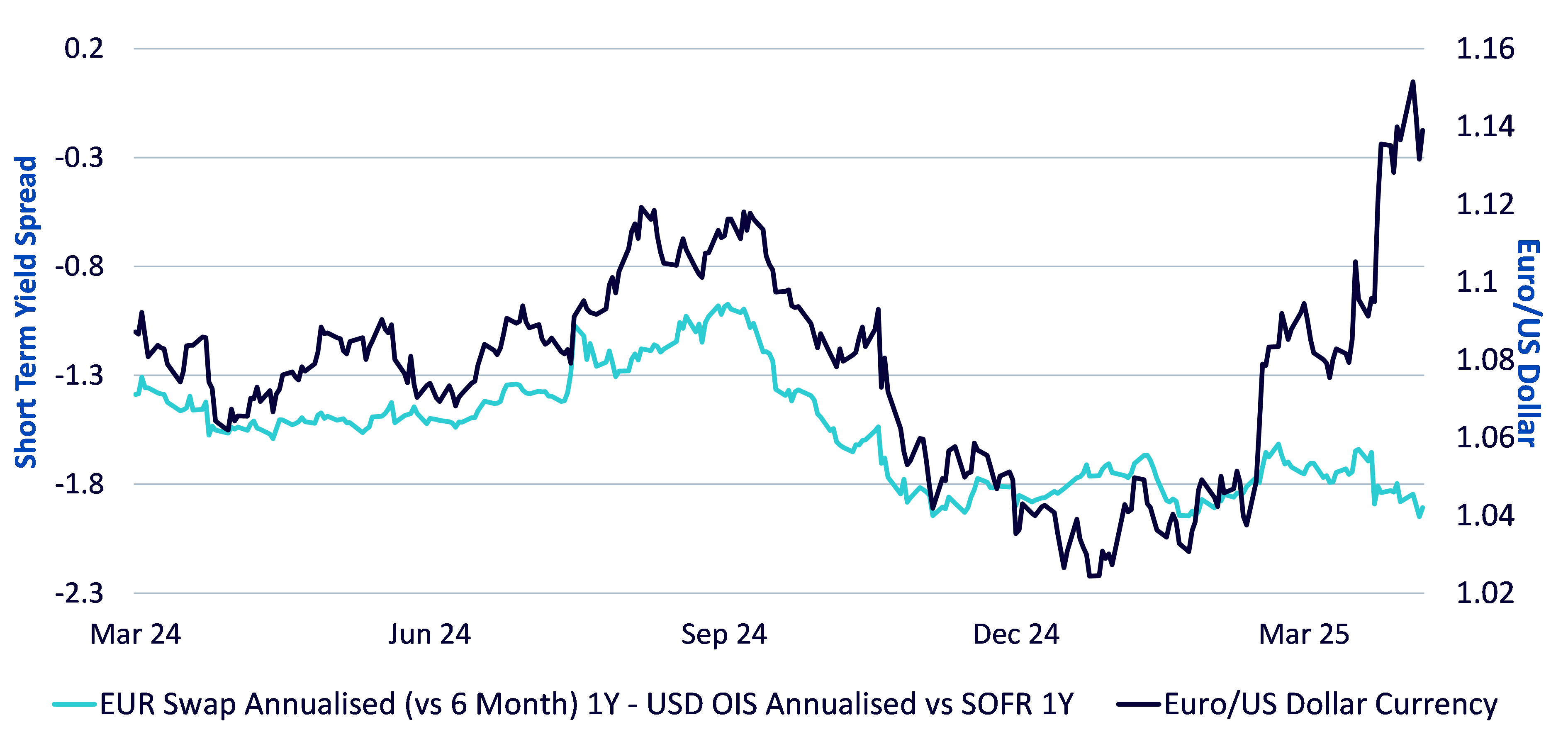
Source: Bloomberg, WisdomTree as of 24 April 2025. Historical performance is not an indication of future performance and any investments may go down in value.
However, potential headwinds remain. The pending US tariff on EU goods could significantly disrupt eurozone growth, particularly affecting export-dependent Germany. Political reluctance, particularly from northern European states, to embrace deeper fiscal integration via joint debt issuance (eurobonds), remains a challenge. Still, options markets show positioning for further euro upside6, and the data highlights traders, including hedge funds, are targeting a move beyond $1.20 over the next three to six months.
While the euro’s current strength reflects confidence relative to US unpredictability, its durability depends heavily on Europe’s ability to convert short-term market favour into sustainable economic cohesion.
Conclusion: new paradigms in safe haven investing
Amid persistent US trade policy volatility, traditional safe havens are evolving. Gold remains a staple, yet digital assets like bitcoin, resilient banking instruments such as CoCos, and the euro currency are gaining traction. Investors are increasingly diversifying their strategies to navigate this complex landscape. These emerging safe havens reflect not just a defensive posture but a strategic adaptation to ongoing global uncertainties.
1 Bloomberg, WisdomTree from 2 April to 22 April 2025.
2 U.S. Securities and Exchange Commission.
3 Markit, WisdomTree as of 23 April 2025.
4 Bloomberg from 2 January 2025 to 24 April 2025.
5 Eurostat as of 31 March 2025.
6 Bloomberg, Depository Trust & Clearing Corporation (DTCC) as of 14 April 2025.








 Previous Post
 All Posts