





 Print Page
Building Europes backbone investing in the next infrastructure wave


Key Takeaways
- Europe is entering a multi-year infrastructure investment cycle driven by electrification, digitalisation, ageing assets and rising security priorities.
- NATO’s 2025 Hague Summit commitment to spend 5% of GDP on defence and security by 2035 includes up to 1.5% allocated to protecting critical infrastructure and strengthening civil resilience.
- Policy support and public funding programmes are translating strategic priorities into large, visible infrastructure spending pipelines.
- Investing through the infrastructure value chain can provide targeted exposure to companies building grids, transport networks and digital infrastructure across Europe.
At NATO’s 2025 Hague Summit, Allies committed to investing 5% of gross domestic product (GDP) in defence and security by 2035, including up to 1.5% of GDP that can be counted towards protecting critical infrastructure and strengthening civil resilience1. That has helped put infrastructure back on investors’ radar. But Europe’s infrastructure narrative goes well beyond resilience spending. After years of underinvestment, ageing assets need replacement and upgrades, while new sources of demand, such as electrification and digitalisation, are lifting the need for new capacity. Together, these forces point to a sustained, multi-year investment cycle across energy, transport and digital infrastructure.
Structural forces driving Europe infrastructure
Underinvestment and ageing assets: Decades of under-spend have left parts of Europe’s grids, rail lines and bridges approaching the end of their useful life. Much of Europe’s rail tunnel and bridge stock is over 50 years old 2 and the average age of power grids in Europe often exceeds 40 years. Ageing assets require more inspection and maintenance, and can constrain capacity as usage rises. Replacement and upgrades are becoming unavoidable, driving multi-year refurbishment programmes.
New infrastructure for Europe’s future: Europe also needs new capacity to compete in a changing world. Electrification across transport and industry is lifting power demand, while digitalisation is adding a new load. The European Commission expects EU electricity consumption to rise by around 60% by 20303. Data centres are expected to be an important driver of incremental power demand, reinforcing the urgency around grid connections, reinforcement and new generation.
Figure 1: Rising AI power demand is making grid capacity the binding constraint
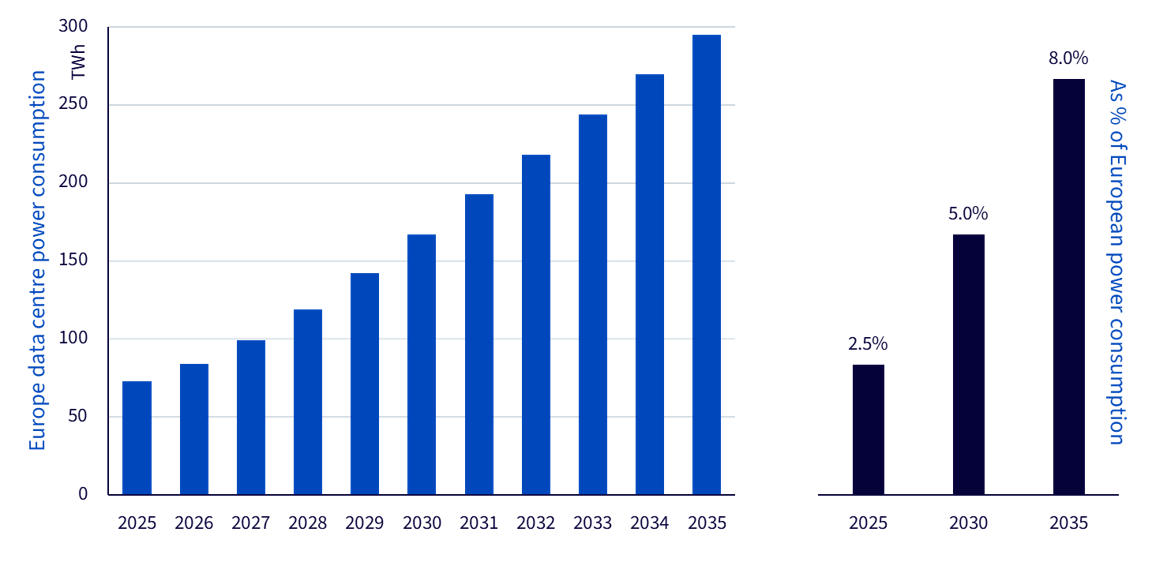
Source: Morgan Stanley, ‘Powering AI Comes To Europe’, 03 December 2025. Forecasts are not an indicator of future performance and any investments are subject to risks and uncertainties.
Multi-year policy funding: EU and national programmes are translating strategic priorities into funded pipelines. Funding programmes imply well over €1tn4 of funding envelopes over the cycle. Stabilised inflation volatility helps those budgets turn into contracts, improving cost visibility for long projects. Germany adds momentum, having eased its fiscal brake and set up a €500bn special fund5 for infrastructure and climate neutrality.
Security and resilience priorities: Geopolitics has added a strategic layer to infrastructure decisions, alongside the traditional focus on cost and efficiency. NATO’s 2025 Hague Summit Declaration states Allies will account for up to 1.5% of GDP annually to protect critical infrastructure and strengthen civil preparedness and resilience. Beyond that, Ukraine reconstruction adds longer-dated optionality, with $524bn estimated to be needed over the next decade6.
Figure 2: Ukraine reconstruction and recovery needs
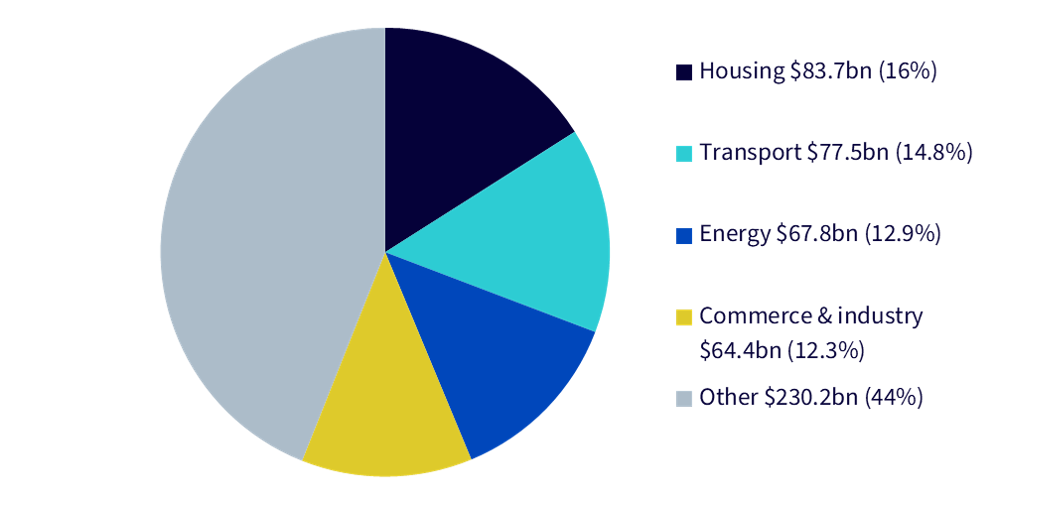
Source: World Bank, Fourth Rapid Damage and Needs Assessment (RDNA4), February 2025; Rebuild Ukraine. Forecasts are not an indicator of future performance and any investments are subject to risks and uncertainties.
A value-chain approach to investing in Europe’s next infrastructure wave
As Europe enters its next infrastructure wave, the investment opportunity is best understood through the value chain. This keeps the focus on where spending flows and on the multi-year project pipeline. The WisdomTree Europe Infrastructure UCITS ETF (WBLD) offers investors targeted exposure to the companies positioned to benefit from long-duration spending on the infrastructure that underpins growth and resilience.
The strategy targets engineering and construction companies, manufacturers of grid and power equipment, makers of specialised infrastructure components, and key materials suppliers involved in the construction of these assets. By contrast, it typically excludes utilities and other operators whose earnings are primarily tied to running existing networks, where returns are more driven by regulation and operating economics than by construction activity.
Figure 3: The WisdomTree Europe Infrastructure portfolio mainly targets exposure to construction and supply segments

Source: WisdomTree.
The strategy focuses on four pillars where spending is most visible across policy programmes and project pipelines:
- Clean power build-out, from renewables and storage to grid connections.
- Smart grids and electrification, including cables, switchgear, substations and grid automation.
- Transport modernisation, especially rail and critical logistics links.
- Digital infrastructure, including fibre, data-centre enablement and the electrical backbone that powers it.
How to capture the opportunities in Europe infrastructure?
The WisdomTree Europe Infrastructure UCITS ETF is designed to give investors targeted exposure to the companies building Europe’s next infrastructure wave. Alongside the WisdomTree Europe Defence UCITS ETF (WDEF), it offers complementary exposure to the physical build-out that underpins Europe’s competitiveness and security.
The fund tracks the WisdomTree Europe Infrastructure UCITS Index. The index starts with the equity universe from eligible developed markets7, then applies size and liquidity requirements and uses caps and other guardrails to help manage concentration.
Stock selection is driven by both revenue relevance and Europe revenue exposure.
- Companies qualify if at least 25% of revenue comes from Core infrastructure activities, or at least 50% from a combination of Core and Adjacent activities. Core activities are directly tied to Europe’s infrastructure build-out, including developers, contractors and specialised equipment or component suppliers, while Adjacent activities support infrastructure projects more indirectly.
- A Europe-revenue overlay ensures exposure is genuinely linked to the region. European-domiciled companies must generate at least 10% of revenue from Europe, while non-European companies must generate at least 20%, helping align the portfolio with growing European demand.
- Each eligible company receives a Relevancy Score of 3, 2 or 1 based on the directness of its infrastructure exposure and the importance of European revenues. Constituents are then weighted by full market capitalisation multiplied by this score, tilting the portfolio towards companies with more direct infrastructure exposure.
A closer look at the WisdomTree Europe Infrastructure UCITS ETF’s portfolio
As of 27 February 2026, the WisdomTree Europe Infrastructure UCITS Index shows higher profitability than broad equity benchmarks. Return on equity is about 22% versus about 14% for MSCI Europe. Valuation signals are mixed, which is typical for a portfolio tilted to industrial technology and specialist suppliers. On trailing earnings and sales, the Index appears cheaper than MSCI Europe and MSCI ACWI.
Figure 4: WisdomTree Europe Infrastructure UCITS Index - Key fundamentals
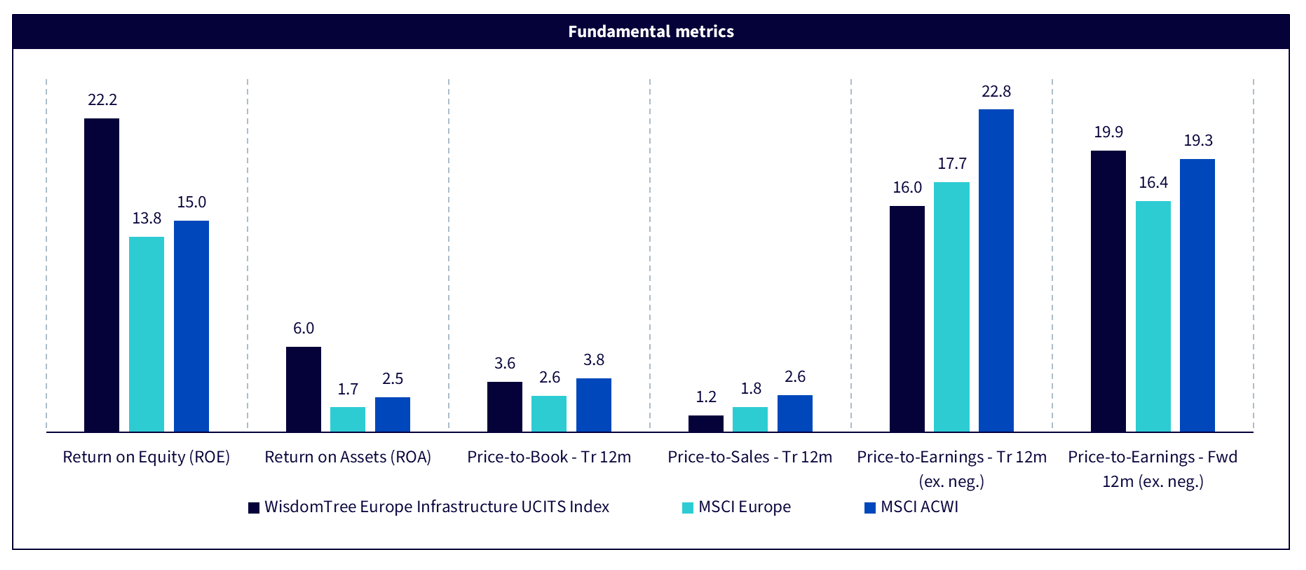
Source: WisdomTree, FactSet, as of 27 February 2026. You cannot invest directly in an index. Historical performance is not an indication of future performance and any investments may go down in value.
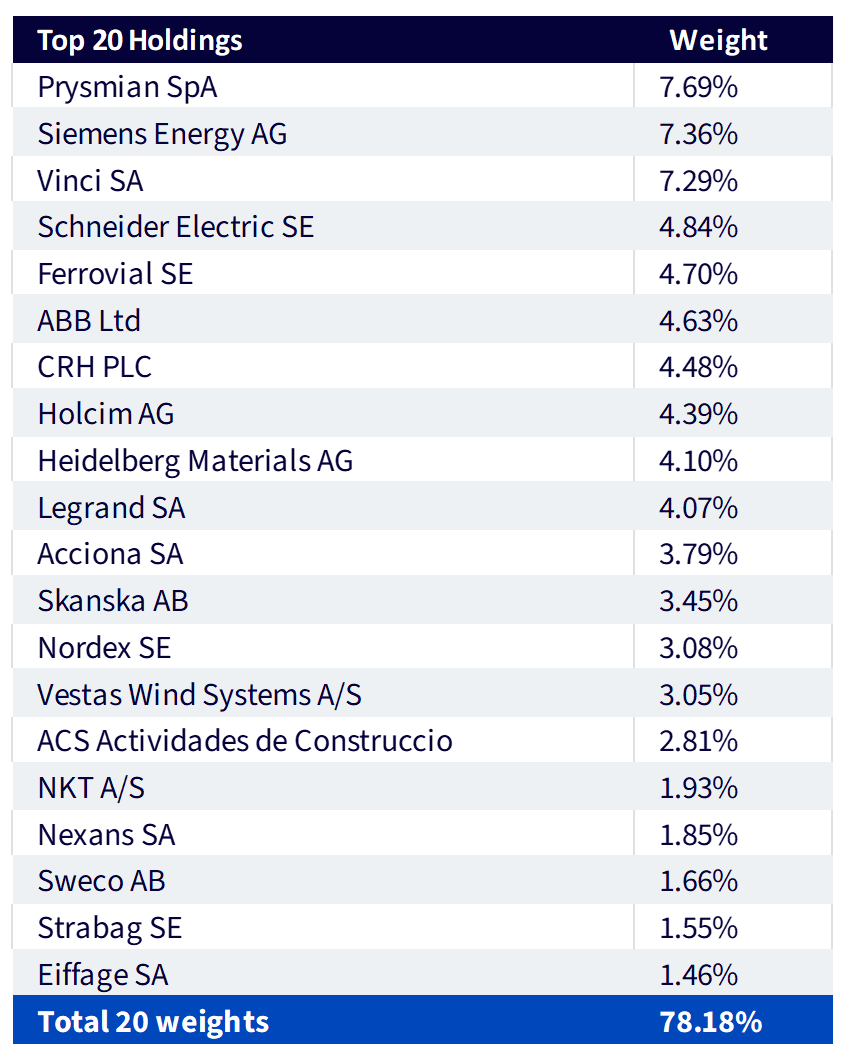
The top 20 holdings represent 78.18% of the Index. They cluster around the parts of the value chain most exposed to Europe’s build-out.
- Builders and transport infrastructure: VINCI and Ferrovial are complemented by construction and engineering names such as Acciona, Skanska, ACS, Sweco, Strabag and Eiffage.
- Materials for construction: CRH, Holcim and Heidelberg Materials support the refurbishment and expansion cycle.
- Grid and electrification enablers: Prysmian is the largest position, alongside Schneider Electric, ABB and Legrand. Cable specialists such as NKT and Nexans also feature.
- Energy system build: Siemens Energy provides exposure to equipment needed for power system expansion. Nordex and Vestas add exposure to renewable build-out.
Figure 5: Top 20 holdings in the WisdomTree Europe Infrastructure UCITS Index
Source: WisdomTree, as of 27 February 2026. You cannot invest directly in an index. Historical performance is not an indication of future performance and any investments may go down in value.
Conclusion
Europe’s infrastructure cycle is shifting from planning to delivery, with a multi-year pipeline across grids, electrification, transport and energy systems. The equity opportunity is concentrated in the companies that build these assets and supply the critical equipment and materials. WisdomTree Europe Infrastructure UCITS ETF (WBLD) provides targeted, rules-based exposure to this value chain through revenue screens and a Europe-revenue overlay, with relevance-weighted construction that tilts the portfolio towards more direct infrastructure developments pure-plays.
Sources
1. NATO, Defence expenditures and NATO’s 5% commitment
2. Europe’s Rail, Extending the life and capacity of Europe’s ageing tunnels and bridges
3. European Commission, A European Grid Action Plan
4. Based on committed envelopes for major EU programmes including the Next Generation EU, Recovery and Resilience Facility, InvestEU, Connecting Europe Facility, as per European Commission documentation.
5. Source: German Federal Ministry of Finance, ‘The Special Fund for Infrastructure and Climate Neutrality’, 5 December 2025.
6. Source: World Bank, Fourth Rapid Damage and Needs Assessment (RDNA4) , February 2025
7. Source: World Bank, Fourth Rapid Damage and Needs Assessment (RDNA4) , February 2025

 Previous Post
 All Posts