




 Print Page
What’s Hot: currency is no longer a side issue


Key Takeaways
- As the US dollar faces a slow but structural decline, investors can no longer afford to treat currency moves as background noise in portfolio construction.
- The Japanese yen's defensive appeal now comes with heightened volatility, making it a key amplifier of portfolio risk during shifts in policy or sentiment.
- Currency-hedged share classes and currency exchange traded products (ETPs) are increasingly essential tools for investors aiming to manage foreign exchange (FX) risk and sharpen returns amid a shifting macro regime.
- Related Products WisdomTree Short USD Long EUR, WisdomTree Short JPY Long EUR, WisdomTree Long JPY Short EUR, WisdomTree Long JPY Short USD Find out more
The US dollar is weakening in a slow, structural way. The Japanese yen is strengthening in bursts, then snapping back. Together, they signal a regime shift: currency is no longer a passive backdrop. It is an active driver of portfolio risk and return.
This is not a foreign exchange (FX) trading story. It is a portfolio construction problem, with implications across equities, bonds, commodities and diversification itself.
The US dollar: weakness is becoming structural, not cyclical
The US dollar (USD) has been under pressure for months. Short-term rallies still occur, but they are increasingly tactical rather than trend-defining. The broader picture is one of gradual erosion.
Several forces are working against the US dollar:
- Persistent US fiscal deficits are reviving long-term concerns about debt sustainability, particularly as interest costs rise.
- Interest-rate uncertainty remains elevated, with markets repeatedly repricing the timing and depth of Federal Reserve cuts.
- Political noise is bleeding into FX markets, including debate around trade policy, fiscal expansion and perceived threats to central bank independence.
- Gradual diversification away from USD continues among reserve managers and long-horizon investors, even if it is slow and uneven.
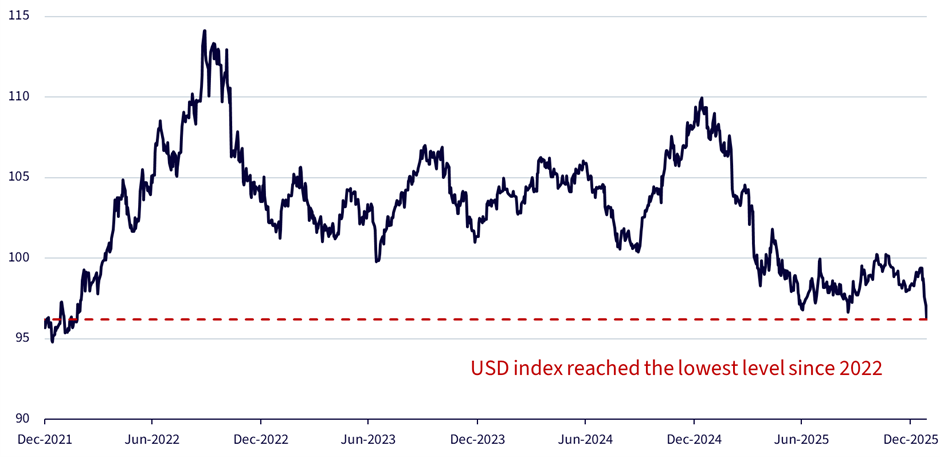
One simple market check is US Dollar Index (DXY) . which has been trending lower into early 2026 and has reached its lowest level since 2022. This supports the idea that USD weakness is broad-based rather than solely driven by a single currency pair.
Figure 1: USD index (DXY index) reached the lowest level since 2022
Source: Bloomberg, as of 27 January 2026. You cannot invest directly in an index. Historical performance is not an indication of future performance, and any investments may go down in value.
The US dollar does not need to collapse to matter. A slow, grinding decline is enough to reshape global portfolio outcomes. It quietly boosts assets that tend to move inversely to USD, most notably gold, while eroding USD-based returns on overseas assets. Currency is no longer a background variable. It is becoming a first-order driver of returns.
The Japanese yen: defensive appeal, but rising volatility
The Japanese yen (JPY) has re-entered investor focus, but not as a stable safe haven. Instead, it has become hypersensitive to policy signals and shifts in global risk sentiment.
Key dynamics include:
- The Bank of Japan has begun edging away from ultra-easy policy, but remains extremely cautious.
- Japanese government bond yields have risen, narrowing the gap with US Treasuries.
- This has triggered sharp yen rallies, particularly when markets price tighter policy or the risk of official intervention.
- At the same time, Japan’s economic fragility caps how far and how fast rates can rise, limiting the durability of those moves.
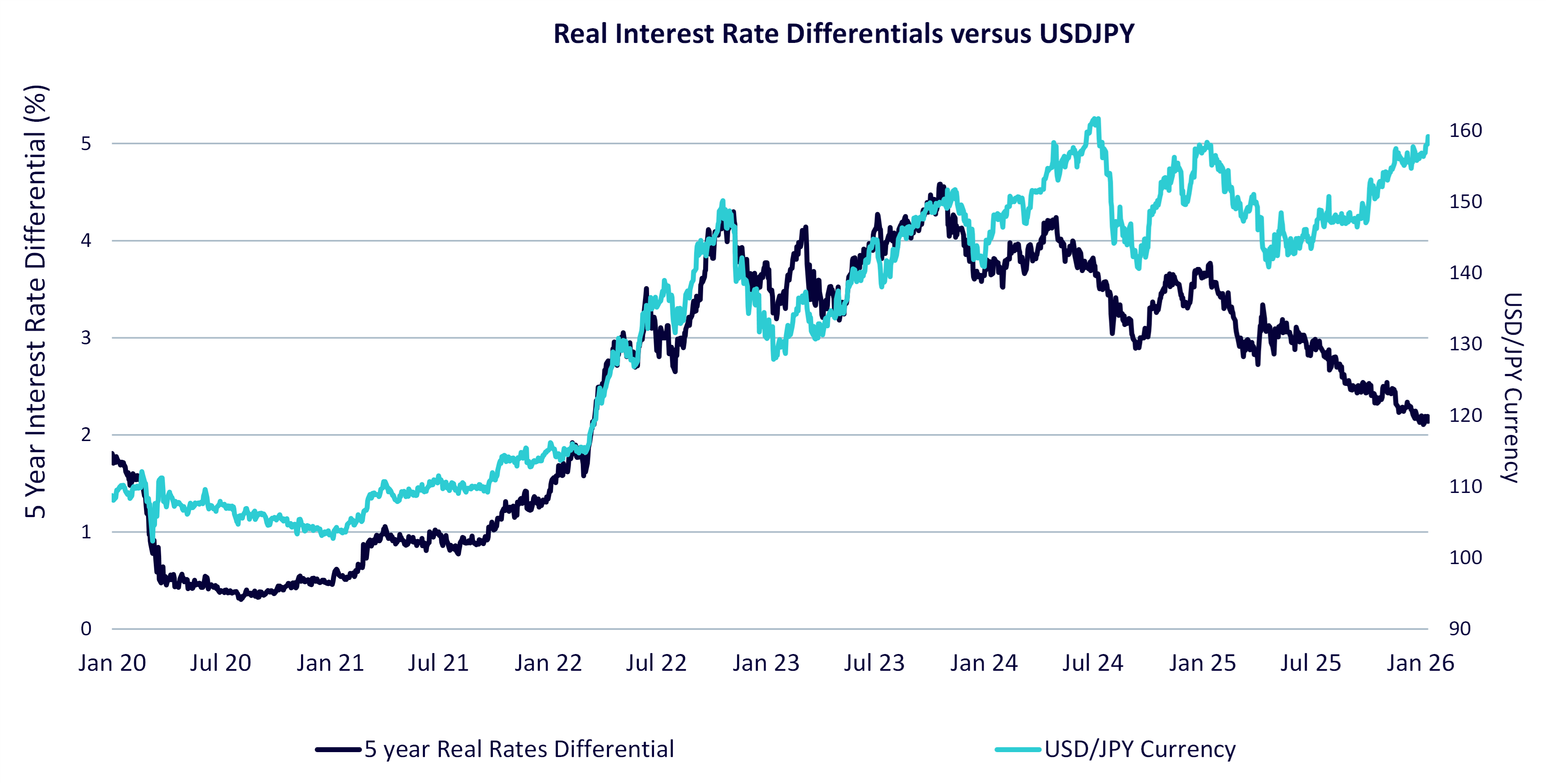
From market data perspective, the USD-JPY real yield differential remains positive, but it has been trending lower. The compression from around 3% in mid-2024 toward roughly 1.5% at the end of January 2026 reduces the rates tailwind behind USDJPY. At the same time, JPY 3-month forward carry remains negative, but it is far less negative than in 2022–2023. That shrinking carry cushion makes “short JPY” positioning more fragile and increases the probability of sharp, stop-driven JPY rallies.
Figure 2: Shrinking real rate differentials weaken the USDJPY carry cushion
Source: Bloomberg, WisdomTree as of 16 January 2026. USD-JPY real yield differential is calculated as (US 5y nominal Treasury yield - US 5y inflation swap rate) - (Japan 5y nominal JGB yield - Japan 5y inflation swap rate). You cannot invest directly in an index. Historical performance is not an indication of future performance, and any investments may go down in value.
Near term, the directional message is less “yen steadily stronger” and more “yen strength arrives in jolts”. In practice, that means downside risks in USDJPY (sudden JPY strength) are more likely than a smooth trend, even if the pair remains range-bound overall.
The Japanese yen: defensive appeal, but rising volatility
A key development is that intervention risk is no longer solely a Japan story. Recent reporting suggested “rate checks” in USDJPY by Japanese authorities and unusually by the New York Fed’s FX desk acting as agent for the US Treasury. While this is not the same as actual intervention, it increases the probability of coordinated action if USDJPY re-tests the highs. The practical implication is a near-term “soft ceiling” on USDJPY: authorities appear more willing to lean against one-way yen weakness, which raises the odds of abrupt JPY-strength episodes even if the broader trend remains choppy.
USD weakness and JPY volatility are now linked
What has changed is that USD weakness and JPY strength are no longer separate stories.
When US yields fall or global risk sentiment deteriorates:
- The US dollar typically weakens.
- The yen often strengthens, reflecting its defensive characteristics.
But when markets question the Bank of Japan’s resolve or economic constraints:
- Yen rallies fade quickly.
- Currency volatility spikes
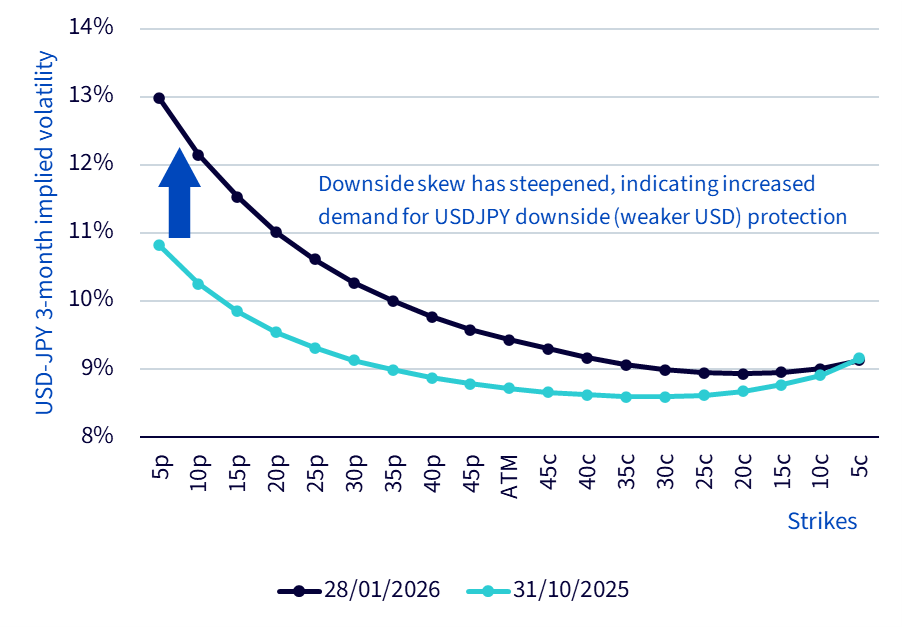
The outcome is a regime of short, sharp currency moves, not long, predictable trends. That makes currency risk harder to ignore and harder to sit through passively. From a market data perspective, USDJPY 3-month implied volatility is higher than late October 2025, and the downside wing is richer. That is consistent with investors paying up for protection against abrupt JPY-strength episodes, rather than just pricing symmetric two-way uncertainty.
Figure 3: Rising USDJPY downside skew signals growing demand for yen strength protection
Source: Bloomberg, as of 28 January 2026. You cannot invest directly in an index. Historical performance is not an indication of future performance, and any investments may go down in value.
For diversified portfolios, this matters. Currency volatility can now amplify drawdowns, dilute returns and undermine assumptions about diversification, even when underlying assets perform as expected.
What investors should do about currency risk
The mistake is to treat this as an FX trading issue. It is not. It is a portfolio design problem.
Investors need to be more deliberate about how currency exposure enters their portfolios:
- Use currency-hedged share classes of existing fund holdings to reduce unintended FX volatility.
- Deploy currency exchange traded products (ETPs) to express views on USD or JPY without disturbing core asset allocations.
- Separate asset views from currency views. Being constructive on Japanese equities does not require being bullish the yen.
- Accept that currency is now a return lever, not a residual risk.
In a world where US dollar weakness is becoming structural and Japanese yen moves are abrupt and policy-driven, and now increasingly intervention-shaped, ignoring currency exposure is no longer neutral. It is an active decision.
Investors who manage currency deliberately through currency-hedged share classes and currency ETPs are better positioned to control risk, sharpen returns and remain flexible as macro conditions continue to shift.






 Previous Post
 All Posts