




 Print Page
Creating a balanced crypto and blockchain exposure: The 40/30/30 framework for a crypto and equities sleeve


Key Takeaways
- Most investors overlook parts of the blockchain investment opportunity by focusing on direct crypto or equities alone. Combining both captures a broader range of value drivers across the ecosystem.
- The 40/30/30 allocation applies a simplified mean-variance optimisation framework to create a diversified blend of direct crypto and blockchain equity exposure, offering a balanced risk-return profile.
- Historically, adding a 40/30/30 blockchain sleeve to a traditional 60/40 portfolio has improved returns, enhanced risk-adjusted performance, and maintained tight downside risk control.
As blockchain adoption accelerates, investors are seeking exposure to both crypto’s disruptive potential and the institutional traction of companies integrating the technology. In a recent blog, we explored the complementary roles that direct crypto and blockchain equities play within the broader digital asset ecosystem. Now, we take the next step: designing an illustrative, combined portfolio sleeve that captures the full spectrum of blockchain innovation through both cryptocurrencies and public equities.
Why allocate to a dedicated blockchain & crypto sleeve?
Blockchain technology is reshaping both centralised and decentralised industry domains. Whether through protocols like Bitcoin and Ethereum or publicly traded companies driving innovation in payments, custody, and infrastructure, the macro tailwinds supporting this theme are undeniable.
While the same structural trends power both crypto assets and blockchain equities, they reflect different investment profiles:
- Direct crypto offers high-beta exposure to network adoption and tokenomics but comes with greater analytical complexity.
- Blockchain equities offer access through traditional business models – revenue-generating firms with familiar investment characteristics applying blockchain in real-world use cases.
Each taps into the blockchain economy through different channels of value accrual. Both are tied to crypto and blockchain technology adoption, but their drivers are fundamentally different and offer uniquely complementary investment exposures.
A blend of different opportunities
A thoughtfully constructed combination allows investors to build a diversified sleeve that captures the full breadth of blockchain technology’s disruptive potential. It balances the potential high-growth opportunity of digital tokens with the fundamentally anchored value creation of companies adopting blockchain technology. This multi-faceted approach reduces the risk of over-concentration in any single segment of the ecosystem and offers more comprehensive exposure to the full blockchain value chain. Yet many investors focus on just one part of the theme, missing meaningful opportunities in complementary areas.
Bitcoin provides a non-sovereign asset exposure rooted in the ‘digital gold’ thesis. It can serve as a macro hedge and store of value in an age of rising debt and monetary debasement.
Altcoin exposure (e.g., Ethereum, Solana) enables participation in smart contract platforms and decentralised ecosystems. These platforms power key innovations such as decentralised finance (DeFi), decentralised physical infrastructure networks (DePIN), digital identity, and other Web3 applications. These protocols are programmable layers that enable digitally-native economic activity to run directly on the blockchain.
Blockchain equities represent infrastructure and integration plays, with traditional business models often already generating revenue. Miners like Marathon Digital, Riot Platforms, and IREN Limited secure the Bitcoin network’s blockchain, earning block rewards and transaction fees. Exchanges and custodians like Coinbase and Swissquote provide the plumbing needed for mainstream adoption, institutional access, and are even tapping DeFi technology in their service offerings1. Fintech innovators like PayPal and Circle are developing blockchain-based payment rails2, challenging legacy networks. Financial institutions such as Robinhood3 and Broadridge4 are pioneering tokenising assets to enhance efficiency, transparency, and distribution.
Together, these public companies act as a bridge between decentralised innovation and institutional-scale implementation. For investors, they offer a familiar format for accessing the theme. When combined with direct crypto exposure, they form a powerful pairing.
A simple framework for construction
One illustrative example of a balanced blockchain sleeve:
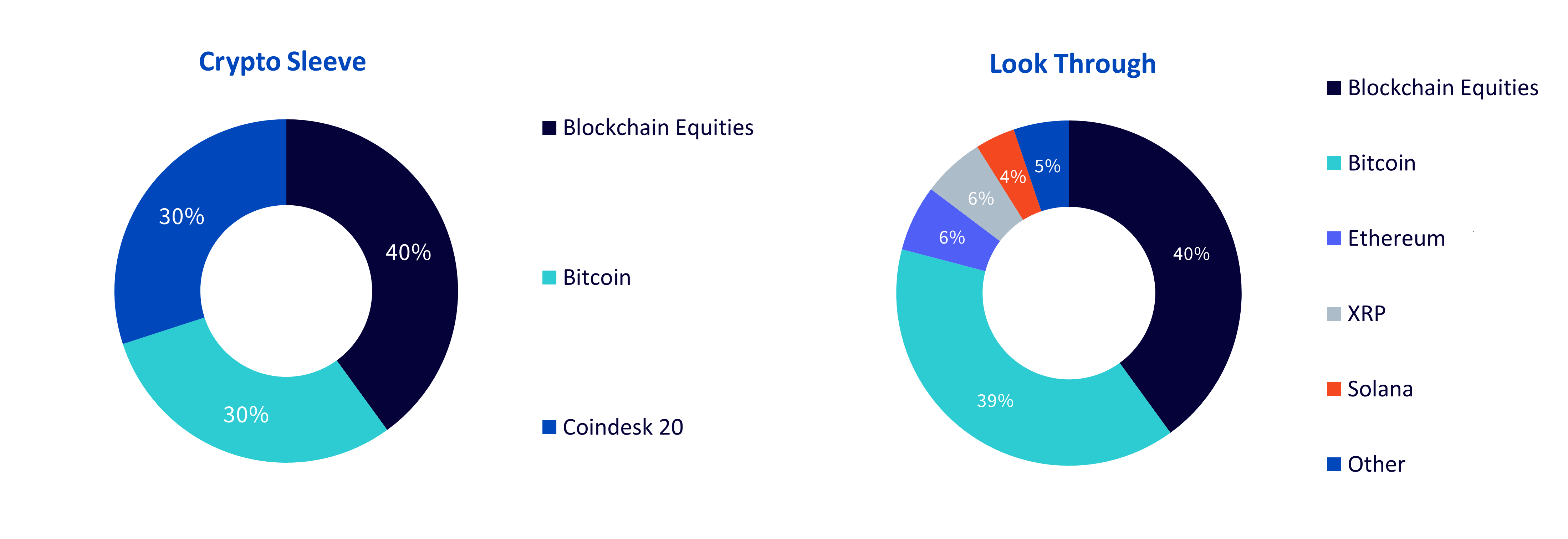
- 40% blockchain equities
- 30% broad-based, investible crypto index (e.g., CoinDesk 20)
- 30% bitcoin
Figure 1: Crypto sleeve allocations and look through
Source: WisdomTree, CoinDesk as of June 5, 2025.
Think of the structure in layers: blockchain equities form the foundation (40%), providing business-model diversification and earnings visibility. The next layer (30%) captures broad crypto trends through a capped, investible index like the CoinDesk 20. Finally, a dedicated bitcoin allocation (30%) addressed the capped crypto index’s bitcoin underweight and gives optionality for strategic tilts to other assets based on investor views.
This structure accomplishes three things:
1. It delivers diversified, complete crypto exposure while aligning with market-cap weighting.
2. It provides flexibility for investors to tilt away from market cap exposure, by making adjustments to the bitcoin allocation (i.e. replacing with other assets to ‘overweight’ vs. the index).
3. It balances broad and diversified cryptocurrency beta with the differentiated, firm-specific drivers found in blockchain equities.
This layered approach is not only intuitive but also supported by basic portfolio theory. Modern portfolio theory suggests that when two assets are uncorrelated, the Sharpe-maximising weights are approximately proportional to expected return over variance. While crypto and blockchain equities are not uncorrelated, this framework provides a useful point of reference. Historically, this points to an allocation of 37% equities and 63% direct crypto, which roughly aligns with our 40/30/30 approach.
However, as correlation increases, greater allocation shifts toward the sleeve with the higher Sharpe ratio. As such, we expect even more weight to tilt in favour of crypto when looking backwards. Looking ahead, we expect the blockchain equities are due to catch up5,6. Year to date, equities have so far exceeded crypto returns by over 10%, while running at lower volatility7 (53% annualised vs. 60% annualised), positioning it for a slight overweight from where history would indicate. Therefore, implementing a 60/40 crypto-to-equity mix through our 40/30/30 framework provides a balanced, diversified solution aligned with mean-variance optimisation principles.
What it means for a traditional 60/40 portfolio
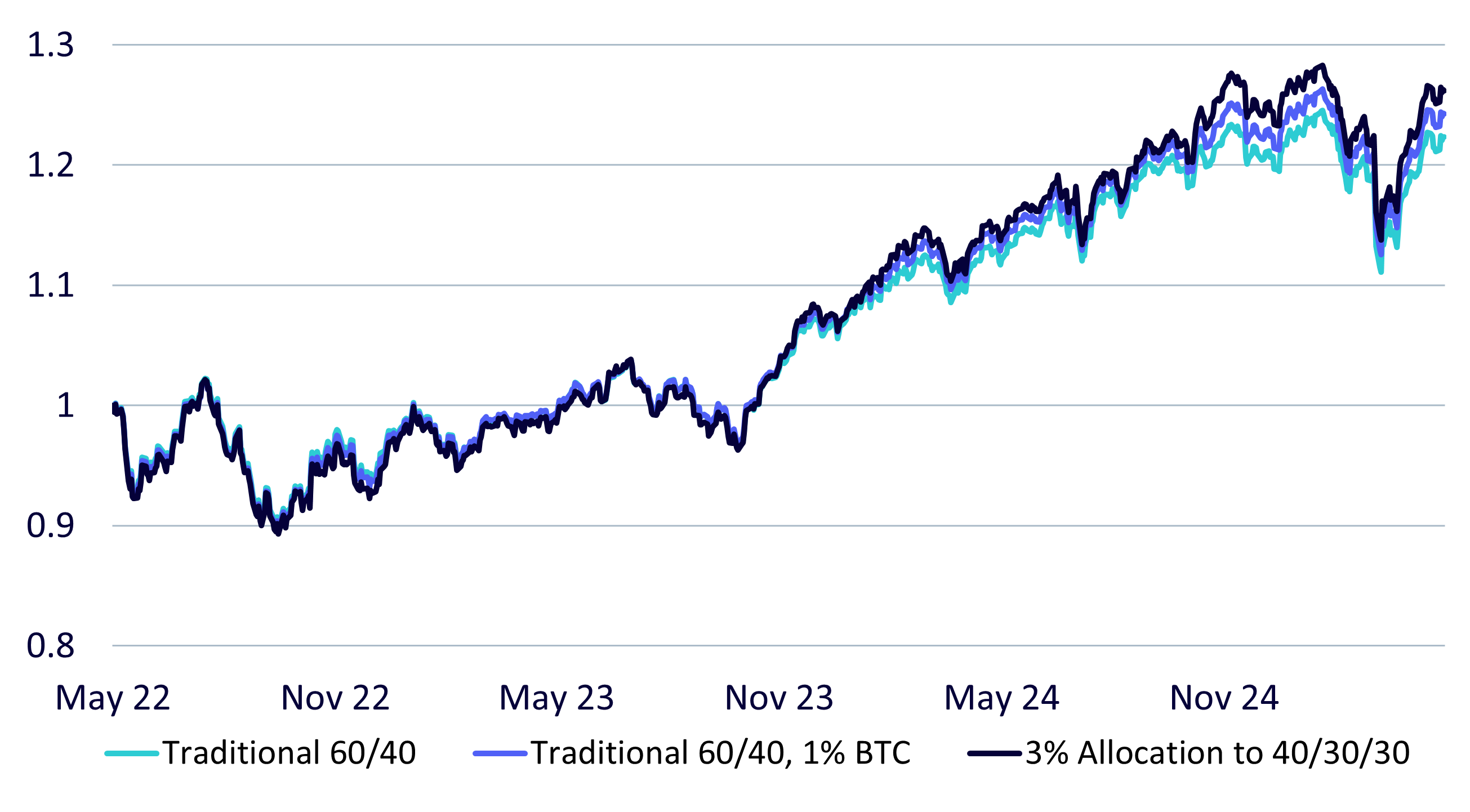
A modest 3% allocation to the 40/30/30 crypto and blockchain equity sleeve from the traditional 60% equity and 40% fixed income portfolio improved performance over the historical period from May 2022 to May 2025.
- Annualised returns improved by 1.1% (7.8% vs. 6.7%) with only a 0.5% increase in volatility.
- The max drawdown increased modestly from -12.1% to -12.6%, maintaining tight downside risk control.
- The information ratio (IR) of 0.93 highlights a strong excess return per unit of tracking error.
- Sharpe ratio improved from 0.28 to 0.39, highlighting better risk-adjusted returns.
Figure 2: Historical performance of 3% allocation of 40/30/30 crypto sleeve vs. traditional 60/40 portfolio and 60/40 with 1% bitcoin
Source: Bloomberg, for period from May 31, 2022 to May 31, 2025. Portfolios rebalanced quarterly. Historical performance is not an indication of future performance, and any investments may go down in value.
Many of these benefits stem from diversification across each sleeve's unique return and growth drivers. While crypto and blockchain equities are highly volatile on their own, the 40/30/30 reduces overall volatility by up to 20% compared to some individual assets, such as Ethereum. This dampens idiosyncratic risk while preserving the upside, giving investors balanced, broad-based exposure to the blockchain ecosystem. The diversification effect is a key reason for the stronger Sharpe ratio observed in the historical analysis.
Figure 3: Historical annualised volatility
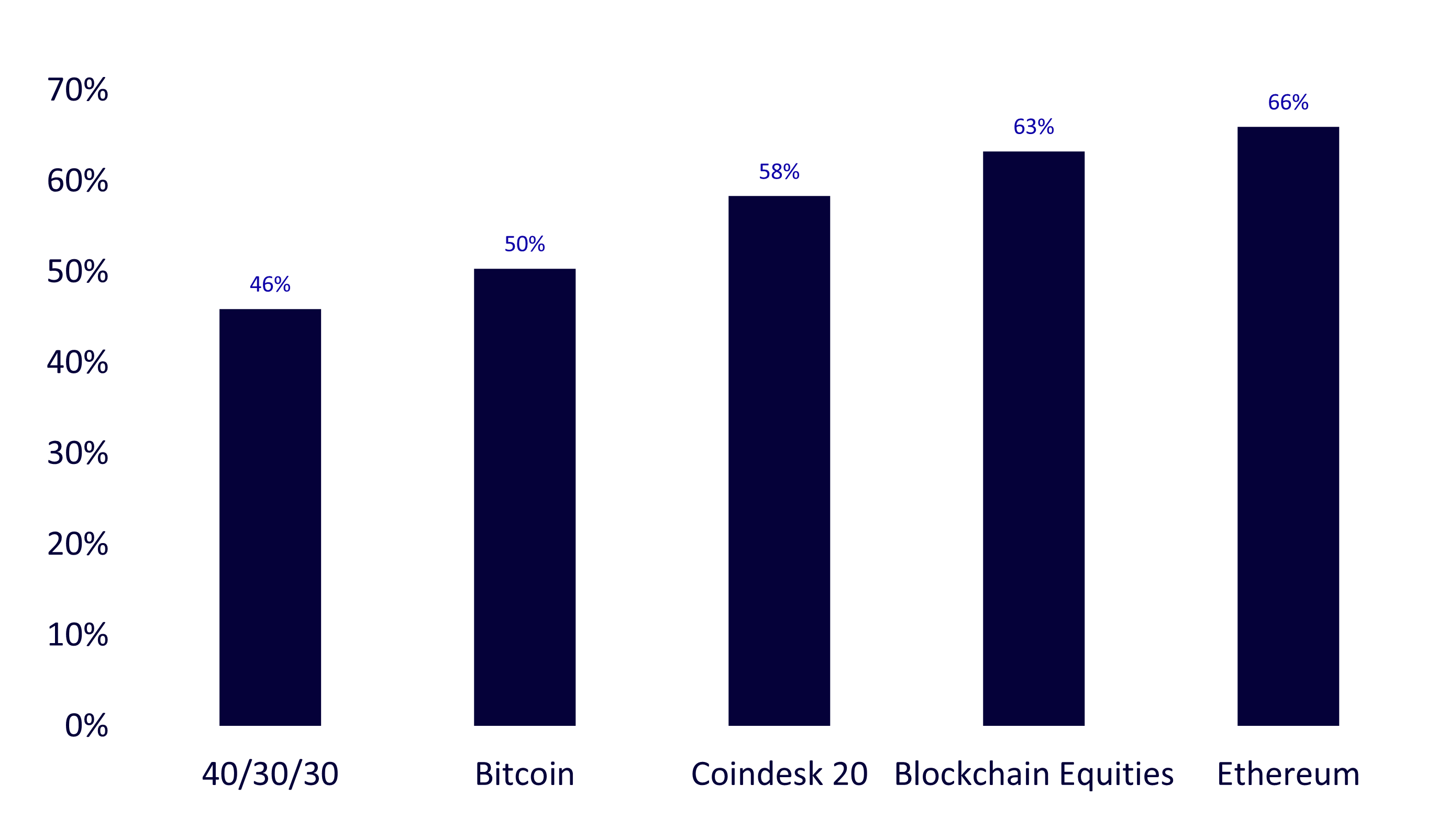
Source: Bloomberg, for period from May 31, 2022 to May 31, 2025. Blockchain Equities Index represents WisdomTree Blockchain UCITS Index. 40/30/30 represents performance of the Crypto and Blockchain equities sleeve, consisting of 40% WisdomTree Blockchain UCITS Index, 30% Bitcoin, and 30% Coindesk 20 Index rebalanced quarterly. Historical performance is not an indication of future performance, and any investments may go down in value.
Conclusion
Blockchain is rapidly transforming finance, payments, and data infrastructure, making it one of the most disruptive technologies of the next decade. A balanced allocation to both crypto assets and blockchain equities offers comprehensive exposure to this evolution. By combining digitally native tokens with revenue-generating businesses, investors can aim to capture the full potential of the blockchain economy without having to choose between them.
1 Coinbase Rolls Out Morpho-Powered Bitcoin-Backed Loans Up to $1 Million for US Users Excluding New York - "The Defiant"
2 PayPal USD: Circulating and stats - DefiLlama; USD Coin: Circulating and stats - DefiLlama
3 Robinhood (HOOD) News: Launches Tokenized Stocks on Arbitrum, Develops Own Blockchain
4 Broadridge - Distributed Ledger Repo Solutions
5 Blockchain is quietly rewiring the financial system
6 2025: a turning point for blockchain equities
7 Bloomberg as of June 5, 2025




 Previous Post
 All Posts