




 Print Page
Thematic Outlook: Seven AI trends investors need to watch


Key Takeaways
- Rate cuts from central banks are expected to become a tailwind for AI and related themes
- As new players emerge, investors will need to constantly reevaluate their AI exposures
- AI will impact other themes like renewable energy, biotech, and cybersecurity
In 1997, IBM's Deep Blue defeated world chess champion Garry Kasparov, marking a pivotal moment in artificial intelligence (AI) history. This victory was a sign of things to come, with AI making headlines again in 2016 when Google's AlphaGo bested Go champion Lee Sedol in a match long thought too complex for machines. While instances of AI brilliance have inspired awe over the decades, its widespread adoption has only recently become possible thanks to a connected world that generates vast amounts of data and has access to immense computing power.
Now that AI is mainstream, it creates exciting opportunities for investors. In this blog, we highlight seven trends that will shape the course of AI investing over the coming six to 12 months.
1. There will be a more favourable macroeconomic backdrop
As central banks, particularly the US Federal Reserve, adopt a more dovish monetary stance, mid and small cap companies are likely to benefit. Historically, equities have gained in the first year following an initial rate cut, with small caps often outperforming their larger counterparts. We discuss this in more detail in ‘Is the ‘great equity rotation’ finally coming?’.
Investors seeking pure exposure to AI and related themes will typically find themselves holding a healthy mix of mid and small cap companies. We predict this approach will be fruitful for those investing in AI and related sectors.
2. The hype will extend beyond just Nvidia
The name Nvidia has become synonymous with the AI revolution, and the company’s earnings releases have become market-moving events. However, while Nvidia understandably dominates the headlines, given the company’s leadership in the semiconductor space and its astronomical ascent in recent years, other companies are quietly making notable strides, too. Qualcomm, Broadcom, Micron Technology, and Marvell Technology are just a few examples of companies that have built a strong customer base and are making great strides without the same hype.
As the AI landscape evolves, investors will likely diversify their portfolios to include a broader set of players beyond the likes of Nvidia.
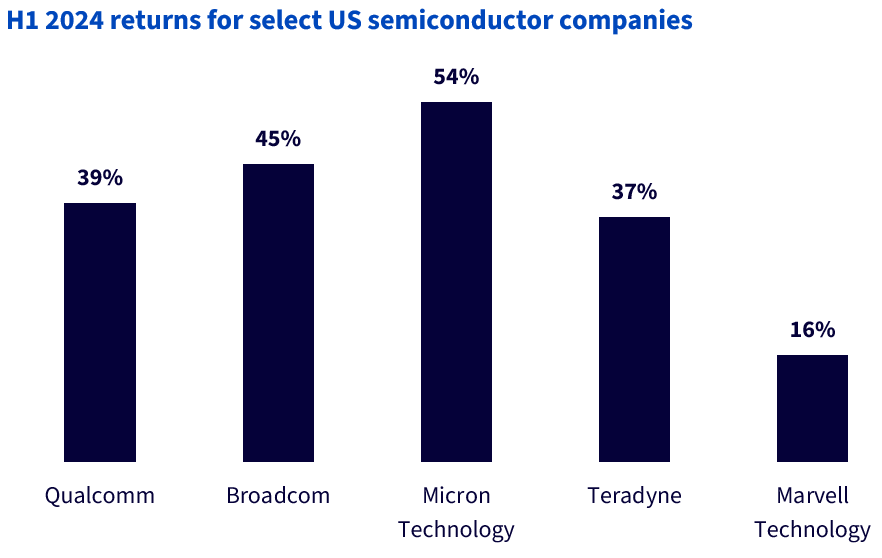
Source: Bloomberg, returns based on stock prices. Historical performance is not an indication of future performance and any investments may go down in value.
3. The Internet of (AI-enabled) Things is about to begin
The number of Internet of Things (IoT) devices is set to nearly double by 2030, rising from under 18 billion in 2024 to over 30 billion. These devices will not only be connected, but many will also be AI-enabled, ushering in a new era of smart devices that collect and process real-world data in real time.
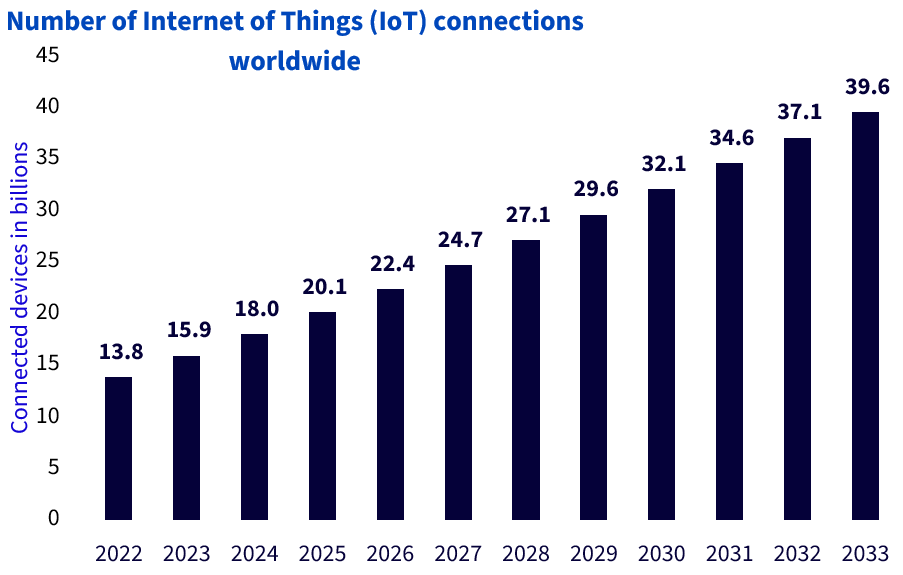
Source: Statista, in cooperation with Transforma Insights, June 2024. Forecasts from 2024 onwards. Forecasts are not an indicator of future performance and any investments are subject to risks and uncertainties.
Apple’s "Apple Intelligence" announcement in June 2024 exemplifies this trend, positioning the company as a leader in integrating AI into daily life. Android phones are doing the same. From wearables to vehicles, AI will increasingly power the devices around us, changing the way we interact with technology.
Investors must constantly reevaluate which companies can be classified as AI stocks and where they fit within the AI value chain.
4. In some cases, David will beat Goliath
OpenAI’s launch of ChatGPT in 2022 caught the tech giants off guard, demonstrating that smaller, more agile companies can lead in AI innovation. According to Bessemer Venture Partners, foundational AI models are the "new oil," with startups like OpenAI capturing a significant share of venture capital funding in AI.
In public markets, smaller companies have the potential to outmanoeuvre larger rivals, either becoming acquisition targets or growing independently. As supportive monetary policies come into play, these companies could see significant growth.
For investors, this means that in the pursuit of gaining exposure to the giants, they must not overlook the smaller players that may be in the earlier stages of the hype cycle but have immense potential.
5. Demand for clean, well-distributed energy will rise
The surge in AI applications is driving unprecedented demand for data centres, which in turn require vast amounts of energy. Amazon’s $150 billion investment in data centres over the next 15 years underscores this trend. By 2030, AI is expected to increase data centre power demand by 160% (see figure below).
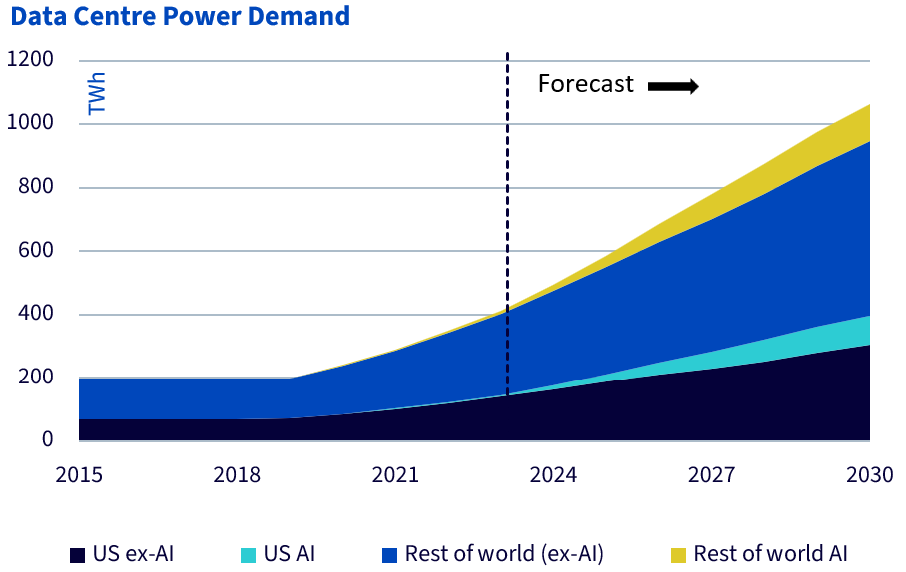
Source: Masanet et al. (2020), Cisco, IEA, Goldman Sachs Research, June 2024. Forecasts are not an indicator of future performance and any investments are subject to risks and uncertainties.
As tech companies rush to secure energy sources, renewables like solar and wind will play a crucial role in powering the AI revolution. For investors, this trend highlights the growing importance of renewable energy providers as a sector that benefits from AI growth.
6. AI’s impact across industries will be better appreciated
AI is set to revolutionise every industry, but the pace and scale of this impact remain uncertain. The biotechnology sector, for instance, could see more frequent breakthroughs as AI accelerates drug discovery processes. Eli Lilly’s partnership with OpenAI is just one example of how AI can transform traditional industries.
Investors should be on the lookout for sectors where AI’s potential has yet to be recognised, as these could offer substantial opportunities.
7. Cybersecurity will assume a broader role in society
As AI becomes more integrated into our lives, cybersecurity will evolve from defending against traditional threats to protecting against new challenges, such as deepfakes. A recent study by Google DeepMind found that shaping public opinion was the most common goal for exploiting AI tools, highlighting the need for robust cybersecurity measures.
For investors, cybersecurity offers an alternative way to access the AI revolution. As the digital landscape becomes more complex, the demand for advanced cybersecurity solutions will only grow.
Conclusion
While the future of AI is filled with promise, it is not without risks. Regulation, trade policies, and geopolitical dynamics will all influence the trajectory of AI development. However, progress is inevitable. Just as we once said, "There's an app for that," we will soon say, "There's an AI for that." Embracing AI is no longer optional – it’s essential for staying ahead in a rapidly changing world.
As AI continues to evolve, so too must our approach to investing. Exciting times lie ahead.
The full outlook can be viewed here.
Source
1 Please see the WisdomTree website for a full description of the three categories.





 Previous Post
 All Posts