




 Print Page
Solana’s advantage: institutional liquidity with structural volatility


Key Takeaways
- As bitcoin matures into a macro-driven institutional asset with nearly 20% of supply now held by exchange-traded products (ETPs), corporates and governments, Solana is emerging as one of the few digital assets still combining deep liquidity with structurally elevated volatility.
- Solana’s highly reflexive ecosystem, driven by rapid innovation, strong retail participation and catalysts such as the proposed Alpenglow upgrade, is creating fertile conditions for momentum, derivatives and quantitative trading strategies.
- With roughly $5.9bn in average daily trading volume and deep perpetual futures liquidity across Binance, Bybit and Hyperliquid, Solana is increasingly emerging as a “middle ground” for institutions, combining scalable execution with active trading opportunities.
As bitcoin matures into a more institutionally owned and macro-sensitive asset, some of the volatility that once defined it is gradually compressing. For investors, that creates a new challenge: finding assets liquid enough to absorb meaningful capital, but still dynamic enough to generate repeatable trading opportunities.
Solana increasingly appears to sit in that gap.
The “middle ground” matters
For institutional investors, volatility on its own is not enough.
An asset may experience large price swings, but if trading volumes are thin, derivatives markets are immature or order books deteriorate during stress events, deploying capital efficiently becomes difficult. Large trades can materially move the market, reducing the attractiveness of the opportunity itself.
At the opposite end of the spectrum, highly liquid assets with declining volatility can become increasingly efficient markets, limiting opportunities for active positioning and alpha generation.
The most attractive trading environments often emerge in the middle:
- Liquid enough for large-scale execution
- Volatile enough to sustain active trading strategies
- Mature enough to support institutional infrastructure
- Early enough to retain strong reflexivity
- In crypto, very few assets currently offer that combination.
Figure 1: Solana combines high liquidity with elevated volatility

Source: Artemis Terminal, WisdomTree. 13 May 2025 – 13 May 2026. Historical performance is not an indication of future performance, and any investment may go down in value.
Bitcoin increasingly behaves like a macro asset. The expansion of physical bitcoin exchange-traded products (ETPs), institutional ownership, corporate treasury allocations and even sovereign participation is steadily reshaping its market structure. This is because institutional adoption changes how assets trade: volatility gradually compresses and macroeconomic sensitivity increases.
Bitcoin increasingly reflects those dynamics, while Solana has not reached that stage yet.
Solana still exhibits strong market reflexivity
One of Solana’s defining characteristics is that its ecosystem remains highly reflexive.
In crypto markets, flows often reinforce narratives, and narratives then attract additional flows. That feedback loop can accelerate adoption, liquidity and price momentum simultaneously.
Solana continues to exhibit many of the characteristics that support this dynamic:
- Strong retail participation
- Rapid ecosystem experimentation
- Fast-moving capital rotation
- Comparatively early institutional penetration
Importantly, reflexivity in crypto is not simply speculation. It is often the mechanism through which networks scale adoption and liquidity.
For investors, that creates an environment where momentum can emerge rapidly, correlations can shift quickly and trading opportunities remain abundant. That is particularly attractive for:
- Quantitative trading firms
- Momentum-driven strategies
- Derivatives desks
- Arbitrage funds
- Volatility-focused investors
In many of these strategies, volatility itself can become an important driver of trading activity and market participation.
Solana’s ecosystem continues to generate tradeable catalysts
Another reason institutional participation around Solana continues to grow is the speed of innovation within its ecosystem.
The network has evolved into one of crypto’s fastest-moving development environments, creating a constant stream of catalysts capable of driving trading activity and volatility. The latest example is Alpenglow, a proposed upgrade to Solana’s consensus architecture designed to materially reduce transaction finality times and improve network responsiveness.
If implemented successfully, Alpenglow could further strengthen Solana’s positioning across:
- Trading infrastructure
- Payments
- Tokenised assets
- Real-world financial applications
That matters because markets tend to reward ecosystems where innovation, liquidity and capital flows reinforce each other.
Liquidity remains the key institutional filter
Liquidity remains one of the most underestimated variables in crypto investing.
Institutional capital cannot scale efficiently into markets where:
- Slippage becomes excessive
- Order books thin out during volatility
- Derivatives infrastructure remains immature
- Execution quality deteriorates under stress
This is where Solana increasingly differentiates itself. Its spot liquidity is broadly distributed across major exchanges, while perpetual futures markets have matured significantly across venues such as Binance, Bybit and Hyperliquid.
Figure 2: Solana’s perpetual futures market is deep
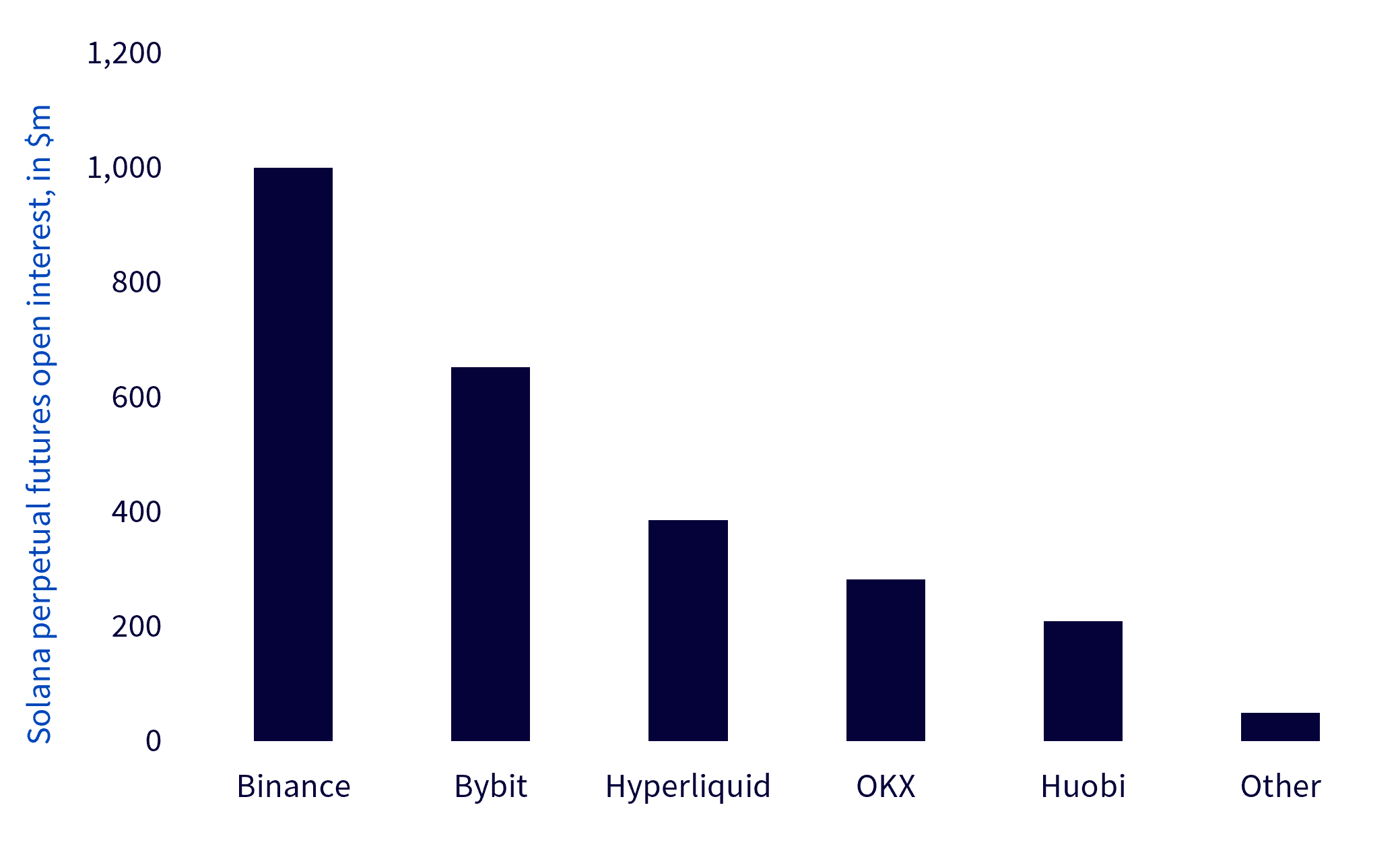
Source: Coinalyze. 15 May 2026. Historical performance is not an indication of future performance, and any investment may go down in value.
Beyond perpetual futures, CME also now offers Solana futures and options. The expansion of regulated trading infrastructure materially broadens the range of institutional strategies that can be deployed around the asset.
That evolution increasingly positions Solana as institutionally accessible, rather than purely speculative.
As bitcoin matures, active crypto risk may migrate elsewhere
Bitcoin remains crypto’s dominant institutional asset. However, its growing institutionalisation may also gradually reduce the structural inefficiencies that historically created outsized trading opportunities.
Figure 3: As institutional ownership rises, bitcoin behaves more like a macro asset

Source: Bitcoin Treasuries, Artemis Terminal. 12 May 2026. Bitcoin total supply is 21,000,000. Historical performance is not an indication of future performance, and any investment may go down in value.
That does not weaken bitcoin’s long-term investment case, but it may increasingly change bitcoin’s role within portfolios: from a high-volatility emerging asset toward an institutional macro asset.
If that transition continues, some active crypto capital may increasingly migrate toward assets that still retain stronger reflexivity and volatility dynamics. Solana increasingly appears to be one of the clearest candidates.
Final thought
Some of the strongest market opportunities emerge during the phase when an asset becomes mature enough for institutional participation, but still early enough for volatility, innovation and adoption dynamics to remain powerful.
Digital assets, including Solana, are highly speculative and involve a high degree of risk. Prices may experience extreme volatility and liquidity conditions can deteriorate rapidly during periods of market stress. Investments may also be exposed to regulatory uncertainty, technological vulnerabilities, network disruptions, counterparty risk and evolving market structure risks. Exposure to derivatives markets may amplify gains and losses. Investors should carefully consider the risks associated with digital assets before investing, including the possibility of partial or total capital loss.




 Previous Post
 All Posts