




 Print Page
Governments are moving from regulator to participant in critical minerals


Key Takeaways
- Governments are moving from regulator to participant, using capital, price support and offtake to shape critical mineral markets.
- The benefit extends across the value chain, including refining, conversion and other downstream bottlenecks, not just miners.
- Rare earths are the clearest example, but the tailwind is spreading across broader critical minerals such as lithium and copper.
- Policy support improves bankability and project economics, making more strategic assets investable.
In the 1980s, when the United States competed with Japan in semiconductors, policy became part of the market. Today, that instinct has returned, but this time one of the clearest battlegrounds is critical minerals. Governments are no longer treating rare earths, lithium, copper and other strategic materials as ordinary commodities. They increasingly view them as inputs that underpin defence, industrial resilience and advanced manufacturing.
Governments are moving from regulator to participant in critical minerals. They are not only setting policy, but are also providing capital, shaping prices and helping build supply chains. The result is a more supportive backdrop for the broader critical minerals sector. Rare earths are the clearest example, but the direction of travel extends well beyond one niche market.
US: from funding projects to shaping markets
The U.S. approach to critical minerals is becoming more direct and more interventionist. Washington is increasingly using tools that shape how projects are financed, how prices are formed and how supply is secured. That broader instinct can also be seen in other strategic sectors, from support for semiconductor manufacturing to stronger government influence in the steel industry. In critical minerals, however, the shift is especially visible because the toolkit now reaches well beyond funding into market design.
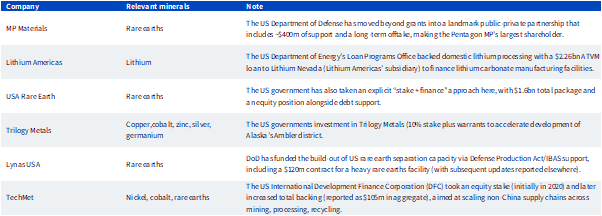
First, the government is taking stakes, not just providing financing. MP Materials is the best example. The Department of Defence agreed to invest around $400 million in preferred equity, alongside a $150 million loan, in a deal that could make the Pentagon the company’s largest shareholder.1 Lithium Americas also illustrates the shift. When the U.S. Department of Energy restructured its support for the Thacker Pass lithium project, it did not simply lend. It also received warrants at both the company and joint-venture level. USA Rare Earth points in the same direction, with a proposed package combining direct funding, shares and warrants.
Second, the U.S. is moving beyond project finance and into price support. Again, MP Materials is the clearest case. The agreement includes a 10-year floor price of $1102 per kilogram for Neodymium-Praseodymium (NdPr). This does not just reduce funding risk, it also changes the project’s economic profile. A floor price offers protection against the kind of pricing pressure that has often made it difficult to compete with Chinese producers.
Third, policy is being used to support demand as well as supply. MP’s package also includes a 10-year offtake structure designed to ensure that output from its future magnet facility is placed with defence and commercial customers. This matters because many critical mineral projects do not fail on geology or technology. They fail because commercial bankability is weak, downstream demand is uncertain, or customers are reluctant to commit. Policy-backed offtake helps solve that problem.
Finally, the U.S. is no longer thinking only about mines. It is thinking about supply chains. The strategic goal is increasingly mine to product, or more broadly, from extraction through processing to advanced manufacturing inputs. That is why so much attention is now being directed not just at mining, but at refining, conversion, magnet production and recycling. In other words, the U.S. is moving from supporting projects to shaping markets.
Figure 1: US plans more stakes in minerals companies
Source: MP Materials, AP News, TechMet, US Department of Energy, Congressional Research Service, WisdomTree as of 31 December 2025. Historical performance is not an indication of future performance, and any investments may go down in value.
Japan and Europe: different tools, but the same strategic logic
The U.S. may be the most aggressive current example, but it is not alone.
Japan’s role is also becoming more important, both on its own and in partnership with allies. First, it uses allied policy coordination to widen the pipeline of viable projects. In October 2025, the United States and Japan signed a framework to secure critical minerals and rare earths through mining and processing, with an emphasis on coordinated investment, financial support and potential stockpiling. Second, it uses long-term contracts with key producers to translate policy into commercial reality. The March 2026 Lynas-Japan agreement extends supply to 2038, sets a floor price for NdPr, and secures heavy rare earth supply for Japanese industry.3
Europe is using a different toolkit again. Rather than taking visible stakes in companies, the European Union is building a system around project designation, financing support and industrial coordination. Under the Critical Raw Materials Act, the EU designated 47 strategic projects inside the bloc and 13 outside it,4 while the European Investment Bank adopted a critical raw materials initiative with expected financing of €2 billion5 in 2025. Europe is less direct than the U.S., but the message is similar: governments are taking a more active role in shaping critical mineral supply chains.
What this means for sectors and investors
Government support is improving project economics across critical minerals. Funding support and price protection reduce risk, improve bankability and make it easier for capital to back strategic assets. That matters because many projects have historically struggled not on resource quality, but on financing and commercial visibility.
The benefits also extend across the value chain, not just to miners. Governments are trying to diversify supply chains, not simply increase raw material output. That means refining, conversion and other downstream bottlenecks should also benefit, because these are often the hardest parts of the chain to build outside China and the parts that matter most for supply security.
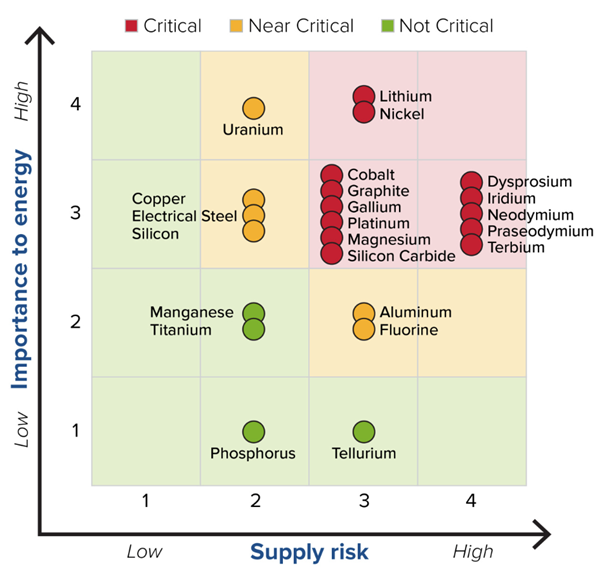
In addition, the tailwind extends beyond rare earths. Rare earths remain the clearest example, but the same logic increasingly applies to lithium, nickel, copper, gallium and other critical minerals tied to defence, semiconductors and electrification. The opportunity is therefore broader than one niche market.
Figure 2: US Medium-term (2025–2035) criticality matrix
Source: US Department of Energy. Forecasts are not an indicator of future performance, and any investments are subject to risks and uncertainties.
Conclusion
Governments are becoming more active participants across critical minerals, and that is creating a structural tailwind for the sector. Rare earths offer the clearest example today, but the broader critical minerals complex should also benefit. For investors, the opportunity is not only in the minerals themselves, but in the parts of the value chain that stand to benefit most from this new era of strategic industrial policy.
While government support may improve project economics, critical minerals markets remain subject to volatility, policy uncertainty and execution risk. Changes in geopolitical conditions, commodity prices or policy priorities could affect project viability and market outcomes.
Investing in the opportunity with WisdomTree
WisdomTree Strategic Metals and Rare Earths Miners UCITS ETF (RARE) provides diversified, yet targeted access to the value chain of metals and rare earth elements (through miners) that are required for an increasingly energy hungry world.
WisdomTree Strategic Metals UCITS ETF (WENU) provides refined exposure to a diversified basket of essential metals needed for electrification, energy security, decarbonisation and digital infrastructure.
1. MP Materials, company press.
2. MP Materials, company press.
3. Australia's Lynas revamps deal to supply rare earths to Japan
4. Commission selects 47 Strategic Projects to secure and diversify access to raw materials in the EU
5. EIB steps up financing for European security and defence and critical raw materials







 Previous Post
 All Posts