




 Print Page
The future is Quantum: Unlocking decades of innovation through quantum computing


Key Takeaways
- Quantum computing represents a paradigm shift in computation, harnessing the very principles of quantum mechanics that govern the physical world.
- Unlike classical computers, which cannot tackle exponential complexity, quantum systems can address challenges once thought unsolvable, opening the door to breakthroughs in healthcare and energy, to finance, logistics, and cybersecurity.
- Quantum computers are poised to solve some of the most pressing challenges of our time, from accelerating drug discovery to enabling sustainable energy solutions, lowering the carbon footprint, and improving climate models that guide global policy.
- Artificial intelligence (AI) and quantum computing form a powerful innovation cycle, with AI helping advance quantum research and quantum poised to supercharge AI with its novel approach to computation.
- Quantum computing has the potential to unlock waves of innovation and drive economic growth, which is why its progress is decisively evolving from a scientific pursuit into a global priority.
A century after quantum theory first rewrote the rules of physics, it now stands at the precipice of rewriting the rules of technology and industry, with the world gradually waking up to a computing revolution decades in the making. From its origins in the early 20th century to the United Nations’ decision to mark 2025 as the International Year of Quantum Science and Technology, quantum science has evolved from abstract theory to the next technological frontier. What began as radical ideas about the very fabric of reality is now taking shape as a computing paradigm capable of tackling problems once thought unsolvable. With recent technological breakthroughs showing steady progress in the field and leading companies unveiling ambitious roadmaps toward fully fault-tolerant quantum computers, the conversation has shifted from if quantum will matter to where its impact will be felt first.
Why quantum computing will be a game-changer for certain industries
What makes quantum computing a true game-changer in certain areas is that the physical world around us is governed by the laws of quantum mechanics, and as Richard Feynman famously said, “if you want to simulate nature, you’d better make it quantum mechanical.” Here, even the most advanced supercomputers quickly hit a wall as complexity grows – for example, modelling the behaviour of a molecule, where the number of possible interactions scales exponentially. The brute-force approach that classical computing uses inevitably runs into limits, leaving various problems beyond its reach. Quantum computers, by contrast, operate according to the same quantum rules as the universe itself. This alignment uniquely positions them to simulate, predict, and ultimately unlock insights into some of the most complex problems.
This revolutionary leap in computation is made possible by a fundamentally different architecture, one that harnesses the principles of quantum mechanics such as superposition, entanglement, and interference. Through superposition, a qubit (the basic unit of quantum information) can exist in a weighted combination of 0 and 1 simultaneously, unlike a classical bit that must be one or the other. This allows a quantum computer to explore vast possibilities in parallel rather than step by step. Entanglement, in turn, enables qubits to share strong correlations, so that the state of one is intrinsically linked to the state of another, even when separated by great distances. Interference adds yet another layer of power, allowing quantum systems to amplify the most promising computational paths while suppressing less useful ones, an effect familiar from the famous double-slit experiment, which revealed the wave-like nature of quantum particles.
Together, these properties form the foundation for quantum computers to excel in areas where complexity grows exponentially, in domains where classical brute force is not just inefficient, but fundamentally inadequate. Drug discovery and materials science stand at the forefront, as quantum systems can simulate molecular interactions with a precision that no supercomputer can match. But beyond simulating the behaviour of molecules and materials, quantum computers are also poised to tackle problems where data dimensionality and complexity defeat classical approaches.
Figure 1. Estimated economic value of quantum computing across selected domains in the next 5 to 10 years
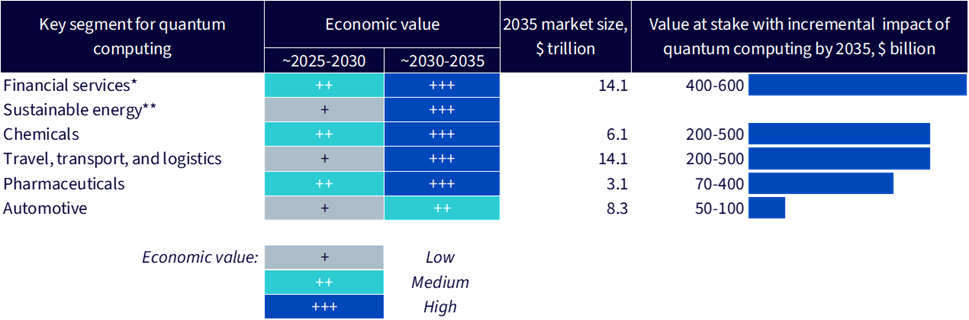
Source: McKinsey & Co, “Quantum Technology Monitor”, April 2024. *Quantum computing technologies and industry is immature and has high uncertainty for viability and value of use cases. Business-value estimates are preliminary and intended to guide research toward high-value-potential areas, not as definitive projections for business value. Insurance is not included. **Sustainable energy market is expected to grow rapidly from 2022–2035; however, the 2035 market size is influenced by numerous factors and challenging to predict. Forecasts are not an indicator of future performance, and any investments are subject to risks and uncertainties.
Finance is a prime example where the ability to evaluate countless market scenarios simultaneously could transform portfolio optimisation and risk analysis. According to McKinsey & Co., financial services may hold the largest near-term value at stake, with significant impact expected within the next five to ten years (see Figure 1). Logistics and supply chain management offer another compelling case, where quantum algorithms could sift through billions of routes, schedules, and constraints to identify near-optimal solutions in real time.
Yet, with all the enthusiasm surrounding the field, quantum computing must still overcome formidable challenges before it can deliver widespread utility. Moving from today’s noisy prototypes with dozens or hundreds of qubits to fault-tolerant machines with millions is one of the greatest engineering undertakings of our time. Today's breakthroughs are important stepping stones on that journey to a full quantum era. In the meantime, hybrid quantum-classical approaches can already be leveraged to deliver meaningful value (see Figure 2), allowing organisations to experiment and build capabilities without waiting for perfect hardware. And once scalable quantum machines are realised, the impact is poised to reshape many aspects of daily life that are silently powered by complex calculations, standing to benefit from a true paradigm shift in computing.
Figure 2. Bridging the gap to fault-tolerant quantum computing: Hybrid quantum-classical architecture
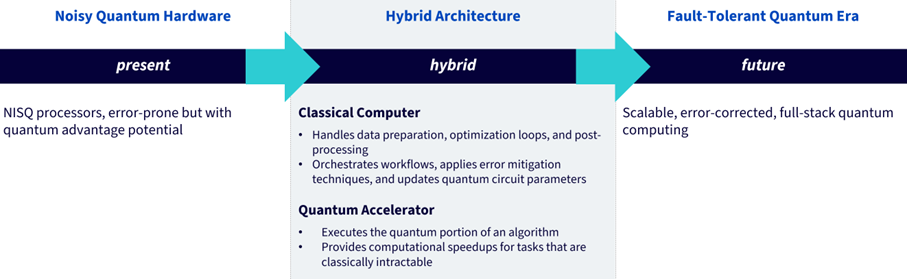
Source: WisdomTree. NISQ refers to the current stage of quantum computing, defined by the term Noisy Intermediate-Scale Quantum (NISQ), introduced by physicist John Preskill in 2018.
The technology to solve the most pressing challenges of our time
The promise of quantum computing to solve previously intractable problems due to their sheer complexity is nowhere more consequential than in the grand challenges humanity faces today. From curing diseases to mitigating climate change, many of our most urgent problems are, at their core, computational.
Take drug discovery. Developing a new medicine can take more than a decade and cost billions of dollars, mainly because accurately simulating how potential compounds interact with biological systems is not something classical computers can deliver. Quantum computing has the potential to change this equation. By modelling molecular behaviour with unprecedented accuracy, fault-tolerant quantum systems could dramatically accelerate the search for new treatments, lower development costs, and even unlock therapies for untreatable diseases. According to a recent paper from the National Quantum Computing Centre (NQCC), the UK’s national lab for quantum computing, researchers have already identified more than 40 potential use cases in healthcare – from drug discovery to diagnostics and early detection, personalised medicine, and even the efficient allocation of resources within healthcare systems.
Another domain where quantum computing could prove transformative is reducing humanity’s carbon footprint. This will require breakthroughs in materials science, from designing next-generation batteries for electric vehicles to creating more efficient catalysts for carbon capture and storage. Quantum computers, by their very design, should excel at this type of task. By simulating chemical reactions with high fidelity, they could accelerate the discovery of sustainable materials, enable more efficient renewable energy technologies, and ultimately improve complex climate models that guide global policy.
The growing wave of government investment and Big Tech commitment underscores quantum computing’s potential to shape the world of tomorrow. At the same time, the global focus on artificial intelligence opens a powerful avenue for synergy. AI can accelerate quantum research by improving error correction, hardware design, and algorithm development, while quantum computing, in turn, promises to supercharge AI by vastly expanding its computational reach. Together, this duo forms a feedback loop of innovation, one that could unlock breakthroughs across science, industry, and society. And perhaps most strikingly, some of the most transformative applications may be ones we cannot yet foresee, emerging from the cycle of innovations sparked as quantum computing and artificial intelligence push each other forward.
Conclusion
Once they become a reality, powerful quantum computers will not only open the gateway to decades of innovation but also have the potential to revitalise economic growth and redefine humanity’s technological trajectory. This is why progress in the field is no longer just a matter of scientific curiosity; it is decisively becoming a global priority.




 Previous Post
 All Posts