




 Print Page
Market crossroads: macro and earnings in focus


Key Takeaways
- Mixed economic data last week ended on a positive note, with labour market strength offering some optimism amid trade-related uncertainty
- Q1 earnings have been broadly strong, though CEO commentary signals growing caution
- AI-driven tech demand remains a bright spot; financials are holding up, while consumer discretionary shows strain as sentiment weakens
U.S. equity markets and the broader economy stand at a pivotal juncture. A mix of corporate earnings and economic data is revealing the early effects of tariffs, alongside signs of a more cautious consumer backdrop. Last week’s early economic reports and a steep decline in consumer confidence pointed to a cooling, but still stable economy amidst rising unease. Together, they set a measured tone as markets await further direction from the Federal Reserve and ongoing earnings results.
Economic recap
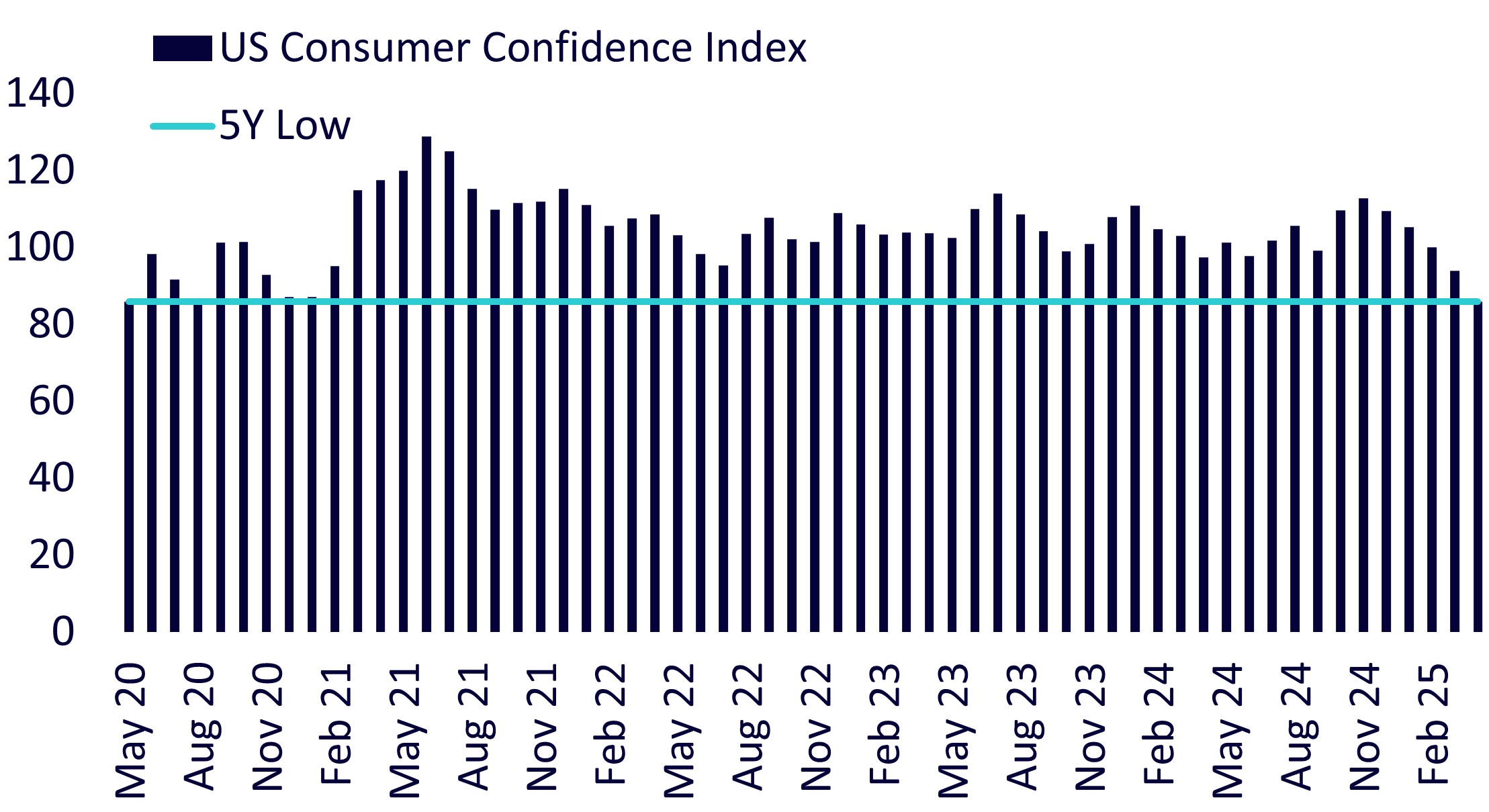
Last, Tuesday’s Job Openings and Labor Turnover Survey (JOLTS) showed job openings falling to 7.4 million-the lowest level since January 2021. This decline signalled weakening labour demand, as CEOs delay hiring and capital decisions amid growing uncertainty due to tariff policy. Consumer confidence also dropped to around 86, a five-year low, with inflation and job security cited as major concerns.
Figure 1: Consumer Confidence Index at a 5Y Low
Source: Bloomberg as of May 6, 2025. Historical performance is not an indication of future performance and any investments may go down.
While Personal Consumption Expenditures (PCE) inflation data remains broadly stable, the Federal Reserve (Fed) has flagged risks of persistent price pressures, particularly as tariff-driven costs begin to flow through the economy. Wednesday’s Q1 Gross Domestic Product (GDP) release revealed a contraction, in part due to a surge in imports as firms rushed to front-run the 90-day tariff pause.
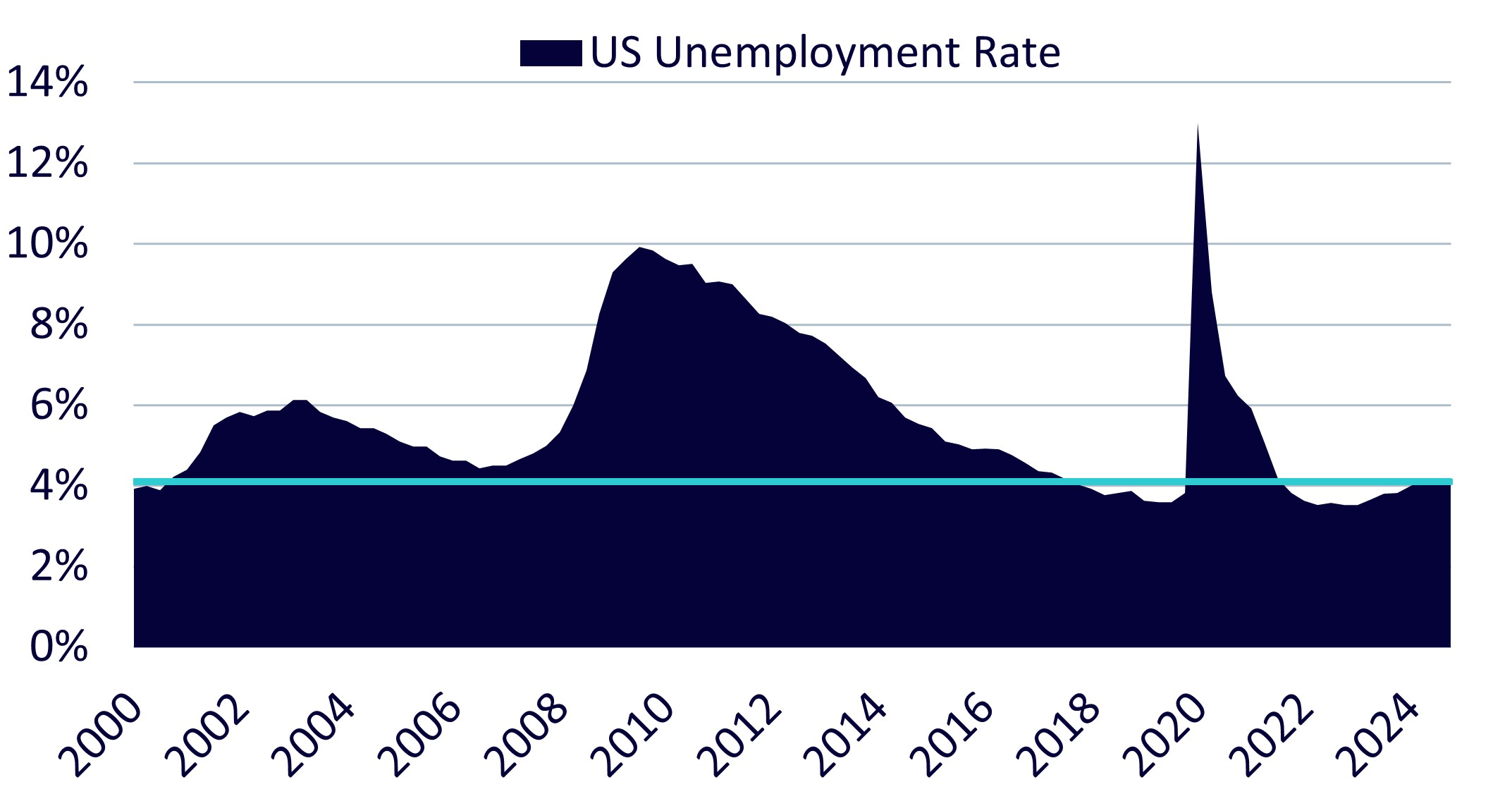
Figure 2: US Unemployment Remains Steady at 4.1%
Source: Bloomberg as of May 6, 2025. Historical performance is not an indication of future performance and any investments may go down.
Over 70% of S&P 500 companies have reported Q1 results, with 75% beating EPS estimates1. However, many have tempered forward guidance -or withdrawn it entirely -amid renewed uncertainty from tariff announcements and ongoing trade negotiations.
Consumer discretionary under pressure
The consumer discretionary sector appears particularly exposed to today’s macro environment. Starbucks missed earnings estimates due to weaker comparable store sales in the U.S.2, as low confidence and elevated prices crimp consumer spending. The company remains midstream in a cultural and operational overhaul aimed at re-engaging customers, which may have contributed to the weak performance.
In travel, Booking Holdings flagged the potential for softer global demand, driven by geopolitical tensions and a U.S. consumer that is more careful with spending3. This comes after airlines such as Delta and American have pulled back guidance earlier this month4, citing subdued demand linked to tariff impacts and weaker economic confidence. Broadly, households seem to be prioritizing essentials over discretionary purchases in the wake of the shifting economic environment.
Financials and payments show resilience
In contrast, financials and payments companies have shown resilience, remaining relatively insulated from tariff impacts. PayPal (PYPL) beat EPS estimates on the back of strong digital payment volumes, supported by profitability efforts, cost discipline, and innovation—including crypto offerings like PYUSD5 rewards and partnership with Coinbase6.
In banking, Deutsche Bank (DB) and Barclays both reported better-than-expected profits, benefiting from a strong growth in the investment banking segment7,8. Robinhood posted a beat as well, lifted by increased market volatility and revenues tied to trading activity9. JPMorgan also delivered strong results, driven by a 48% increase in equities trading revenue10.
The common thread across financials: payment activity remains strong, with innovation playing a key role - particularly in digital and crypto-enabled offerings. Investment banking seems to show some healthy momentum, and elevated market volatility is supporting trading-related earnings. Despite persistent macroeconomic and geopolitical risks, earnings within this group appear to be remaining stable.
Mega-cap tech: solid results, cautious outlooks
Earnings season for big tech revealed a mix of robust performance and cautious forward guidance. Three key themes emerged:
- Hyperscalers show strength, but AI demand outpaces supply: Microsoft led the way, with Azure accelerating to 35% YoY growth, fuelled by AI services contributing 16 percentage points. Management flagged capacity constraints, noting AI demand is growing faster than infrastructure can be brought online. Meta raised its CapEx guidance to $64-72B, also citing compute supply constraints as it ramps up AI infrastructure investment11. Amazon’s results also reflected continued acceleration in AI workload demand, with AWS growing 17% YoY to a $117B run rate. However, Amazon also raised concerns about the impacts of tariffs and the strength of the consumer given the nature of their business, widening their guidance range.
- China ties remain a drag for Apple and Qualcomm: Apple beat earnings expectations but incurred a $900 million hit from tariff-related costs12, underscoring its vulnerability to China-centric supply chain risks. Qualcomm also delivered strong results but faces rising competitive pressure from Chinese chipmakers, as well as potential geopolitical backlash as U.S.-China trade tensions escalate - a significant concern given its revenue dependence on the region. Both firms remain strategically entangled in an increasingly fraught geopolitical and regulatory environment.
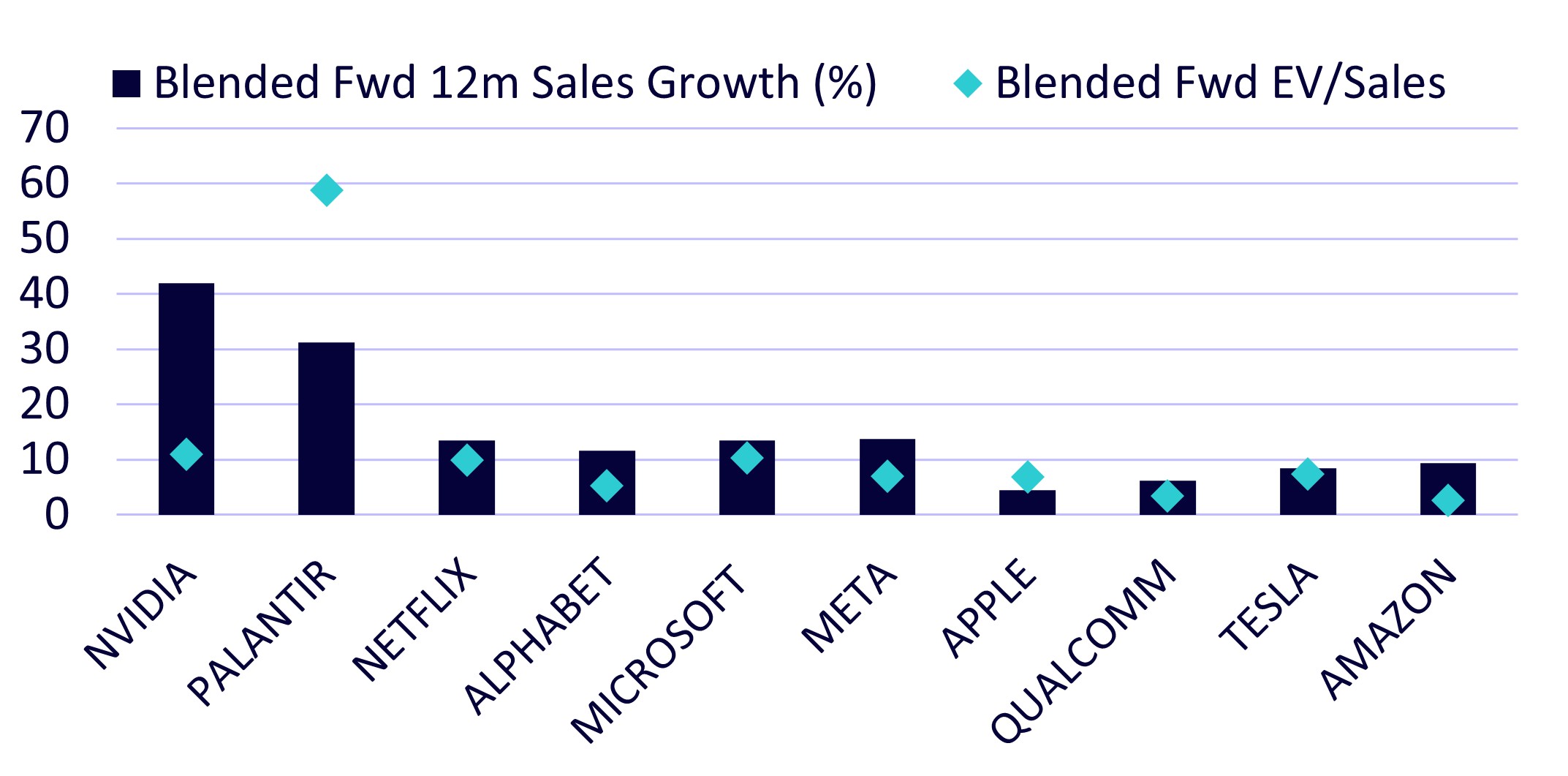
- Palantir’s growth is strong, but valuation still matters: Palantir reported 39% YoY revenue growth and raised full-year guidance to $3.8-3.9B13. However, with a forward Price to Earnings (P/E) of approximately 200 and EV/Sales near 59x14, the stock remains highly sensitive to sentiment. In a market growing more focused on fundamentals, valuation discipline is becoming increasingly important even for breakout names. This is particularly evident as shares sold off after the upbeat announcement.
Figure 3: Sales growth and valuation multiples for select tech names
Source: Bloomberg as of May 6, 2025. Historical performance is not an indication of future performance and any investments may go down.
Across the board, while big tech remains fundamentally strong and continues to lead the charge in AI and cloud, companies face a complex landscape of infrastructure bottlenecks, global trade uncertainties, and valuation risk. As AI reshapes industries, investors are not just chasing growth - they’re also reassessing how much they’re willing to pay for it. With valuations now well off their earlier-year highs following the market pullback, the current setup may present an opportunity - but as recent events have shown, conditions can shift quickly in today’s fluid macro and policy environment.
Conclusion
Despite the negative tone in recent headlines, the U.S. economy continues to show signs of resilience. Labor markets have yet to crack, earnings are broadly solid, and inflation, while persistent, remains manageable.
This week, the Federal Reserve announced its decision to maintain interest rates at 4.25–4.50%. In the press conference that followed, Chair Jerome Powell reiterated a cautious, data-dependent approach to future rate changes. The market for Fed funds futures now reflect a 20% probability of a cut in June15, though more convincing signs of economic weakness are needed before the Fed takes action.
With earnings mostly in and macro data sending mixed signals but hinting towards stability, many CEOs are holding back on capital plans while awaiting clarity on tariffs. Investors also appear to be in a holding pattern across much of equity land. Still, a few bright spots may help cushion some of the broader uncertainty.
1 Source: Factset Earnings Insight
2 Source: Starbucks Earnings Call, 29 April 2025
3 Source: Booking Holdings Earnings Call, 29 Apr 2025
4 Source: Delta Air Lines pulls financial forecast, saying Trump tariffs hit demand | Reuters
5 Source: Paypal USD Stablecoin
6 Source: Paypal Earnings Call, 29 April 2025
7 Source: Barclays Q1 earnings 2025
8 Source: Deutsche Bank (DBK) Q1 earnings 2025
9 Source: Robinhood Reports First Quarter 2025 Results | Wed, 04/30/2025 - 16:05
10 Source: JPMorgan profit beats estimates on record stock trading, CEO sees economic turbulence | Reuters
11 Source: Clouded Judgement 5.2.25 - Cloud Giants Report Q1 '25
12 Source: Apple says Trump’s tariffs will boost costs by $900mn in June quarter
13 Source: Palantir (PLTR) Q1 earnings report 2025
14 Source: Bloomberg, as of May 6, 2025
15 Source: CME Fedwatch - CME Group

 Previous Post
 All Posts