





 Print Page
What’s hot: CPUs Return to the AI Spotlight


Key Takeaways
- Evolving AI training needs more CPUs as reinforcement learning requires external environments to test, verify and score model outputs.
- AI agent inference is more CPU-intensive because agents involve planning, routing, retrieval, tool calls, execution and repeated workflow loops.
- Leading CPU players are showing early momentum, with Intel and AMD benefiting from renewed attention to data-centre CPU demand.
- The AI semiconductor landscape is still evolving, as bottlenecks shift across GPUs, memory, CPUs, networking and advanced packaging.
In 2025, Amazon, Alphabet, Meta and Microsoft planned to spend more than $300bn on AI infrastructure and data-centre build-outs. The broader hyperscaler capex cycle could reach around $700bn in 2026.1 The picks and shovels narrative remains intact: NVIDIA has continued to report record data-centre revenue, while memory-chip makers have gained strong momentum as AI demand tightens HBM and DRAM supply. More recently, CPUs have also started to stand out. The recent rally in AMD and Intel, the two leading CPU suppliers, suggests investors are beginning to reassess the role of CPUs in the AI infrastructure stack.
Figure 1: Hyperscalers’ capex since Q1 2020
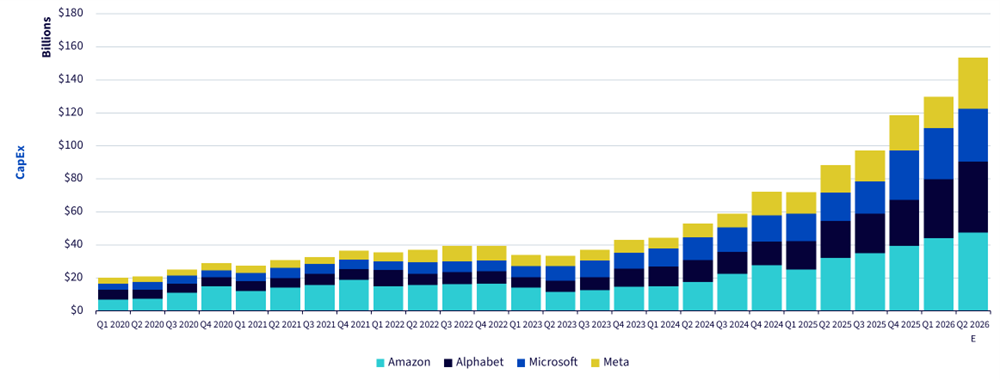
Source: WisdomTree, Bloomberg. As of 29 April 2026. Figures for Q2 2026 are averages of analysts’ estimates available on Bloomberg. Historical performance is not an indication of future performance and any investments may go down in value.
Figure 2: AMD and Intel outperformed Nvidia and broad semiconductor index
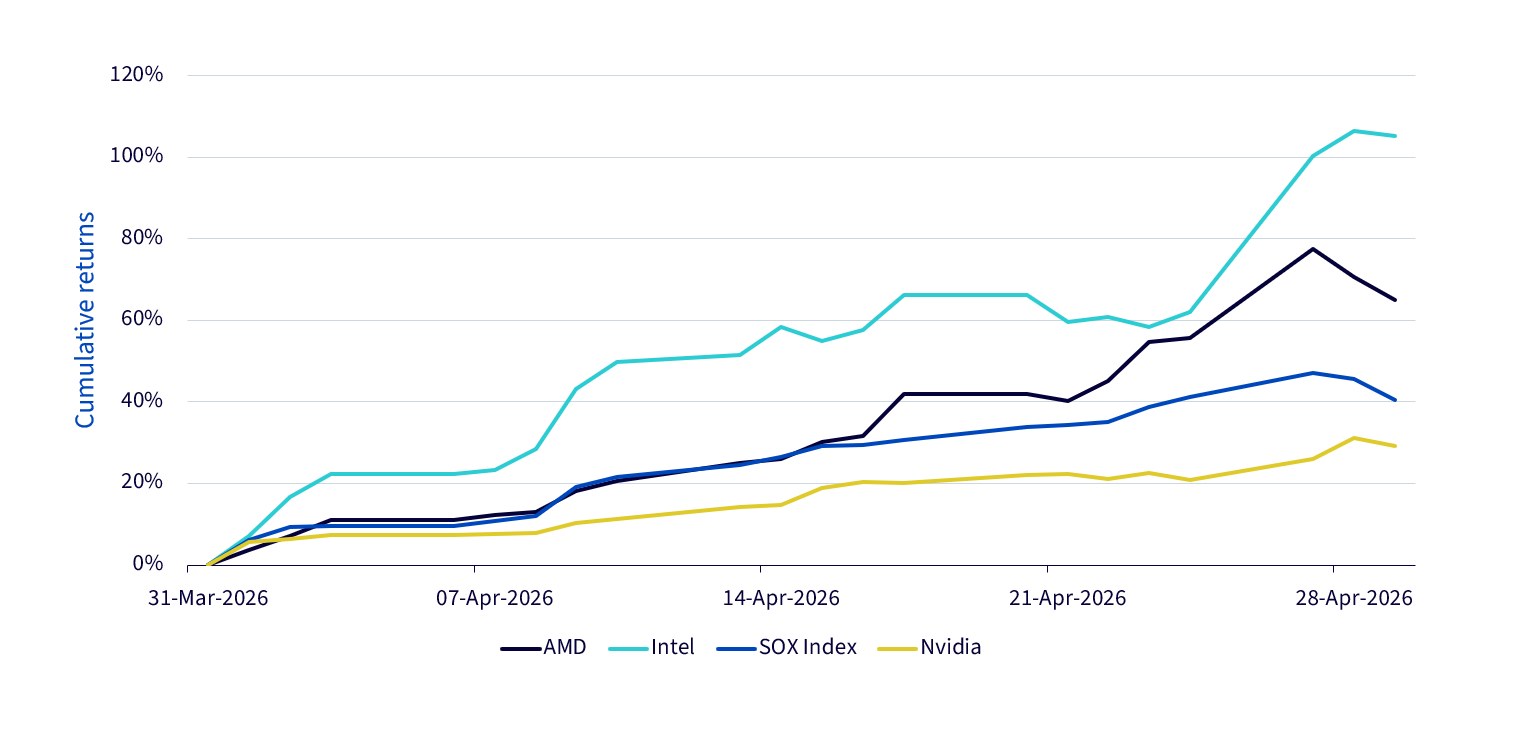
Source: WisdomTree, Bloomberg. From 31 March 2026 to 29 April 2026. SOX index denotes Philadelphia Stock Exchange Semiconductor Index. You cannot invest directly in an index. Historical performance is not an indication of future performance and any investments may go down in value.
AI Training Is Raising CPU Demand
The focus of generative AI was mostly on pre-training large models. That work is highly parallel and heavily dependent on matrix multiplication, which is why GPUs became the centre of the AI compute stack. However, CPUs remain important in AI model training. They help store, shard, index data that are fed into GPU clusters. As models become larger and datasets move into petabyte scale, this supporting layer becomes harder to ignore.
The CPU role becomes even more important when reinforcement learning (RL) is added to the training loop. RL helps models improve by rewarding better outputs and penalising weaker ones. In this process, AI models often generate actions on GPUs, while CPUs run the external environments that execute those actions, test and verify the outputs, and calculate rewards before feeding the results back into the GPU-driven training loop. As GPUs become more powerful, the CPU-side environment also needs to scale. If the CPU-side cannot keep up, expensive GPUs can sit idle while they wait for the next batch of work. A future GPU generation such as Rubin may require an even higher ratio of CPU to GPU power than 1:6 ratio.2
Agentic AI Makes Inference More CPU-Intensive
The CPU opportunity is even clearer on the inference side, especially as Agentic AI marks a structural shift from compute to orchestration.
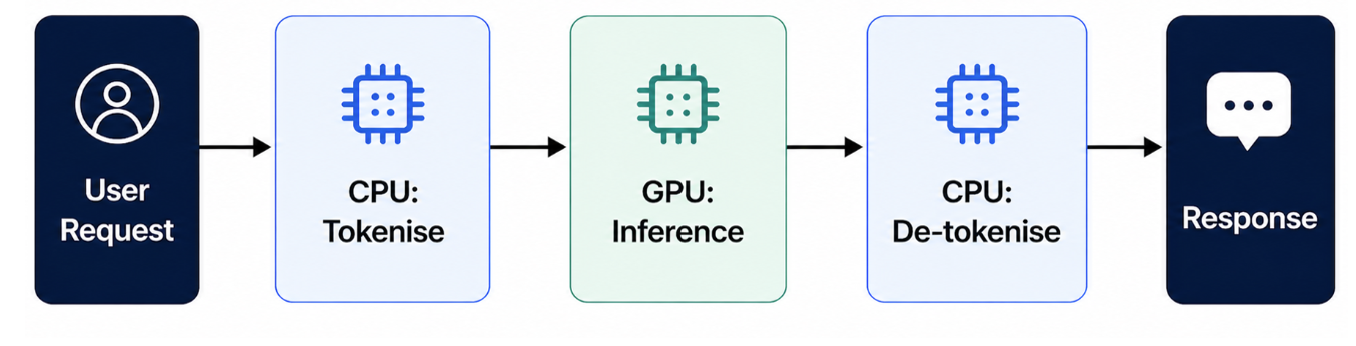
A simple chatbot may follow a relatively straightforward path: the CPU receives a request, the GPU runs the model, and the CPU returns the answer.
Figure 3: Chatbot inference workflow
Source: WisdomTree.
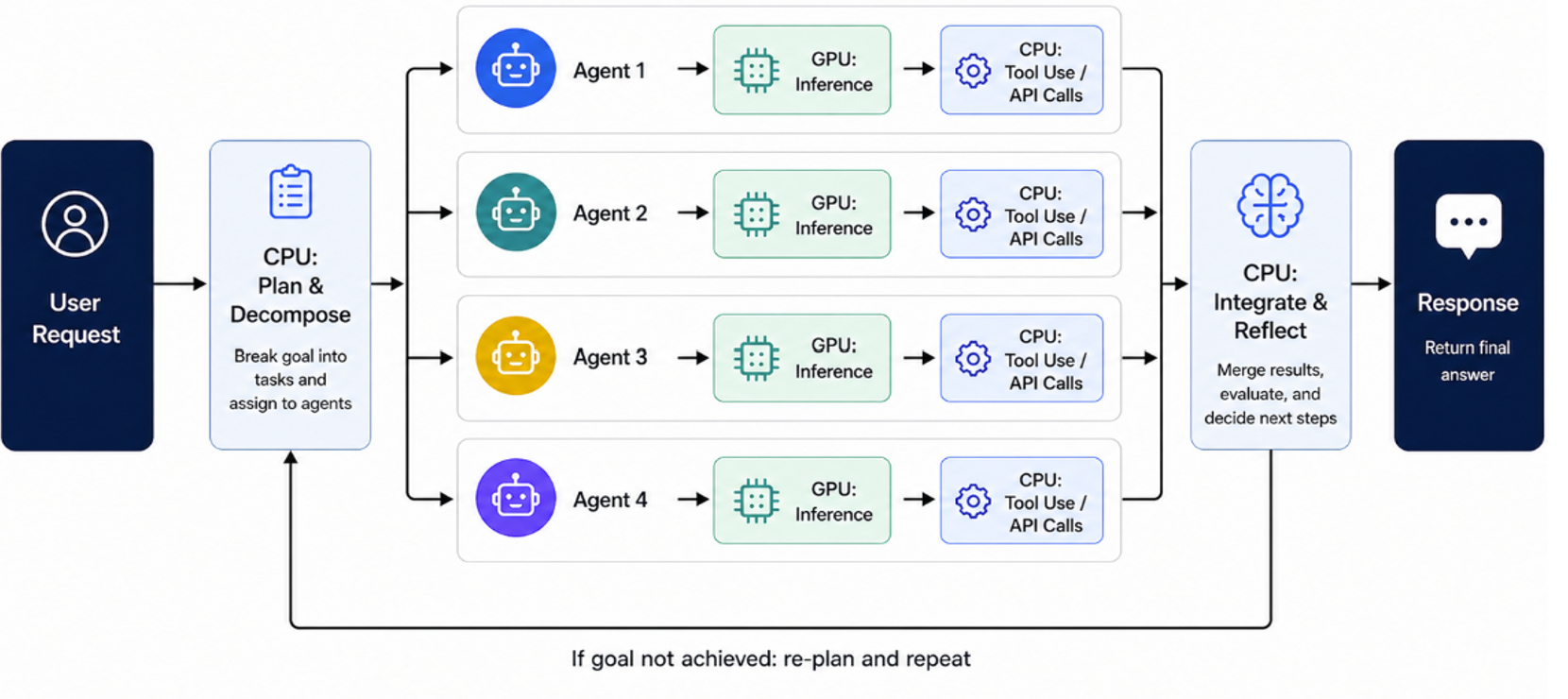
An AI agent is different. It can involve multiple steps: planning, routing, retrieving data, calling tools, checking outputs etc. Much of this workflow is not pure GPU computation. It is branch-heavy, latency-sensitive and closely tied to orchestration, APIs, execution etc. Those are generally better suited to CPUs rather GPUs. Repeated agent loops also increase the amount of CPU-side work per request. As workflows become more complex and involve more steps, CPUs may be increasingly needed to support AI inference at scale.
Figure 4: Agentic inference workflow
Source: WisdomTree.
That helps explain why CPUs are returning to the AI infrastructure debate. The more AI systems become agentic, the more compute is needed around the model, not just inside the model.
Evidence from leading players
Intel and AMD are the two dominant suppliers of x86 server CPUs, with Intel Xeon and AMD EPYC widely used across data centres. Their recent results suggest CPUs are starting to re-enter the AI infrastructure story.
Intel offers the clearest signal. Its data center and AI segment revenue rose 22% year on year in Q1 2026,3 and management said investments in CPUs are accelerating as AI evolves from foundational training to inference and agentic workloads. This suggests Intel may benefit not only from its manufacturing turnaround, but also from renewed CPU demand in the AI cycle.
AMD’s signal is also positive, although less pure. Its data centre segment revenue rose 39% year on year in Q4 2025,4 driven by strong demand for EPYC CPUs and the continued ramp of Instinct GPUs. This shows AMD is benefiting across the AI compute stack, but the CPU-only contribution is harder to isolate.
The competitive landscape of CPUs is still evolving
Intel and AMD dominate the x86 CPU market, but the AI-era CPU opportunity is not limited to x86. Hyperscalers are increasingly designing their own Arm-based CPUs to optimise cost, power efficiency and workload fit. AWS Graviton, Google Axion and Microsoft Cobalt are examples of this shift.
In addition, Nvidia’s Grace and Vera CPUs are also based on ARM and they are head-node CPUs which mean they are attached to GPU systems and tightly coupled to the accelerator platform to host GPUs.
The competitive landscape of CPUs is still evolving. Although AMD and Intel are in the leading position for now, others still may catch up.
Conclusion
AI infrastructure expansion is not just a GPU story. GPUs remain central, but as AI systems scale from model training to agentic deployment, the supporting semiconductor ecosystem becomes increasingly important. CPUs are one example of this shift, as reinforcement learning and agentic inference require more general-purpose compute to coordinate, test and support workloads around GPU clusters. This is raising demand across multiple layers of the chip value chain. For investors, a more diversified semiconductor strategy may better reflect how the AI ecosystem is developing.
What WisdomTree offers
The WisdomTree Artificial Intelligence UCITS ETF (WTAI) was launched in November 2018 and is developed in partnership with industry experts, the Consumer Technology Association (CTA).
Compared with its major peers, WTAI has a higher allocation to semiconductors and covers a broader range of semiconductor companies across the AI ecosystem, providing wider exposure to the chip value chain supporting AI infrastructure expansion.
Figure 5: Semiconductors exposure comparison: WTAI vs Major European AI ETFs
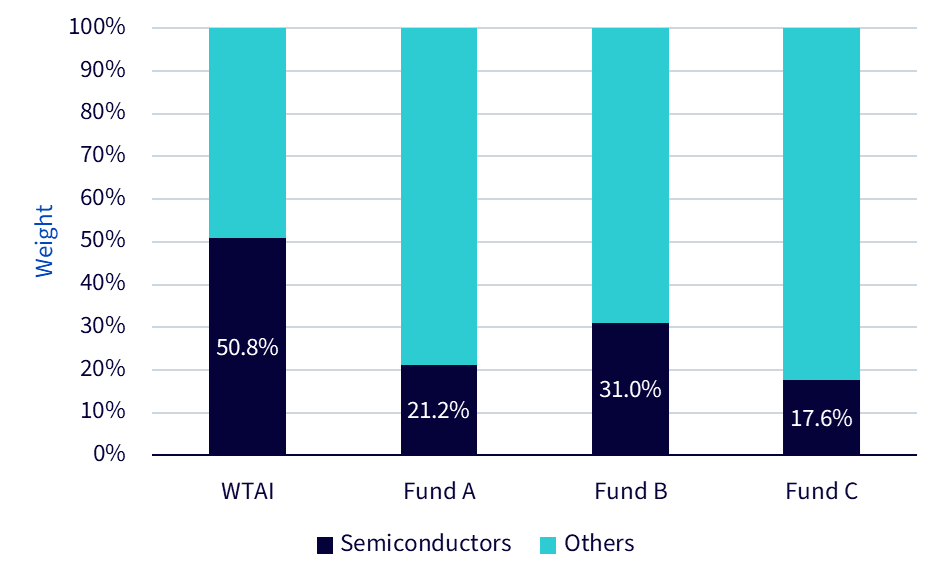
Source: WisdomTree, Bloomberg. As of 29 April 2026. Semiconductor exposure is represented by weights allocated in GICS industry group “Semiconductors & Semiconductor Equipment”. Fund A, B, C are the AI Themed ETFs domiciled in Europe (AUM > $1bn, as of 29/04/2026). GICS is the Global Industry Classification Standard. Historical performance is not an indication of future performance and any investments may go down in value.
1Source: Bloomberg: US Big Tech Ratchets Up AI Spending Past $700 Billion This Year
2SemiAnalysis
3Nasdaq: Intel Reports First-Quarter 2026 Financial Results
4AMD: AMD Reports Fourth Quarter and Full Year 2025 Financial Results





 Previous Post
 All Posts