





 Print Page
5 silent winners that quietly outpaced the market


Key Takeaways
- WisdomTree Europe Equity Income UCITS ETF (EEI): Benefited from Europe’s value rotation, high dividend yield and limited US exposure.
- WisdomTree Quantum Computing UCITS ETF (WQTM): Gained from increasing interest following technical breakthroughs, institutional backing and a Nobel Prize.
- WisdomTree Battery Solutions UCITS ETF (VOLT): Rose on progress in solid-state battery development as well as increasing energy demand due to artificial intelligence (AI).
- WisdomTree Renewable Energy UCITS ETF (WRNW): Advanced with strong demand from data centres and growth in solar and hydrogen technologies.
- WisdomTree Coffee (COFF): Rallied on weather disruptions, tariff shifts, and declining inventories before stabilising later in the year.
Markets have offered no shortage of success stories in 2025. A wide range of assets have delivered solid performance, and some of the standout winners have already dominated headlines and market commentary (see our recap on some of those here). But not every winner has been in the spotlight.
Beyond the most talked-about themes, several assets have quietly generated impressive returns. In this blog, we highlight five exchange-traded funds (ETFs) that have performed well in 2025 and may have gone unnoticed.
Source: WisdomTree, Bloomberg. 31/12/2024 to 09/12/2025 for all fund except WQTM. *27/08/2025 to 09/12/2025 for WisdomTree Quantum Computing UCITS ETF (after the inception date of the fund). Performance is in USD for all except EEI which is in EUR. Historical performance is not an indication of future performance and any investments may go down in value.
Europe’s 2025 upswing: why value led the charge
European equities posted a strong performance in 2025, driven by three key pillars: policy support, earnings resilience and compelling valuations. By H1 2025, eight of the world’s best-performing bourses were European, a reminder that breadth, not just a handful of mega caps, drove returns. Germany’s multi-year infrastructure and defence push improved visibility on capital spending, while the European Central Bank’s (ECB) front-loaded cuts in H1 2025 kept financial conditions supportive. The US-EU tariff framework reduced tail risk and allowed investors to re-rate export-exposed franchise on more predictable margins. Overlay a still-wide valuation discount to the US and a healthy dividend yield.
Value sectors were prime beneficiaries. Banks benefited from a re-steepening yield curve, robust asset quality and renewed buyback capacity. Defence and capital goods stocks benefited from higher order books tied to re-armament, grid upgrades and industrial automation. Utilities added a ballast with regulated cash flows. The WisdomTree Europe Equity Income UCITS ETF captured this shift. Its dividend-weighted approach tilted naturally to banks, defence-linked industrials and utilities. With low US revenue exposure and a forward dividend yield above 5%, EEI outpaced Euro Stoxx Europe 600 Index (Ticker’s Index) by 9.11%, delivering stronger carry and resilience1.
What many missed in 2025 wasn’t Europe’s catch-up but a regime shift rewarding balance-sheet strength, dividend durability and operational leverage, attributes concentrated in Europe’s value cohort.
A Nobel Prize and a breakout year: Quantum’s inflection point
Quantum computing is nearing an inflection point as breakthroughs, corporate commitment and government support begin to align. Google’s December 2024 breakthrough in below-threshold error correction catalysed the space by demonstrating, for the first time, that quantum errors can be systematically suppressed as systems scale, a long-viewed essential prerequisite for achieving practical fault tolerance. This milestone reset expectations for the field and was followed by Amazon and Microsoft clearly signalling their quantum ambitions in early 2025. Updated roadmaps from IBM, IonQ and leading private players now outline credible paths to powerful fault-tolerant machines by the end of the decade and early 2030s. These plans are backed by tangible engineering progress: IonQ achieved 99.99% fidelity, while IBM unveiled its Nighthawk and Loon processors, with the latter integrating core fault-tolerant components required for powerful quantum machines. The Nobel Prize in physics was awarded to researchers who laid the foundations of quantum computing, further reinforcing the field’s scientific credibility.
Momentum is broadening across the ecosystem. Nvidia strengthened its commitment with the NVQlink release, complementing its CUDA-Q platform, and strategic investments in multiple private start-ups. Large private funding rounds, the planned SPAC listings of Infleqtion and Xanadu, and new government programmes such as the US Tech Prosperity Deals all highlight rising strategic relevance. Global awareness has also increased through Q-Day discussions, reinforced by a 2025 paper showing Shor’s algorithm could run on roughly 1 million physical qubits.
For investors, this creates a compelling frontier-tech opportunity that remained overlooked in 2025, when Defence, artificial intelligence (AI) and China Tech dominated thematic flows in Europe. Early adopters have already been rewarded. The WisdomTree Classiq Quantum Computing UCITS Index returned 78.44% between 30 April and 9 December, and 2025 also saw the launch of the first European quantum funds. With early enterprise pilots emerging, from pharma to finance, and continued momentum across private markets, big tech and government programmes, quantum computing is transitioning from a distant promise toward an investable commercial reality. The WisdomTree Quantum Computing UCITS ETF, launched on August 27 2025, offers balanced early exposure to this rapidly developing and transformative megatrend.
Battery technology is on the charge again
At the 2025 Internationale Automobil-Ausstellung Mobility Show, QuantumScape and PowerCo SE delivered the first real-world demonstration of an anode-free solid-state battery powering a vehicle. This was a modified Ducati V21L electric motorcycle powered by the QSE-5, a solid-state lithium-metal cell. The showcase highlighted the technology’s viability outside the lab, with high energy density and rapid 10–80 per cent charging in about 12 minutes. This momentum is being echoed across the electric vehicle (EV) sector as the industry shifts from lab breakthroughs to prototype ramp-ups, with QuantumScape now shipping QSE-5 B1 prototypes to automotive partners for testing.
Solid-state batteries matter because they offer the industry greater energy density for longer range, faster, more reliable charging, and improved safety by eliminating flammable liquid electrolytes. Their potential to reshape electric vehicles and energy storage has not gone unnoticed. Markets have been closely watching the technology, as evidenced by QuantumScape’s share price gains in 2025. Commercial viability could be a gamechanger.
The WisdomTree Battery Solutions UCITS ETF, a strong performer in 2025, offers targeted exposure across the battery value chain, spanning 37 subsectors across raw materials, manufacturing, enablers and emerging technologies. Built in collaboration with industry expert Wood Mackenzie, the ETF adopts a forward-looking approach to technology selection and weighting.
Renewable energy is rising on the energy-addition narrative
In February 2025, Bloom Energy struck a major deal with Equinix to deploy hydrogen fuel cells across more than 19 data-centre sites with over 100 MW of capacity. As the world builds an expanding network of energy-hungry data centres, these fuel cells offer near-zero emissions, 24/7 power and a cleaner alternative to diesel generators. Their modular design allows rapid scaling and Bloom Energy’s share price has risen sharply since the announcement, highlighting growing confidence in hydrogen fuel cells as part of the data-centre energy mix.
According to the International Energy Agency’s October 2025 report, global renewable power capacity is expected to double by 2030, remarkable for a sector that has already expanded rapidly. Solar is projected to deliver most of the increase, helped by falling costs, faster permitting and improving social acceptance, while easing financing conditions are supporting wind. Solar may be leading, but emerging technologies, such as hydrogen fuel cells, show how renewable energy is becoming essential to meeting rising global energy needs and how innovation across the sector is accelerating.
The WisdomTree Renewable Energy UCITS ETF, another strong performer in 2025, provides investors with access to 32 unique subsectors across the renewable energy value chain, including raw materials, manufacturing, enablers, applications and emerging technologies. This ETF has also been built in partnership with industry expert Wood Mackenzie.
From scarcity to balance: coffee’s 2025 round trip
Coffee was one of 2025’s headline commodities because policy, weather and inventory dynamics all pulled in the same direction. The year opened with Arabica coffee supply anxiety after Brazil’s off-cycle harvest and patchy rainfall, while La Niña risk and logistics friction kept roasters defensive. Then the US imposed steep tariffs on Brazilian coffee, abruptly diverting trade and creating a domestic shortfall. This was evident from International Continental Exchange (ICE) registered inventories, which fell below 400,000 bags, with fewer than 20,000 bags from Brazil. In the aftermath, Arabica spiked to a record 438 US cents per pound as buyers scrambled for cover2.
Figure 1: Coffee front month futures price over one year
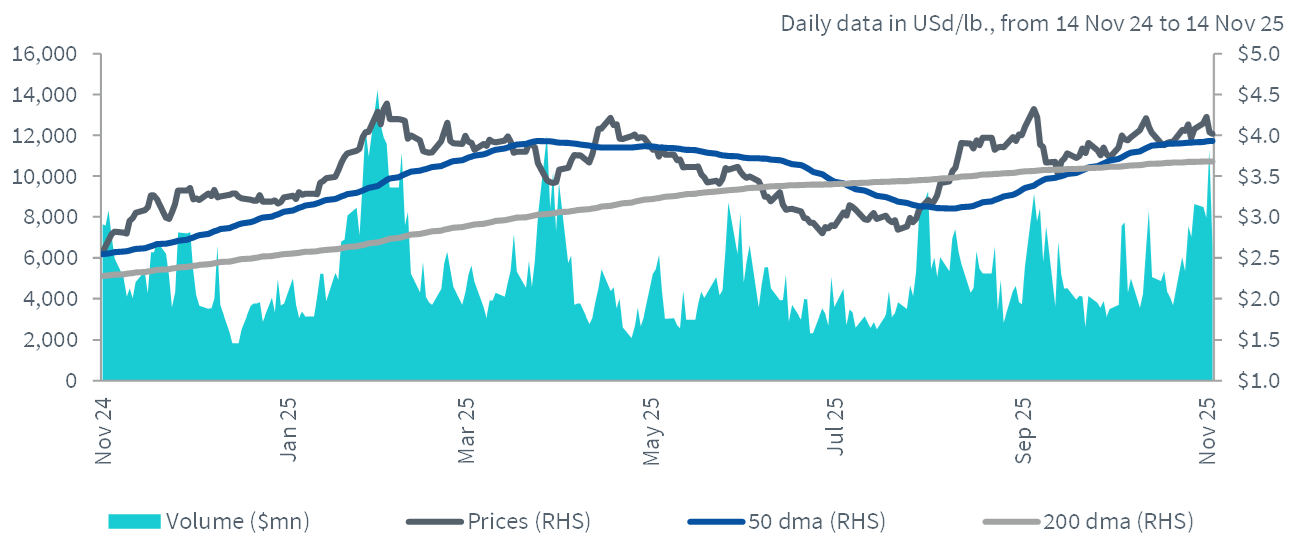
Source: Bloomberg, WisdomTree as of 14 November 2025. Historical performance is not an indication of future performance and any investments may go down in value.
Prices tapered once those tailwinds faded. On November 13, the White House retroactively removed the 40% levy on Brazilian agricultural imports, reopening the largest Arabica pipeline and triggering a sharp sell-off. Fundamentals then normalised further. Brazil’s agency Conab revised the 2025 crop upward by 1.3mn to 56.5mn 60-kg bags. This matters, since Brazil is the largest producer and exporter of Arabica and the second largest supplier of Robusta. As backlog shipments are cleared into the US over the next six months and non-tariff differentials compress, scarcity premia ease, Arabica is likely to stabilise.
1 Bloomberg from 31 December 2024 to 8 December 2025
2 Bloomberg as of 22 October 2025

 Previous Post
 All Posts