





 Print Page
Crypto ETPs: four common misconceptions among UK investors


Key Takeaways
- Despite regulatory differences in labelling, physically backed crypto exchange traded notes (ETNs) in Europe offer the same economic exposure as US exchange traded funds (ETFs) – making structure, custody, and legal protections the real investor priorities.
- Crypto ETPs are not just unsecured promises as they use institutional-grade custodians and segregated collateral to reflect actual ownership of digital assets.
- Income generation is possible in crypto ETPs tied to proof-of-stake networks like Ethereum, though investors must weigh the potential rewards against unique staking-related risks.
UK investors now have exchange-listed access to bitcoin and Ether through physically backed crypto exchange traded products (ETPs), yet many still approach the market with assumptions shaped by an entirely different era of products. Outdated comparisons with early unsecured exchange traded notes (ETNs), confusion over exchange traded fund (ETF) vs ETN labelling, and persistent myths around custody and issuer risk continue to distort how crypto ETPs are evaluated.
This gap in understanding matters. When investors focus on the wrong risks, they overlook the factors that truly determine safety and performance: how the product is structured, where the assets sit, who controls the keys, and what protections apply if something goes wrong.
In reality, today’s physically backed crypto ETPs are straightforward in purpose but sophisticated in design. The mechanics under the hood, not the marketing label, define the quality of the exposure.
Below are four misconceptions that most commonly mislead UK investors, and the facts that matter far more when assessing the strength of a crypto ETP.
Myth #1: “Americans get ETFs, we get ETNs. Does that mean we get an inferior product?”
This belief refuses to die, but it misses the regulatory logic that drives the labels. The names differ because:
- In Europe, UCITS1 rules require diversification and force issuers to use ETNs for listing single-asset (such as bitcoin) exposures on regulated exchanges.
- The US has different rules and permits single‑asset crypto products to be called ETFs.
Different words. Same economic exposure as both structures aim to track the price of the digital asset.
The real distinctions investors should care about:
- ETFs are funds and ETNs are collateralised debt securities.
- Custody quality, legal structure and issuer safeguards matter more than branding.
- Stress behaviour comes from design, not marketing language.
The ETF/ETN divide is regulatory, not hierarchical. The questions that determine risk are about physical backing, collateral segregation and what happens if the issuer fails – not the label on the wrapper.
Myth #2: “Crypto ETPs are not backed by anything. They are just promises.”
This myth lingers from the early era of unsecured ETNs, where investors were exposed to issuer credit risk. Today physically backed ETPs use a different architecture entirely.
- The crypto is held with an institutional-grade custodian using secure wallet infrastructure.
- Assets sit off the issuer’s balance sheet in segregated accounts.
- Daily published holdings allow investors to verify that collateral matches issuance.
Figure 1: How physically backed crypto ETPs work: from investor’s trade to digital asset custody
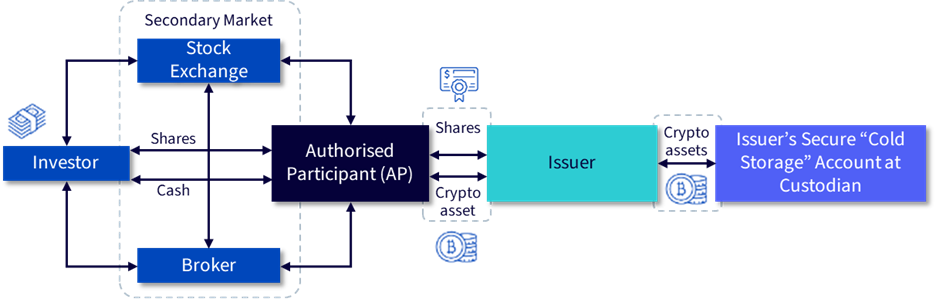
Source: WisdomTree. November 2025.
These products are built to reflect exposure to real digital assets, not promises.
Operational risk does not disappear, and crypto custody introduces risks unique to digital assets, from key-management failures to network-level events such as forks, and while transparency helps, these operational risks are inherent to the asset class rather than a function of the wrapper.
Myth #3: “If the issuer goes bankrupt, investors lose everything.”
This is a historical fear because early ETNs were unsecured credit. Nowadays physically backed crypto ETNs use bankruptcy-remote special purpose vehicles (SPVs) that are designed to shield investors from issuer failure.
- All crypto is placed into a ring-fenced pool owned by the SPV, not the issuer.
- A trustee oversees the vehicle and ensures collateral is used to satisfy investor claims.
- In an insolvency event, issuer creditors should not be able to access the assets held by the SPV.
But there are limits:
- The SPV protects against issuer credit risk, not potential technological failure of the underlying blockchain.
- Timing matters. If markets fall sharply during an issuer failure, collateral values can drop before assets are returned.
The SPV structure removes one category of risk, not the entire stack.
Myth #4: “Crypto ETPs cannot generate income”
True for bitcoin as there are no dividends, coupons or cashflows. But proof‑of‑stake (PoS) networks change the equation. By participating in network security, Ethereum ETPs can generate staking rewards that flow back to investors.
- Validators secure the network by processing and validating transactions.
- In return, they earn newly created tokens as compensation.
- Some ETPs pass these net rewards through to investors by increasing coin entitlement.
However, it is important to note that rewards vary and are not guaranteed, and that staking introduces new risks such as slashing and / or illiquidity. Importantly, investors should assess the net return they are likely to receive – the expected staking reward after accounting for the ETP’s management expense ratio.
What this means for UK investors
Stepping back, the message for UK investors is straightforward: physically backed crypto ETPs simplify access without altering the economic reality of owning digital assets. They:
- Deliver transparent, collateralised exposure.
- Protect investors through segregated custody and bankruptcy‑remote structures.
- For PoS networks, can pass through staking rewards that improve the economic profile of holding the asset.
Figure 2: Crypto ETP myths vs reality: a quick-reference summary for investors
Source: WisdomTree. November 2025.
However, it’s important to remember that crypto ETPs won’t remove the inherent volatility of the asset class. The role of crypto ETPs is to make crypto exposure simpler and more accessible – not to change the nature of the market itself. Understanding that distinction helps investors use these products with confidence and clarity.
For more insights and educational resources on crypto ETPs, visit our Crypto ETP centre.
1UCITS = Undertakings for Collective Investment in Transferable Securities.



 Previous Post
 All Posts