





 Print Page
Quantum’s Nobel moment and how investors can act


Key Takeaways
- The 2025 Nobel Prize in Physics honoured groundbreaking experiments that laid the basis for quantum computing. The award signals that the field is firmly moving from theory to practical reality.
- The quantum revolution is now an investable theme. With accelerating innovation across hardware, software and infrastructure, the ecosystem is expanding from scientific labs into early-stage pilots and commercial applications.
- From quantum chips and qubit technologies to software, quantum annealers and simulators, and Quantum-as-a-Service, innovation is unfolding across every layer of the ecosystem, creating multiple entry points for investors.
- Beyond computing, post-quantum cryptography, quantum networking, high-performance computing (HPC) infrastructure and enabling technologies are driving near-term utility and are paving the way for broader adoption.
Quantum computing is nearing an inflection point, with companies announcing breakthroughs and releasing updated roadmaps suggesting that the arrival of the quantum era is sooner than initially thought. The 2025 Nobel Prize in Physics signals that the scientific community recognises the promise that the technology holds, as well as recent tangible progress towards building a scalable quantum computer.
2025 Nobel Prize in Physics: what’s next for quantum computing?
This year’s award went to three scientists: Professor John Clarke, Professor Michel H. Devoret, and Professor John M. Martinis, demonstrating that quantum phenomena, such as quantum tunnelling, exist not just in the subatomic world, but also in a system as large as a chip. The joint work of the Nobel laureates has laid the ground for a new transformative frontier in quantum technologies spanning quantum computers, quantum cryptography and quantum sensing. The 2025 award follows a recent recognition of another discovery, with the Nobel Prize in 2022 confirming the existence of quantum entanglement, one of the principles at the heart of quantum science and quantum computing.
To be eligible for a Nobel Prize, a discovery must make a significant contribution to humanity. Currently, ‘noisy’ quantum computers have yet to realise their full potential with the arrival of fault-tolerant machines. However, this year’s Nobel signals that the physics community agrees that the technology will be transformative for humankind, and that there is a path to scalable quantum computers in the future.
In fact, the Nobel Prize frequently serves as a bellwether of inflection points in emerging technologies. For example, the Nobel Prizes awarded for discoveries in the field of semiconductors and lasers helped catalyse the ensuing digital and optical revolutions, which were pivotal in enabling inventions ranging from fibre-optic networks to smartphones.
The Nobel Prize can also reduce the ‘scientific risk premium’ that may have previously limited larger investments. Alain Aspect, one of the 2022 laureates, co-founded Pasqal, a company building quantum computers based on neutral atom architecture, in 2019. Shortly after the 2022 Nobel Prize, Pasqal closed a €100m Series B financing round, reflecting growing investor confidence in the future of quantum computing. We expect similar first-order effects from this year’s award: increased awareness of the technology and more corporate pilots, stronger academic-industry pipelines and fresh funding into the field, adding further to the strong financing rounds we have seen in recent months.
For investors, this means quantum is evolving from an experimental technology with huge potential into an investable theme with long-term growth. The Nobel Prize serves as further validation that the quantum future is not just theoretical; it is bound to deliver significant value for humankind, which means that the quantum future is also investable.
Capturing early growth in quantum computing
Governments, major technology players and deep-tech funds are set to accelerate investment in quantum computing, acting as a catalyst for the next wave of innovation. At WisdomTree, we view this as a chance to participate early through curated exposures across the ecosystem, positioned to benefit as the technology advances toward scale.
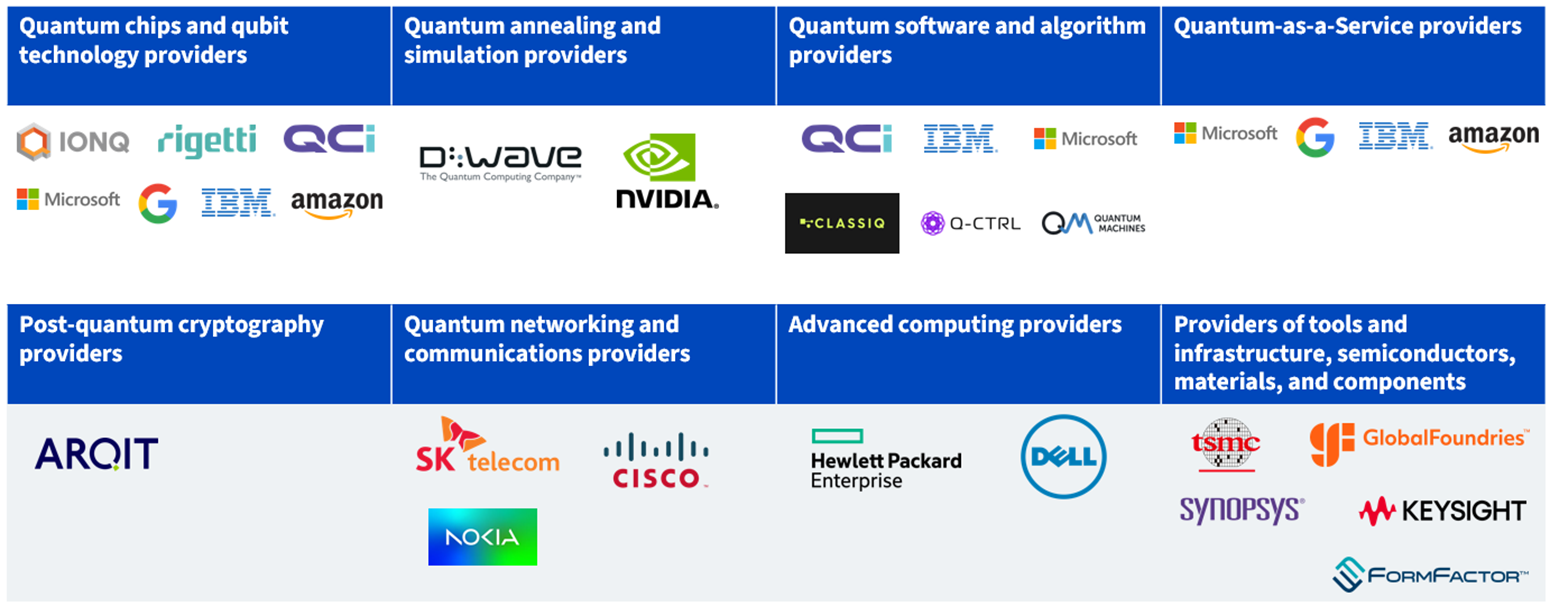
Figure 1. WisdomTree’s quantum computing ecosystem.
Source: WisdomTree. For illustrative purposes only.
At the heart of every quantum computer lies the hardware. Companies in this space develop the physical qubits and the sophisticated chip architectures that support them. This is where the toughest scientific and engineering challenges meet cutting-edge innovation. These firms form the foundation of the entire ecosystem, creating the breakthroughs that make quantum computing possible.
If hardware is the engine of quantum computing, software is what makes it move. Companies in this segment develop the full technology stack, from user-facing platforms and quantum-native algorithms to compilers, error-correction tools and control systems that translate code into quantum operations. Software is what unlocks the full value of quantum hardware, improving its performance and making it usable for real-world problems.
Quantum annealers and simulators deliver early quantum utility now. These specialised (often hybrid) systems tackle optimisation problems, model quantum phenomena and emulate future hardware, delivering near-term proof-of-value and enabling users to research, prototype and experiment with the technology before fault-tolerant machines arrive. That commercial traction in the form of pilots, cloud usage, measurable time- or cost-savings is critical for near-term adoption and skills building. In short, this segment of the ecosystem bridges the gap between classical high-performance computing (HPC) and universal quantum computers while creating momentum the ecosystem can scale on.
Quantum-as-a-service providers offer on-demand access to quantum hardware, software platforms and developer tools via the cloud, often integrated with existing artificial intelligence (AI)/HPC workflows. This model democratises access to quantum computing, lowering cost and complexity, allowing organisations to experiment, prototype and run pilots sooner. With usage-based pricing, multi-hardware access and enterprise features, teams can find fit-for-purpose solutions and scale what works.
Post-quantum cryptography (PQC) creates encryption designed to withstand future quantum attacks while running on today’s classical computers. It is one of the most immediate and investable parts of the ecosystem because adoption is needed now, not after ‘Q-day’. The biggest risk is ‘harvest now, decrypt later’ (HNDL) attacks, where adversaries steal encrypted data today to unlock once quantum machines mature. Governments are already moving with urgency. Arqit Quantum in our portfolio, selected for the UK’s National Cyber Security Centre pilot, demonstrates how this shift has already begun.
Quantum networking applies the laws of quantum mechanics to build ultra-secure communication channels and over time, a distributed quantum internet. The investment case combines near-term revenues from government, telecom, financial and healthcare pilots with long-term upside as these networks become essential to quantum computing’s scale and reach.
Advanced computing providers supply the high-performance computing (HPC) infrastructure enabling hybrid quantum–classical workflows that make early quantum advantage possible. This segment offers investors a way to benefit from quantum’s early utility while also participating in the strong, established demand for AI, cloud and supercomputing, where quantum adds an accelerating growth layer.
Behind every quantum advance are enabling technologies, the ‘quiet workhorses’ of the ecosystem. They span companies that manufacture quantum chips, provide cooling, photonics, precision measurement, control electronics and specialised materials. For investors, this layer offers diversified exposure, as these same players drive AI and semiconductor progress while quantum introduces a new, complementary growth curve.
Figure 2. WisdomTree’s quantum computing strategy offers highly relevant exposure tilted towards core quantum computing activities.
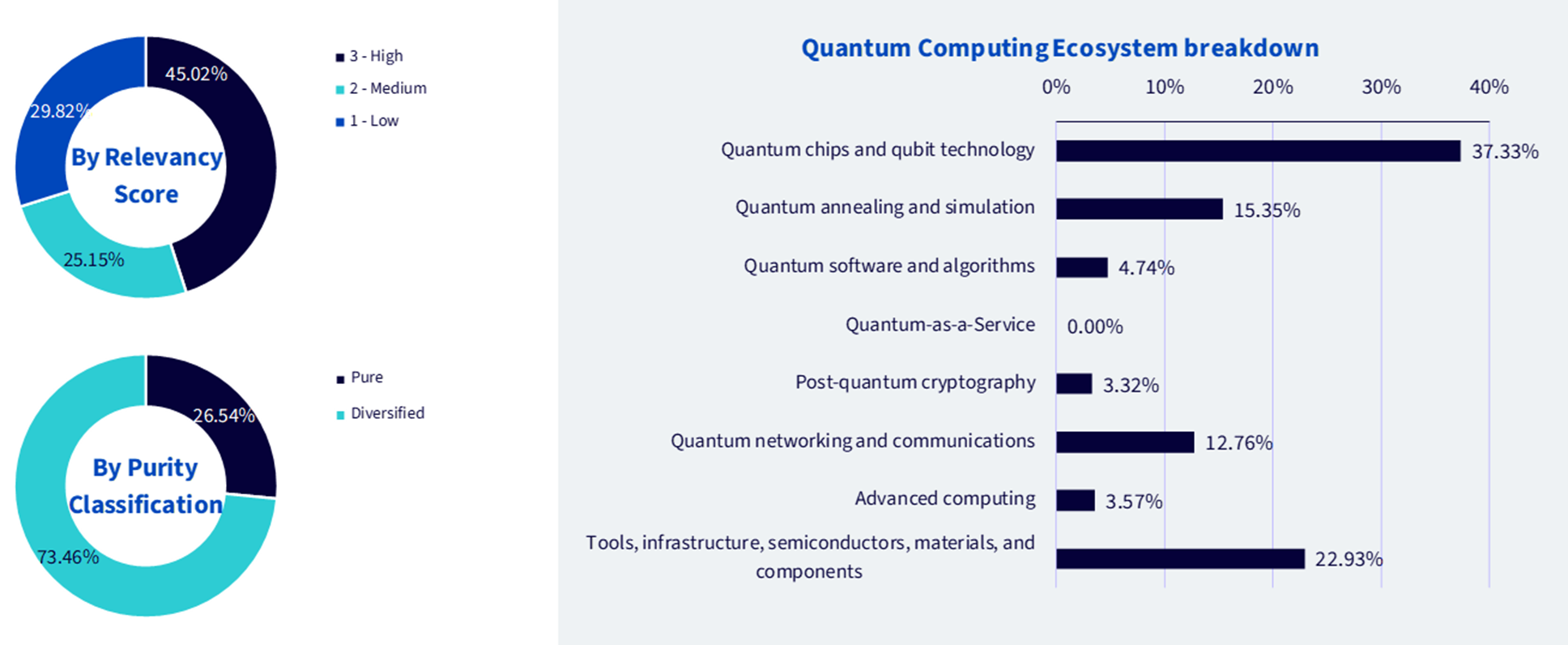
Source: WisdomTree. Weights are target weights set for the rebalance of the WisdomTree Classiq Quantum Computing UCITS Index on 15 August 2025. You cannot invest directly in an index. Historical performance is not an indication of future performance and any investments may go down in value.
Bottom line
At WisdomTree we have created an expert-driven strategy that invests across the quantum computing ecosystem while combining pure players and diversified leaders most directly contributing to the progress in the field. The selection of companies is informed by the insights of Classiq, a leading pure-player in quantum software and our expert partner for the strategy. This collaboration ensures that our portfolio is built on domain-specific expertise and stays current with the latest developments. The weighting tilts exposure towards the purest, most relevant and impactful companies advancing quantum computing.



 Previous Post
 All Posts