




 Print Page
From ore to core: why uranium supply chains matter


Key Takeaways
- Demand for firm, low-carbon power is rising. Nuclear’s high capacity factors make it the anchor that lets renewables scale without sacrificing reliability.
- Upstream supply is slow and concentrated with long lead times, restart slippage, and input bottlenecks, keeping the mine-to-requirements balance tight.
- Midstream is a pinch point – conversion is tight and Western enrichment capacity is limited, with a large share still located in Russia. Policy shifts are re-routing contracts but will take time to relieve.
- Treat uranium and nuclear as a system. The balance between mining and processing will drive returns as much as new-build headlines.
The moment for firm, low-carbon power
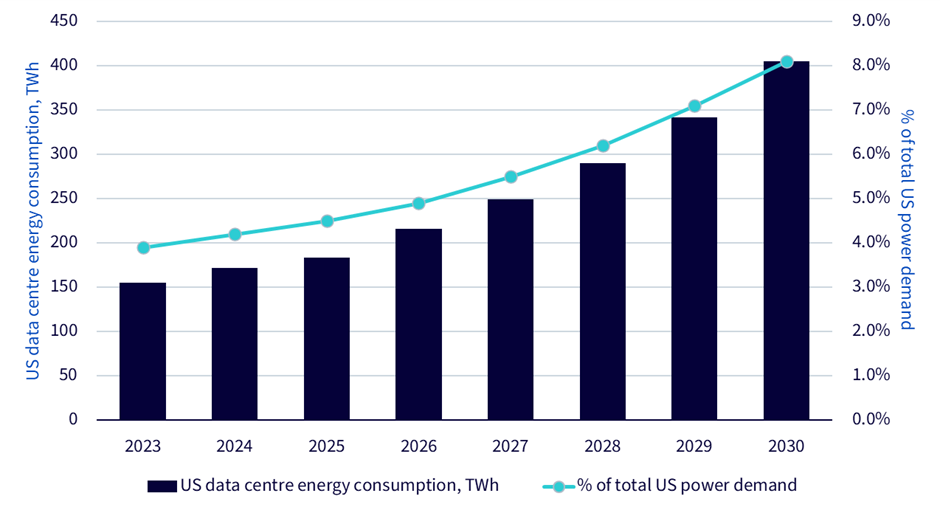
Electricity demand is accelerating. Transport is shifting to electric vehicles, industry is electrifying heat and processes, and homes are adopting heat pumps. On top of that, data centres, driven by cloud services and artificial intelligence (AI), are emerging as large, always-on consumers of power. The common thread is simple: these loads run for long hours and need dependable supply, not just energy in aggregate but energy when it’s needed.
Figure 1: U.S. data centre energy consumption (TWh) and as % of total U.S. power demand
Source: McKinsey, How data centers and the energy sector can sate AI’s hunger for power (Sep 2024).
Forecasts are not an indicator of future performance, and any investments are subject to risks and uncertainties.
Nuclear fits this moment. It delivers very low lifecycle emissions, aligning with net-zero goals, and it operates with a consistently high output regardless of weather. That reliability makes it a natural complement to wind and solar, which are vital but variable. For data centres in particular, where downtime is costly and backup diesel is unattractive, low-carbon power is essential. Nuclear’s fuel costs are a modest share of total generation costs, and once plants are operating, their output is relatively insulated from commodity swings, supporting predictable power over long periods.
Two further points matter for systems planning. First, firmness gap: grids can only absorb so much variability before they need steady generation or long-duration storage at scale. Storage is improving but is not yet deployed widely enough to cover multi-day and seasonal gaps. Secondly, location and land use: nuclear plants produce large amounts of clean electricity from a small footprint and can be sited near major demand centres, easing transmission constraints. This is useful where data-centre clusters grow faster than grid upgrades. In short, rising electrification and digitalisation are increasing baseload needs. Nuclear provides the low-carbon, high-reliability anchor that lets renewables grow without sacrificing system stability.
Why uranium mining matters
Supply is slow to respond. New uranium projects typically take 10–20 years from discovery to production, meaning short-term price spikes do not create instant tonnes. This makes the cycle unusually sensitive to durable price signals and long-lead investment decisions.
Depletion and concentration add fragility. The World Nuclear Association’s 2025 fuel report flags a sharp step-up in reactor requirements, around 86,000 tonnes by 2030, rising to ~150,000 tonnes by 20401, while output from today’s mines could halve between 2030 and 2040 as existing deposits are exhausted, creating a significant gap2. In plain terms: without fresh supply, the industry leans harder on restarts and secondary material just as demand accelerates.
Figure 2: Global nuclear power capacity by scenario, 2023 - 2050
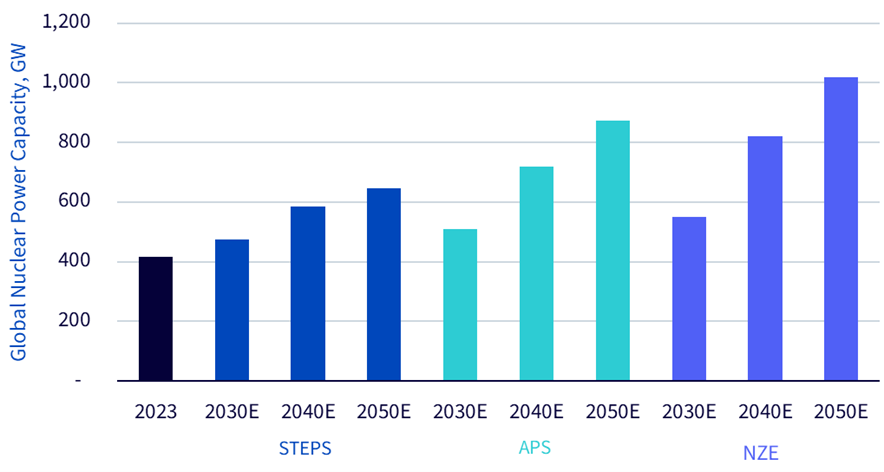
Source: IEA, “The Path to a New Era for Nuclear Energy (Jan 2025)”. STEPS denotes Stated Policies Scenario, APS denotes Announced Pledges Scenario, NZE denotes Net Zero Emissions by 2050 Scenario and E denotes estimated.
Forecasts are not an indicator of future performance, and any investments are subject to risks and uncertainties.
Restarts help, but more slowly than headlines suggest. Several notable operations have come back online or are ramping, although timelines have slipped and guidance has been trimmed. U.S. miners, such as Energy Fuels and Uranium Energy, have trimmed guidance and Paladin has faced weather-related challenges. Even the world’s largest producer, Kazatomprom, cites sulphuric-acid constraints and project delays, issues that cannot be fixed overnight and can ripple through the market.
Upstream is coupled to midstream. When enrichment is tight, utilities often raise the tails assay to save separative work units (SWU)3. That reduces SWU per kg of product but increases natural-uranium feed per kg. Even if reactor counts do not change, this behaviour pulls extra pounds through the front end. This is another reason resilient, diversified mine supply matters as fuel chains rebalance.
Uranium enrichment: a potential bottleneck for U.S. nuclear sectors
U.S. policy momentum since mid-2025 has buoyed nuclear and uranium equities, but the next leg of growth depends on where and how fuel is processed. After mining, material moves through conversion, enrichment, deconversion and fabrication before it becomes reactor fuel. Enrichment is the most technically demanding step as precision centrifuge cascades are required, and capacity is highly concentrated, with roughly 43% of global capability located in Russia.4
Figure 3: Global uranium enrichment capacity by country
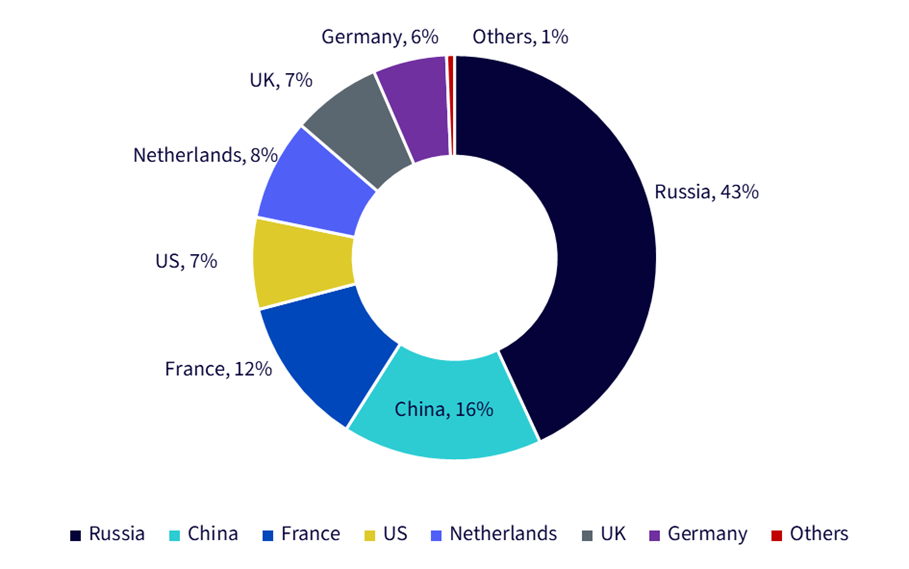
Source: World Nuclear Association and company websites, 2025. Enrichment capacity is attributed to individual countries based on where the plants are located.
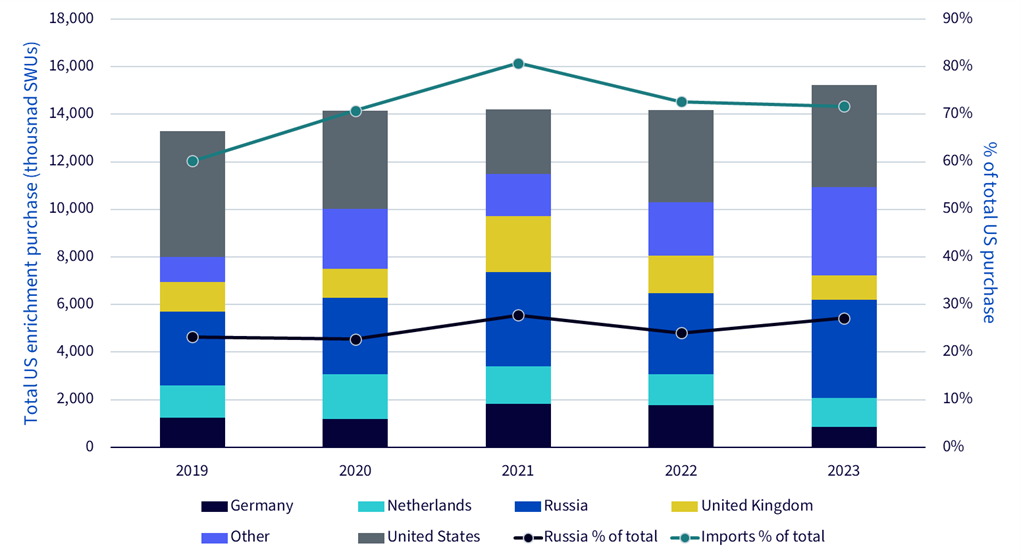
The United States has long relied on imports for enrichment services. In recent years around 70% of U.S. enrichment purchases were imported, with roughly 25% of the total U.S. purchase coming from Russia5. New U.S.6 law phases out Russian enriched-uranium imports by 2028, creating a near-term Western shortfall until additional centrifuges come online. Urenco USA has begun feeding a new cascade, but lead times mean constraints ease gradually, not instantly.
Figure 4: Purchases of enrichment services by owners and operators of U.S. civilian nuclear power reactors by origin country and year, 2019–23
Source: U.S. Energy Information Administration. SWUs denotes separative work units.
Most large enrichment capacity is state-owned or private, limiting direct listed exposure. Two investable angles stand out in the U.S. market context: Centrus Energy, the only listed U.S. enricher, has delivered first HALEU7 and established a beachhead for domestic supply, with a path to add cascades (and potentially LEU8) as contracts and funding accumulate. Cameco and Silex Systems are exploring laser-based enrichment via a joint venture (JV)9. The technique can offer flexible, potentially lower-cost capacity if commercialised at scale. Both are small versus incumbents today, but the strategic shortfall in Western enrichment gives them clear optionality as new contracts, policy support and utility diversification progress.
Conclusion
Electricity systems need more firm, low-carbon power as electrification and data centres reshape load. Nuclear already provides that, with high utilisation and predictable operating costs. As demand for nuclear generation rises, through life-extensions, uprates and new builds, the fuel chain is catching up. A mine-to-requirements gap has emerged after years of under-investment and it is amplified when enrichment is tight because raising tails to save SWU increases natural-uranium needs. Midstream conversion and enrichment are the tight spots today, especially in the West, and they will take time and capital to ease. The takeaway is simple: uranium and nuclear are a system, and over the next few years outcomes will be driven as much by the balance between mining and processing as by headline reactor counts.
1FT: Uranium shortfall threatens nuclear energy renaissance, industry warned
2FT: Uranium shortfall threatens nuclear energy renaissance, industry warned
3Separative work units: the amount of separation done by a Uranium enrichment process
4World Nuclear Association
5U.S. Energy Information Administration
6Prohibiting Russian Uranium Imports Act
7High-Assay, Low-Enriched Uranium
8Low-Enriched Uranium
9Global Laser Enrichment






 Previous Post
 All Posts