




 Print Page
Staking is yield, pure and simple


Key Takeaways
- Staking is protocol-native income—not lending, not credit exposure.
- Yield and risk vary widely across blockchains; Solana and Ethereum offer contrasting models.
- Institutional-grade staking demands operational control, not yield farming.
- Ignoring staking is a capital efficiency mistake in digital assets.
- WisdomTree ETPs enable access to staking without compromising custody or control.
In a yield-starved world, staking stands out as crypto’s most elegant answer to the income challenge. It is not credit exposure and not a backroom deal with questionable risk controls. Staking is protocol-native income—earned for securing decentralised networks, not for taking on opaque third-party risk.
For institutions that are serious about capital efficiency in digital assets, staking is not a nice-to-have. It is foundational.
Yet staking remains misunderstood, and that misunderstanding is costing investors real money. Too often, it is lumped in with high-risk lending, dismissed as overly technical, or written off as the domain of crypto die-hards. That narrative needs to change, fast. Institutions must take control of the staking conversation or risk getting left behind.
What is staking and why is it nothing like mining?
Staking is the process of committing crypto assets to a Proof-of-Stake (PoS) blockchain in order to help validate transactions and secure the network. In return, participants earn native rewards—typically a combination of newly minted tokens and a share of transaction fees.
Think of staking as the monetary plumbing of crypto. You commit capital, provide essential infrastructure, and get paid with yield—not from borrowers, but from the protocol itself. Unlike energy-intensive Proof-of-Work (PoW) mining, which rewards brute computational force, PoS rewards economic alignment. Validators are selected based on how much they stake—how much skin they have got in the game.
Figure 1: Solana and Ethereum reward rates
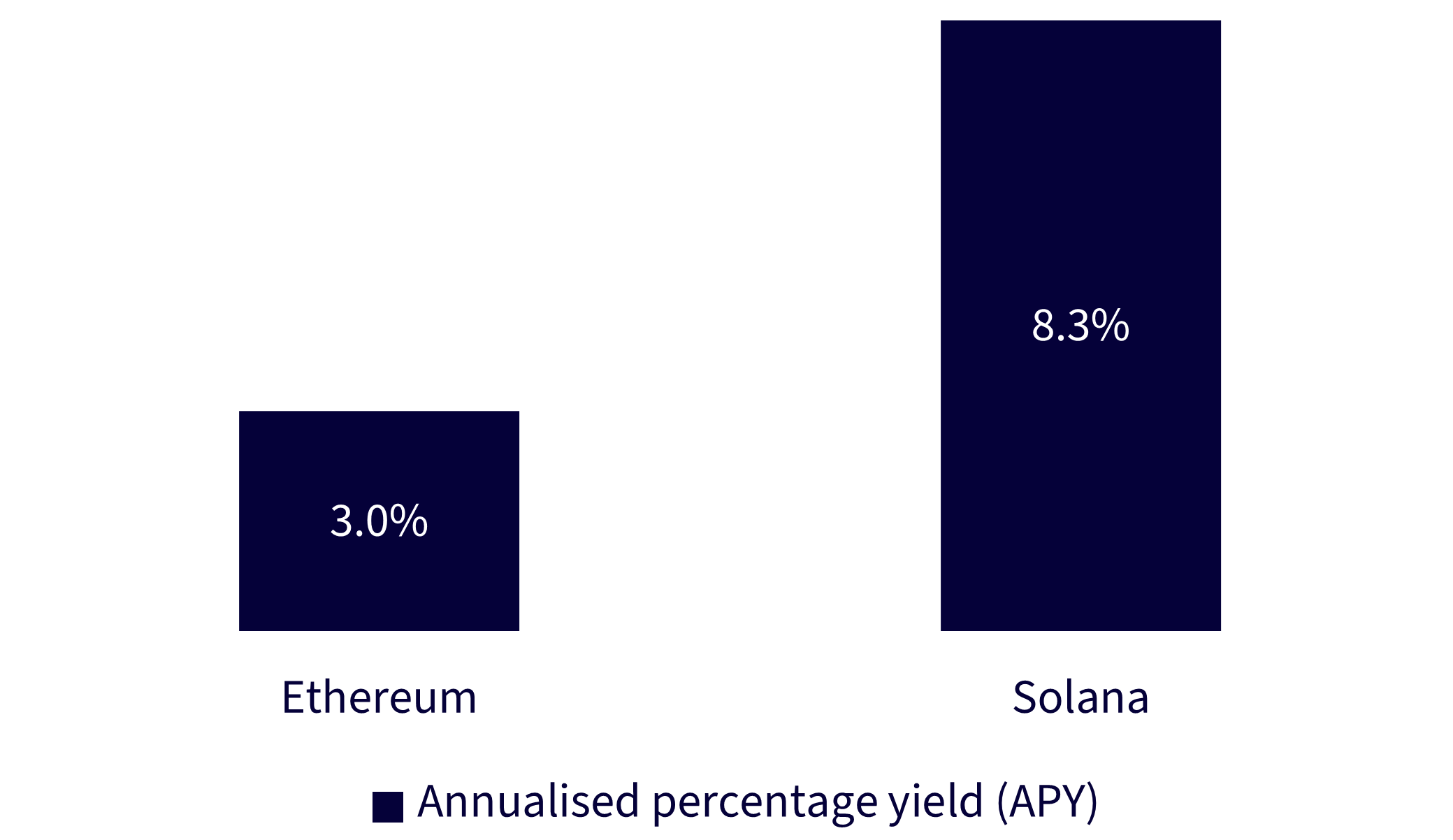
Source: Staking Rewards. 07 May 2025. Historical performance is not an indication of future performance and any investment may go down in value.
Of course, opportunity brings with it a corresponding responsibility. Most blockchains punish technical failure or dishonest behaviour through slashing (the loss of part of your stake) or leakage (reduced rewards). It is a cleaner, smarter, and far more capital-efficient model for securing decentralised infrastructure.
Why staking rewards (and risks) vary
Staking rewards compensate validators for locking up capital and helping secure the network. But not all protocols are created equal. Incentive models and operational requirements vary widely depending on the blockchain:
- Inflationary issuance (that is, newly minted tokens).
- Transaction fees paid by users.
- Unbonding periods (that is, how long it takes to withdraw staked assets).
- Minimum staking thresholds, which influence capital commitment.
- Compounding mechanisms—some protocols reinvest rewards automatically; others require manual action.
- Slashing penalties—these vary in severity based on the network’s risk model.
By way of example, Solana consistently maintains a significantly higher staking ratio than Ethereum. This divergence stems from fundamental differences in staking design. Solana was built from the ground up with a native delegation model and no withdrawal delays, allowing users to easily stake and unstake through user-friendly wallets and platforms. In contrast, Ethereum’s staking is more complex, historically requiring validator infrastructure or pooled solutions.
Figure 2: Solana and Ethereum staking ratios1
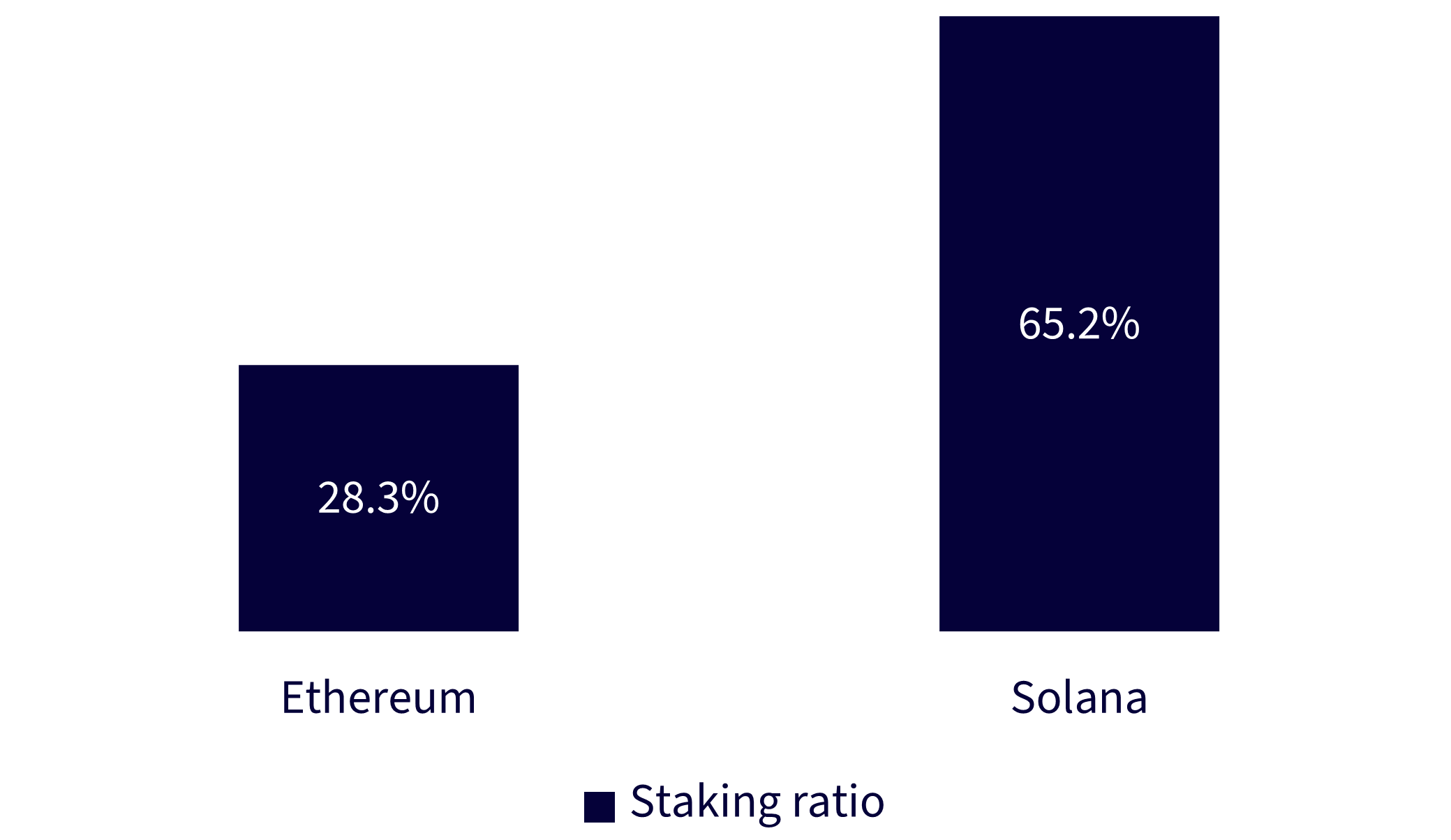
Source: Staking Rewards. 07 May 2025. Historical performance is not an indication of future performance and any investment may go down in value.
Bottom line: staking is not a set-it-and-forget-it income stream. Capturing staking yield at scale demands deep protocol knowledge, robust infrastructure, and active oversight.
Discipline over drama: why staking is not lending
The most damaging myth in crypto yield strategies? That staking is just another form of lending.
It is not. Staking does not involve relinquishing custody. There is no counterparty. No rehypothecation. No exposure to off-platform balance sheet games. Done right, staking is a clean operation that keeps your assets secured and working.
At WisdomTree, we do not lend. We stake with discipline:
- Cold storage custody and complete segregation.
- No exposure to third-party credit or balance sheets.
- Multi-party consensus models for staking and unstaking.
- Validator selection driven by uptime, governance alignment, and slashing protection.
- Diversified wallets to optimise across yield, liquidity, and operational resilience.
This is institutional staking, not yield farming roulette. What separates passive participation from professional-grade execution is operational control.
Final thought: staking is the future of monetary participation
Staking is not a side hustle for crypto hobbyists. It is the core engine of decentralised economic systems. As blockchain infrastructure matures, staking will become the standard way to earn protocol-native yield—aligned, transparent, and secured by design.
At WisdomTree, we treat staking as core strategy—not just for income generation, but as a structural alignment with the future of finance. Our exchange-traded products (ETPs) give investors access to staking rewards while maintaining critical pillars of institutional investment: security, liquidity, and oversight.
In crypto, staking is where capital efficiency meets institutional-grade execution. It is time to stop treating it as optional and start treating it as essential.
1 Staking ratio is the percentage of the total circulating supply of a given crypto asset that is currently being staked.




 Previous Post
 All Posts