




 Print Page
The Mar-a-Lago Accord: a hypothetical strategy for dollar depreciation


Key Takeaways
- The "Mar-a-Lago Accord" is a speculative concept proposing a deliberate US strategy to weaken the dollar to boost exports and address trade imbalances—though no official policy has been declared.
- Inspired by the 1985 Plaza Accord, this modern version envisions unilateral US actions—such as diplomatic pressure, fiscal tools like a sovereign wealth fund, and industrial policy—to realign currency values.
- Global coordination appears unlikely, as geopolitical conditions have shifted. Europe is rearming independently, reducing US leverage, and China remains cautious, wary of Japan’s historical experience with forced currency appreciation.
- Critics see it as more discord than accord, arguing it would face resistance internationally and lacks the cooperative spirit needed for successful currency interventions.
- If such a policy emerged, assets likely to benefit include gold, silver, and commodities (due to their inverse relationship with the dollar), as well as high-dividend, value-oriented equities seen as defensive plays in turbulent markets.
In recent months, the concept of a so-called "Mar-a-Lago Accord"—a hypothetical policy initiative aimed at depreciating the US dollar—has gained traction among market commentators. In this blog, we explore what such a policy might entail, where it would likely face resistance, and which assets could benefit if it were implemented. To be clear, no policymakers have officially endorsed this as a strategic goal, and we remain sceptical about the feasibility of such a system. Nevertheless, we believe the thought experiment is worth exploring.
The tricky task of predicting currency moves
Between the US election on 05 November 2024, and President Trump’s inauguration on 20 January 2025, the US dollar Index appreciated by 5.7%. His pro-growth platform led many analysts to anticipate a slower pace of rate cuts relative to other economies, reinforcing a bullish dollar view. Additionally, his tariff-focused rhetoric was seen as dollar-positive, based on the logic that tariffs would reduce US import demand, lowering the need for foreign currencies.
By January 2025, a strong dollar had become the consensus view1. Yet since then, the dollar has more than erased all post-election gains, and the outlook has turned neutral at best2.
This reversal may reflect broader concerns—slowing global trade, an escalating trade war, and perceived policy instability in Washington. Ironically, tariffs once seen as supportive of the dollar are now being blamed for its weakness.
Is dollar depreciation a policy goal?
Amid these shifts, some commentators speculate whether the Trump administration is pursuing dollar depreciation as a deliberate strategy—aimed at boosting US export competitiveness and reducing the current account deficit.
While there has been no formal declaration, President Trump and his advisors have long criticised a strong dollar. He has previously accused foreign nations of currency manipulation3 and suggested the US should respond by letting the dollar weaken.
The Mar-a-Lago Accord: coordinated strategy or narrative mirage?
Nearly 40 years after the 1985 Plaza Accord—a historic agreement to weaken an overvalued dollar—the idea of a modern equivalent has emerged. Dubbed the “Mar-a-Lago Accord,” this concept imagines a coordinated effort to realign the US dollar through diplomatic, fiscal, and industrial policy measures.
While still speculative, the idea has gained intellectual traction in certain circles, driven by political momentum, global imbalances, and market dynamics.
Lessons from the 1985 Plaza Accord
The Plaza Accord was a rare moment of international coordination, involving the US, Japan, Germany, France, and the UK. It succeeded in delivering a controlled depreciation of the dollar and temporarily rebalancing trade flows.
Figure 1: Real effective exchange rate for US
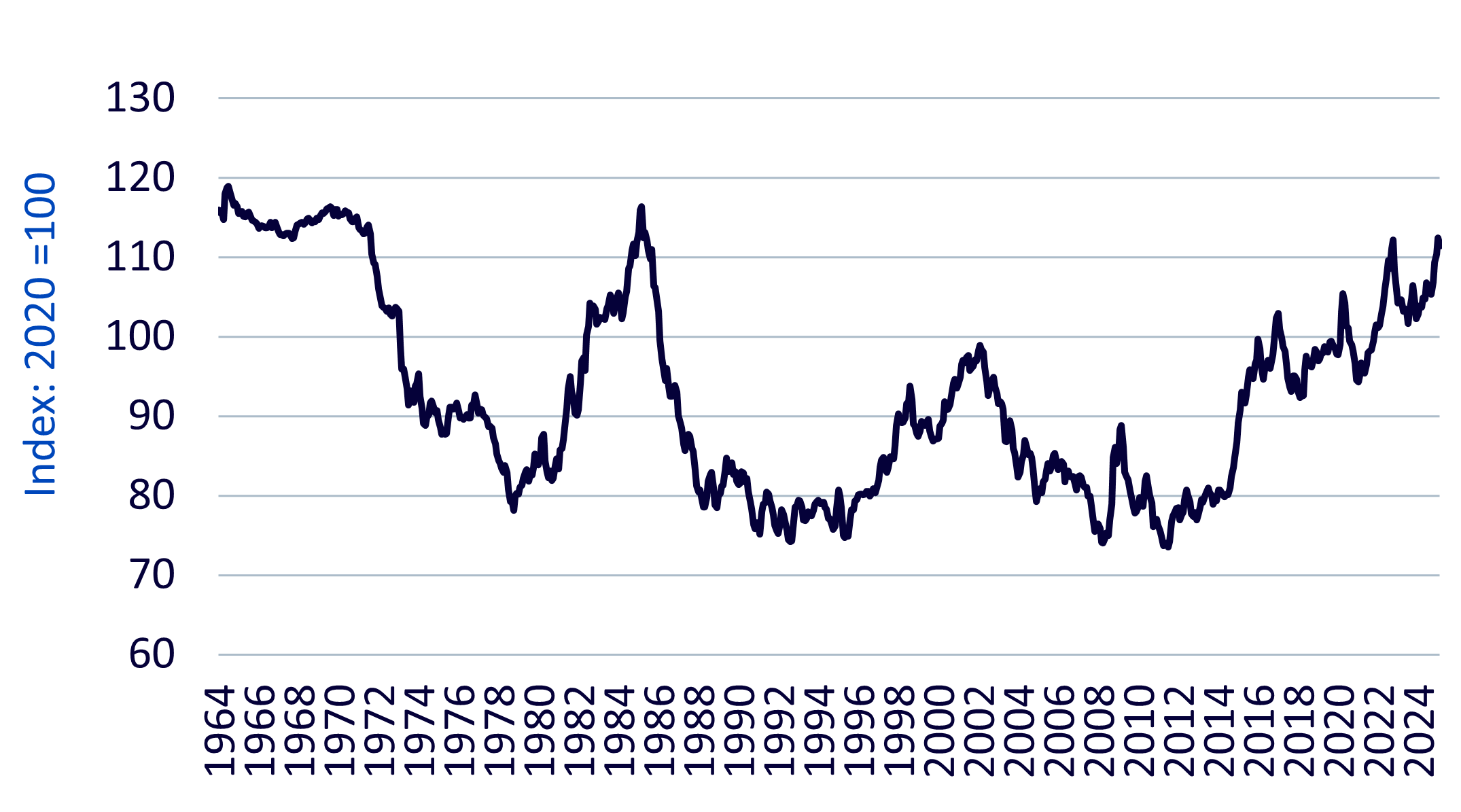
Source: Bank for International Settlements via FRED® (Federal Reserve Bank of St Louis). January 1964 – February 2025. Historical performance is not an indication of future performance and any investments may go down in value.
However, today’s geopolitical landscape is very different, and replicating such coordination appears far more difficult.
What Would a Mar-a-Lago Accord Involve?
1. Dollar realignment via diplomatic leverage
The US could use access to its markets and security guarantees as bargaining chips to persuade G7 allies, Middle Eastern partners, and Latin American countries to weaken their currencies in coordination. Countries unwilling to participate might face tariffs or trade restrictions.
2. Fiscal engineering to redirect capital flows
The creation of a US sovereign wealth fund to actively intervene in currency markets. A shift from short-duration debt to long-dated Treasuries to reduce refinancing risk and downward pressure on the dollar. Some even speculate about refinancing interest-bearing debt into zero-coupon bonds—a radical proposal.
3. Reindustrialisation and supply chain realignment
Incentives for domestic manufacturing and efforts to reduce reliance on global supply chains. Potential exclusion of close partners like Canada and Mexico from core sectors such as autos.
Discord, not accord
Unlike the Plaza Accord, which was a cooperative effort, the Mar-a-Lago concept appears more unilateral—an exertion of US will rather than multilateral consensus. Some have called it the “Mar-a-Lago Discord.”
Europe: rearming regardless
The leverage implied in the proposal—such as conditioning military support on currency cooperation—may already be diminishing. European countries have taken US threats seriously and are now abandoning traditional budget rules to pursue military rearmament. If Europe is rearming anyway, the US has less leverage to secure their support for a dollar depreciation effort.
China: a wary observer
Comparisons to Japan’s experience in the 1980s are common. Back then, Japan agreed to currency appreciation under US pressure, which many now believe led to speculative bubbles and the country’s subsequent “lost decades”. China views this as a cautionary tale and is unlikely to follow a similar path.
While China is also contemplating a shift toward consumption-led growth, as Japan once did, it remains deeply wary of agreeing to any externally imposed currency appreciation.
Investment implications (if it happens)
To reiterate, we think the likelihood of a formal “Mar-a-Lago Accord” being implemented is low. But if the US does pursue a weak-dollar policy from a position of hegemony, we see several potential winners:
Gold: already a favoured asset among central banks like China’s, gold could benefit as a store of value with no credit risk. Investors in currency-hedged gold may also benefit from pure translation effects.
Silver: typically moves in tandem with gold and may be due for a performance catch-up.
Commodities: a weaker dollar usually boosts commodity prices. However, if trade restrictions accompany this policy, commodity prices could face short-term turbulence.
Equities: we favour high-dividend, value-oriented stocks in a weaker dollar environment. Amidst a slowing economy coupled with a weaker US dollar, investors are likely to turn their attention to dividend stocks—a classic defensive play that offers both the potential for capital appreciation and a steady income stream. The high dividend factor is synonymous with an investment strategy that gains exposure to companies that appear undervalued and have demonstrated stable and increasing dividends. Stalwart names in consumer staples, utilities, industrials and healthcare—sectors renowned for their stability—are posting impressive gains even as the mega cap tech stocks falter.
Why we think it’s unlikely
We believe any attempt to engineer a dollar devaluation—if it is indeed a policy goal—would be met with scepticism or outright resistance from other nations. History shows that successful currency interventions require broad coordination and sustained commitment. That seems increasingly implausible in the current environment.
However, as with many aspects of the current US administration, we can’t fully rule anything out.
1For example, on 15/01/2025 when the DXY was 109.1, Bloomberg’s survey of economists indicated they only expected the dollar to ease to 107.1 by the end of the year.
201/04/2025 when the DXY was 104.1, Bloomberg’s survey of economists showed a median of 104.0 by the end of the year.
3For example, in 2019, Trump officially labelled China a currency manipulator. Moreover, the latest spate of tariffs announced on 02/04/2025, or “Liberation Day” apparently used a degree of currency manipulation to determine tariff levels.


 Previous Post
 All Posts