




The Space Economy takes flight
The space economy is transitioning from concept to commercial reality. At an expected annual growth rate of 9% through 2035, the global space economy is estimated to reach $1.8 trillion1 in value, highlighting both the scale of the opportunity and the pace of its expansion. The WisdomTree Space Economy UCITS ETF offers targeted exposure to this accelerating shift, investing in companies operating across the space value chain, from infrastructure and launch systems to data, connectivity and commercial applications on Earth.
At the heart of this shift stands SpaceX, which has materially altered the economics of launch and satellite deployment. Alongside it, a broader ecosystem is emerging, spanning defence, communications and data-driven services. As use cases expand and capital continues to flow into the sector, the space economy is evolving into a powerful, long‑term investment theme.
1Source: World Economic Forum, McKinsey & Company, “Space: The $1.8 Trillion Opportunity for Global Economic Growth”, April 2024.
Estimated value of the global space economy from 2023 to 2035
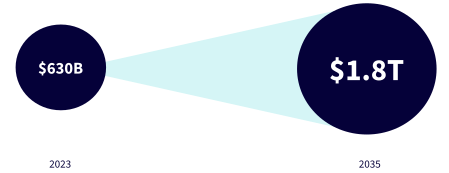
Source: World Economic Forum, McKinsey & Company, “Space: The $1.8 Trillion Opportunity for Global Economic Growth”, April 2024. Forecasts are not an indicator of future performance, and any investments are subject to risks and uncertainties.
Structural drivers of the space economy
Several long-term forces are accelerating adoption:
Reusable launch systems and more frequent launch cadence are lowering costs and improving reliability, reshaping the economics of access to space.
The US, Europe and China are treating space as a strategic priority, providing sustained demand through programmes, policy support and sovereign capability initiatives.
Connectivity, earth observation, navigation and data-driven services are embedding space into the real economy.
Advances in artificial intelligence and robotics are enhancing space-based intelligence and enabling more complex in-space operations.
New areas such as in-orbit manufacturing, servicing and space-based data infrastructure are opening additional sources of long-term demand.