





 Print Page
Better together: bitcoin and gold


Key Takeaways
- Since the end of 2013, bitcoin has delivered higher risk-adjusted returns than gold, with a Sharpe ratio of 0.7 versus gold’s 0.6 and a Sortino ratio of 1.0 versus gold’s 0.3, despite its higher volatility.
- Bitcoin and gold exhibit a low long-term correlation of 6%, offering powerful diversification when combined as a macro risk barbell across inflation, fiat debasement and geopolitical shocks.
- Rather than replacing gold, bitcoin extends the safe-haven toolkit, combining gold’s resilience with bitcoin’s asymmetric upside potential in a digitally disrupted world.
For centuries, gold has stood as the ultimate safe-haven asset. Today, bitcoin is emerging as its digital challenger. Over the past decade, bitcoin has not only delivered stronger absolute performance but also surpassed gold on risk-adjusted terms, even after accounting for its volatility. Investors are rethinking the hierarchy of store-of-value assets and increasingly seeing bitcoin and gold as complements, not substitutes.
Gold vs bitcoin: stability meets disruption
Gold’s traditional strengths remain intact:
- Finite supply and scarcity: mined with difficulty, trusted for millennia.
- Universal acceptance: recognised globally as money and collateral.
- Crisis hedge: historically showing negative correlation to risk assets during stress events.
Since 2013, gold has delivered annualised returns of 10.4% with 14.5% volatility, producing a Sharpe ratio of 0.61. Gold remains steady and defensive, but its upside is constrained.
Bitcoin, by contrast, tells a different story. From 2013, it has produced annualised returns of 50.5% with 67.0% volatility, resulting in a Sharpe ratio of 0.7, which is slightly better than gold despite its extreme swings2. On the Sortino ratio, which captures downside risk, the gap widens further: 1.0 vs 0.33.
In plain terms: bitcoin has historically rewarded investors for the risk they have taken, while gold looks defensive, but less efficient on risk-adjusted metrics.
Figure 1: Sharpe and Sortino ratios of bitcoin and gold since the end of 2013

Source: Optuma, WisdomTree. From 31 December 2013 to 05 November 2025. In US dollars. Based on daily returns. You cannot invest directly in an index. Historical performance is not an indication of future performance and any investment may go down in value.
Bitcoin volatility: risk or opportunity?
Critics argue that bitcoin’s volatility disqualifies it as a safe haven; however, volatility is not the same as risk. Since the end of 2013, bitcoin’s 90-day annualised volatility has compressed from over 150% to just under 40%4, now closer to commodities. Meanwhile, daily spot volumes rival those of major S&P 500 stocks, while futures and options markets provide institutional-grade hedging tools.
Figure 2: Bitcoin’s 90-day annualised volatility
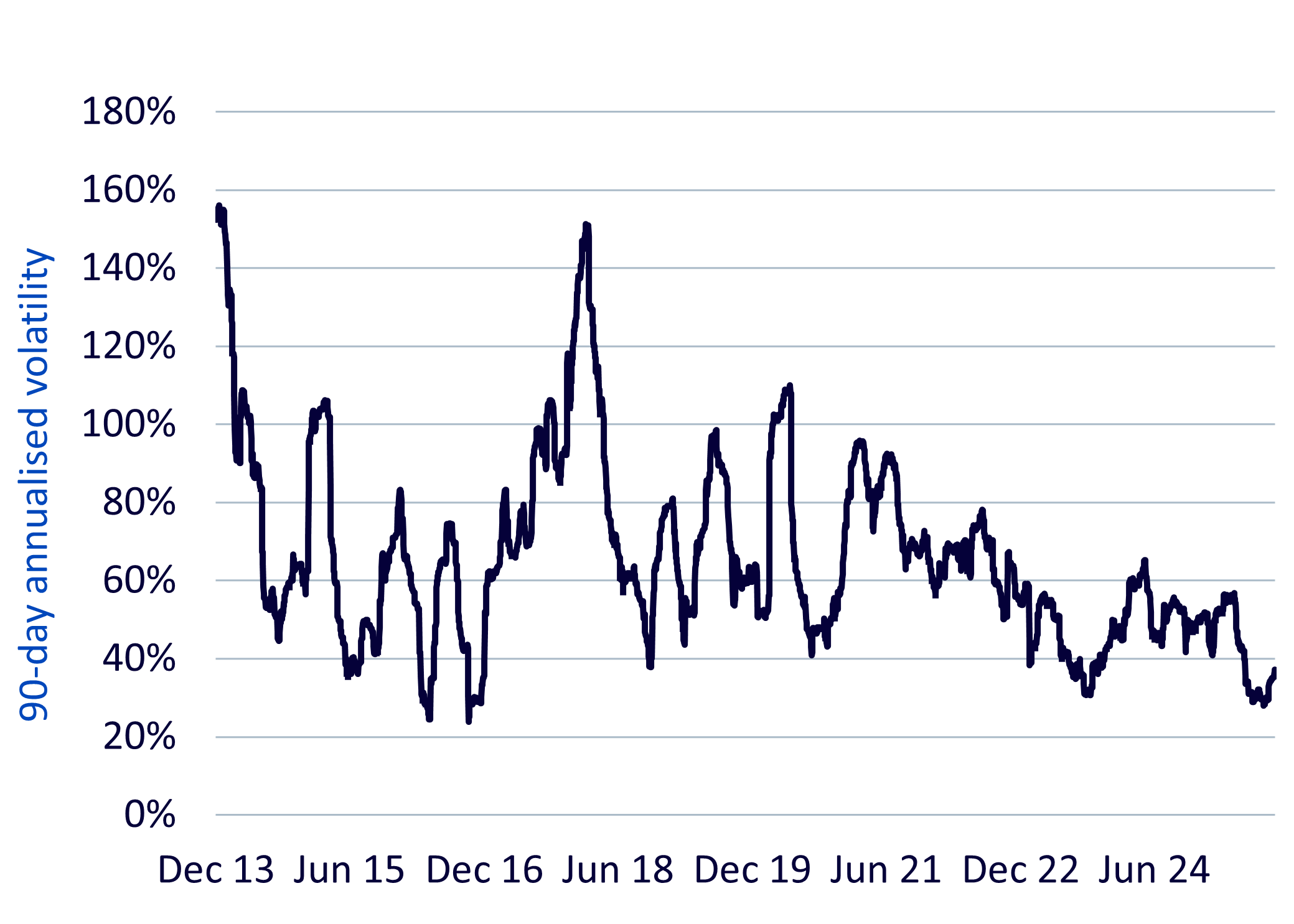
Source: Artemis Terminal, WisdomTree. 03 November 2025. Historical performance is not an indication of future performance and any investment may go down in value.
Volatility remains a tax, but a declining one. For professional investors, liquidity depth and derivatives availability mean volatility can increasingly be reframed as manageable risk rather than disqualifying noise.
Macro backdrop: gold and bitcoin as complements
The macroeconomic case supports a “bitcoin and gold” rather than “either-or” framework:
- Gold thrives on inflation, geopolitical stress, and negative real yields.
- Bitcoin offers decentralisation, a capped supply of 21 million units, and digital portability – effectively “gold with wings.”
Correlation between gold and bitcoin remains structurally low at 6%5. This creates diversification benefits: gold hedges inflation and systemic crises, while bitcoin hedges fiat debasement and technological disruption. Together, they form a barbell across macro risks.
Portfolio implications: turning evidence into allocation
Bitcoin’s Sharpe and Sortino ratios suggest that even modest allocations can improve portfolio efficiency. A 1% bitcoin sleeve in a 60/40 global portfolio lifts Sharpe ratio by 0.06, while drawdowns only increase slightly from -24% to -25%6.
Strategic role in portfolios:
- Complementary roles: gold anchors stability and bitcoin amplifies upside.
- Diversification: combined, they provide defensive-plus-asymmetric opportunities.
- Macro hedges: gold protects against inflation and rates, while bitcoin adds convex exposure against fiat erosion and digital disruption.
Conclusion: evolution, not replacement
On risk-adjusted returns, bitcoin has outshone gold. But this is not a replacement story. Gold is not obsolete. It has gained a digital counterpart. Together, they broaden the safe-haven spectrum:
- Gold = resilience.
- Bitcoin = convex upside.
Investors must weigh these benefits against bitcoin’s continued regulatory and market risks. Still, the evidence suggests a modernised hedge mix of gold and bitcoin deserves serious consideration in forward-looking portfolios.
1Source: Optuma, WisdomTree. 05 November 2025.
2Source: Optuma, WisdomTree. 05 November 2025.
3Source: Optuma, WisdomTree. 05 November 2025.
4Source: Artemis Terminal, WisdomTree. 03 November 2025.
5Source: Bloomberg, WisdomTree. From 31 December 2013 to 31 October 2025. In US dollars. Based on weekly returns. You cannot invest directly in an index. Historical performance is not an indication of future performance and any investment may go down in value.
6Source: Bloomberg, WisdomTree. From 31 December 2013 to 31 October 2025. In US dollars. Based on daily returns. The 60/40 Global Portfolio is composed of 60% MSCI AC World and 40% Bloomberg Multiverse. You cannot invest directly in an index. Historical performance is not an indication of future performance and any investment may go down in value.





 Previous Post
 All Posts