




 Print Page
Why CoCos remain attractive in a tariff-heavy environment


Key Takeaways
- AT1 CoCo bonds offer attractive yields amid uncertainty: with spreads nearing 400 basis points and yields above historical averages, Contingent Convertible (CoCo) bonds present an opportunity for income-seeking investors in a volatile economic environment
- Banking sector fundamentals are exceptionally strong: banks are currently well-capitalised with record-high CET1 ratios and historically low non-performing loan levels, providing a robust buffer against potential economic shocks
- Banks are less vulnerable to tariff risks: due to their indirect exposure to trade and strong regulatory oversight—including stress testing and country-specific capital requirements—banks are structurally more resilient than sectors directly affected by tariffs
In today's uncertain economic landscape, where tariff concerns dominate headlines and market volatility has spiked again, investors are rightfully seeking resilient investment opportunities. Additional Tier 1 (AT1) Contingent Convertible bonds (CoCos) from the banking sector present a case for consideration, particularly given the widening spreads now close to 385 basis points as of 28 April 20251.
The banking sector currently stands at its strongest position in decades. Financial institutions now maintain record-high Common Equity Tier 1 (CET1) capital levels, creating substantial buffers against potential economic shocks as can be seen in Figure 2. Simultaneously, Non-Performing Loan (NPL) ratios remain at historic lows, indicating healthy loan books and limited credit risk exposure. This combination positions banks substantially better than during previous economic crises, establishing a foundation of stability that cannot be overlooked.
Figure 1: Top 10 AT1 CoCo issuers CET1 ratios and AT1 CoCo Issuers CET1 buffer to max. trigger breakdown
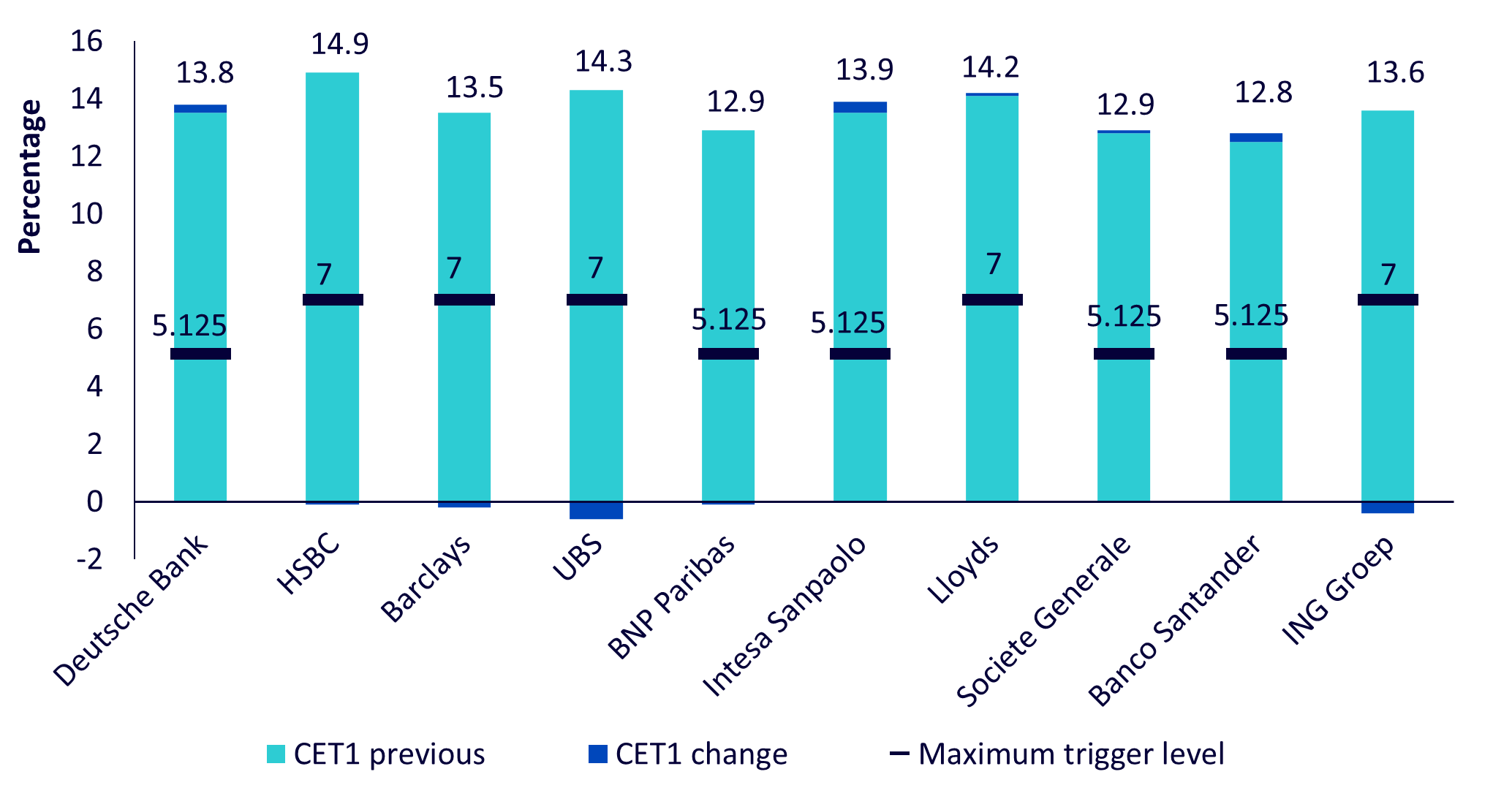 Source: WisdomTree, Markit, Bloomberg, respective issuers financial results. Data as of 31 Mar 2025. CET1 change represents value change in CET1 ratios from data available as of 31 Mar 2025 (generally Q4 2024 available reporting) compared to latest data available as of 31 Dec 2024 (generally Q3 2024 available reporting). No change may indicate reporting cycle has not ended. CET1 ratio is the Common Equity Tier 1 Capital ratio reported on a fully loaded basis available on Bloomberg and from the issuer’s latest financial results, if not reflected on Bloomberg. Maximum trigger level is represented by the maximum trigger observed across all CoCo issues of a given issuer. The strategy is represented by the iBoxx Contingent Convertible Liquid Developed Europe AT1 Index. Historical performance is not an indication of future performance and any investments may go down in value.
Unlike manufacturing, agriculture, or consumer goods sectors, banks face relatively less direct impact from rising tariffs. While these protectionist measures immediately affect companies engaged in cross-border trade, banking institutions remain one step removed from these pressures. Any effects on banks would materialise indirectly and later in the economic cycle, primarily through potential pressure on client companies or individuals if unemployment rises significantly. This built-in delay provides banks with valuable adaptation time that directly affected industries simply don't have.
Perhaps most reassuring for investors is the rigorous regulatory framework governing the banking sector. Financial institutions undergo regular stress tests calibrated to economic scenarios far more severe than any predicted tariff fallout. These assessments deliberately test banks against extreme conditions, including sharp economic contractions, severe unemployment spikes, and dramatic asset price declines. The fact that banks consistently pass these tests demonstrates resilience far beyond what would be needed to weather tariff-related economic turbulence.
The regulatory requirement for banks to be independently financed and regulated in each operating country further mitigates cross-border contagion risks. Unlike multinational corporations that may face direct impacts across their global supply chains, each banking entity maintains its own capital base and regulatory compliance. This compartmentalisation provides natural protection against the spread of localised economic challenges that might arise from targeted tariff measures.
With CoCo spreads currently close to 400 basis points, and yield above historical mean (Figure 2), these instruments offer notable value given the sector's fundamental strength. For yield-seeking investors navigating an uncertain economic environment, bank CoCos present an opportunity to access returns backed by a sector that is well-positioned to withstand economic pressures that may emerge from ongoing tariff discussions.
Figure 2: Historical yield on AT1 CoCos
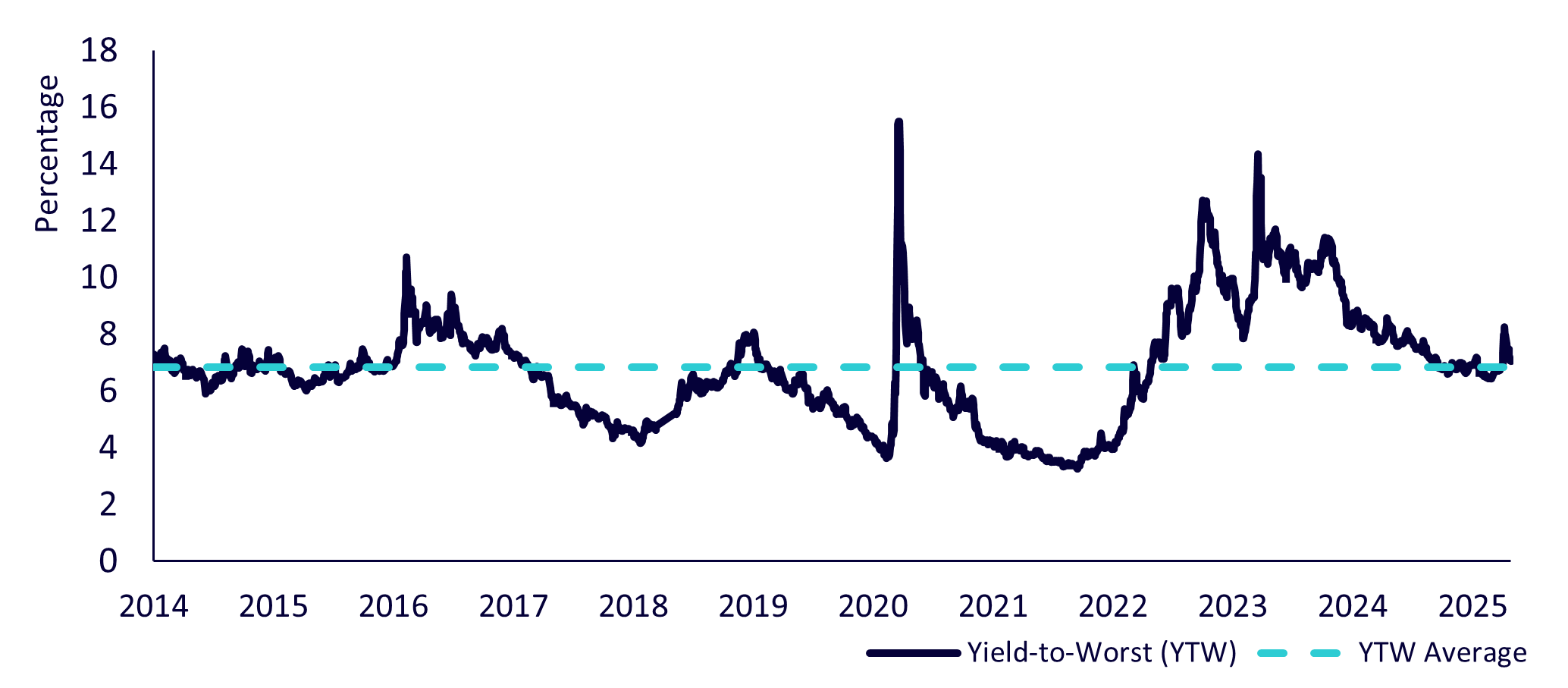 Source: WisdomTree, Markit. Period from 02 January 2014 to 28 April 2025. Calculations include backtested data. YTW is Yield to Worst reported by Markit and is based on the duration-adjusted market value weighting. Workout dates used in the yield to worst calculation of individual bonds are reset at the end of the month in case the bonds are not called. This calculation approach impacts the yield to worst figures for the index intramonth until the workout dates are reset. The strategy is represented by the iBoxx Contingent Convertible Liquid Developed Europe AT1 Index. You cannot invest directly in an index. Historical performance is not an indication of future performance and any investments may go down in value.
1Source: WisdomTree, Markit. Data as of 28 April 2025.







 Previous Post
 All Posts