




 Print Page
Renewable energy is catching a second wind


Key Takeaways
- Renewable energy deployment is accelerating at a record pace as countries prioritise both decarbonisation and energy security.
- China accounted for more than 60% of global renewable capacity additions in 2025 and is helping drive performance across the theme.
- The AI boom is creating new demand for renewable energy infrastructure, including technologies such as hydrogen fuel cells.
Back in the 1970s, the Arab-Israeli War changed the way the world thought about energy. In 1973, oil-producing nations imposed an embargo on several Western countries, sending oil prices higher and creating fuel shortages. Few countries felt the shock more acutely than Denmark, where imported oil accounted for around 90% of basic energy supplies at the time1. Faced with the risks of relying so heavily on foreign energy, Denmark began investing in alternatives, particularly wind power.
More than fifty years later, Denmark generates close to 90% of its net electricity from renewable sources, making it one of the world's leading renewable energy success stories2.
The recent conflict in Iran has once again highlighted the geopolitical risks associated with fossil fuels. If your car relies on imported fuel and that supply is disrupted, the car either stops running or becomes very expensive to run. But if all you need is electricity and you have a local supply of renewables, you have energy independence. Meanwhile, the AI revolution is driving a surge in electricity demand, creating another source of support for the sector. No, data centres aren’t running on solar power, but there is something else which will be discussed in this blog.
Renewable energy is catching a second wind, and investors seem keen to make hay while the sun is shining.
WisdomTree’s solution to capture the opportunity
The WisdomTree Renewable Energy UCITS ETF provides investors with the following:
- Comprehensive exposure across the renewable energy value chain.
Across five categories which include raw materials, manufacturing, enablers, applications, and emerging technologies, the exchange-traded fund (ETF) captures 32 distinct subsectors. For example, hydrogen electrolysers and hydrogen fuel cells are two distinct subsectors within the category of emerging technologies. This breadth provides diversification and access to the full spectrum of opportunities driving the world of energy. - A forward-looking design built with industry expertise.
Developed in partnership with Wood Mackenzie, the ETF uses a research-driven framework to evaluate the relevance and attractiveness of each subsector and company. These insights guide stock selection and weighting, with the aim of keeping the strategy aligned with the industry's evolution.
The structural trend remains strong
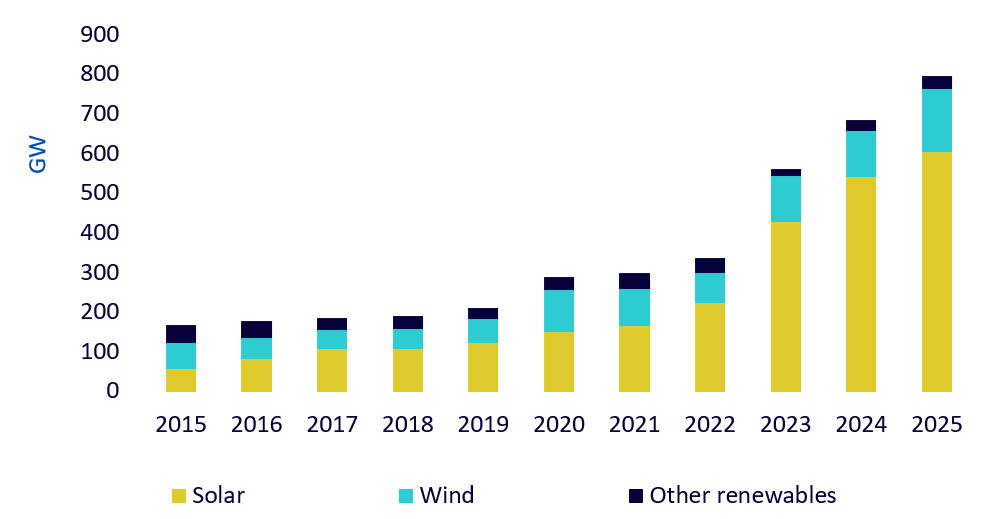
Figure 1: Global renewable energy capacity addition
Source: IEA, Global Energy Review, April 2026. Historical performance is not an indication of future performance and any investments may go down in value.
If investors needed a reminder that the renewable energy story is about more than short-term market sentiment, the latest data from the International Energy Agency (IEA) provides it. According to the IEA's Global Energy Review 2026, global renewable energy capacity additions reached almost 800 gigawatts (GW) in 2025, up 16% year-on-year and marking the 23rd consecutive year of record expansion. As the figure above shows, annual capacity additions have accelerated dramatically over the last decade, rising from less than 200 GW in 2015 to nearly 800 GW in 2025. Solar photovoltaic (PV) accounted for more than three-quarters of all new renewable capacity additions, while wind represented a further 20%.
The pace of growth is particularly striking since 2022. Following Russia's invasion of Ukraine and the resulting energy crisis in Europe, countries were reminded of the risks associated with dependence on imported fossil fuels, particularly Russian natural gas. Renewable capacity additions jumped from around 340 GW in 2022 to more than 560 GW in 2023, before continuing higher in 2024 and 2025. In many respects, renewable energy has become as much an energy security story as a decarbonisation story. The latest tensions involving Iran reinforce that point. While it is impossible to know whether recent events will trigger another acceleration in deployment, history suggests that geopolitical shocks often strengthen the case for domestically generated energy. With electricity demand also rising rapidly due to artificial intelligence, many investors continue to view the long-term outlook for renewables favourably.
Chinese stocks are helping lift the theme
China remains at the centre of the renewable energy story. According to the IEA, the country accounted for more than 60% of global renewable capacity additions in 2025, commissioning nearly 370 GW of solar PV and 117 GW of wind capacity in a single year. More broadly, Chinese equities have enjoyed a resurgence over the past year, supported by technological advances in areas such as artificial intelligence, robotics, electric vehicles, batteries and renewable energy. A weaker US dollar, improving investor sentiment towards China and supportive domestic policies have also helped attract capital back into the market. As a result, renewable energy stocks have benefited not only from strong industry fundamentals but also from a broader re-rating of Chinese equities.
Several Chinese companies linked to the renewable energy value chain have delivered particularly strong returns. Consider two examples. Beijing Sifang Automation, which provides grid automation and power system solutions, has benefited from rising investment in electricity networks needed to accommodate growing renewable energy capacity. As more solar and wind power is added to the grid, the need for intelligent transmission and distribution infrastructure increases. Meanwhile, Jiangsu Zhongtian Technology has gained from strong demand for power cables and energy transmission equipment, which are essential for connecting renewable energy projects to end users. In both cases, investors appear to be recognising that the energy transition is about more than simply generating renewable power. It also requires the infrastructure needed to transmit, manage and store that energy efficiently. Both companies have been among the top-performing stocks in this theme this year.
The AI effect is boosting renewable energy
When investors think about renewable energy, they typically think of solar panels and wind turbines. The renewable energy universe is much broader than that. One technology that has spent years in relative obscurity is hydrogen. Despite its promise as a clean energy source, many investors questioned where hydrogen would fit into the future energy system and whether demand would ever materialise at scale.
The rise of artificial intelligence may be providing an answer. Bloom Energy, whose fuel cell technology can run on hydrogen and other fuels, has been one of the standout performers in the sector. In October 2025, the company announced a $5 billion strategic partnership with Brookfield to help power the next generation of AI infrastructure. Bloom's fuel cells were selected because they can provide reliable onsite power quickly, helping data centres overcome grid constraints at a time when electricity demand from AI is surging. Just six months later, Bloom expanded its relationship with Oracle, announcing a framework agreement that could see up to 2.8 gigawatts of fuel cell capacity deployed to support AI and cloud computing infrastructure across the United States.
The significance extends beyond a single company. For years, the challenge facing hydrogen-related technologies was finding a strong commercial use case. AI may be changing that. Data centres require enormous amounts of electricity, and increasingly, they need it faster than traditional grids can deliver. Technologies that can provide scalable, resilient and lower-emission power solutions are therefore attracting renewed attention. In other words, the AI revolution is not only creating demand for semiconductors and data centres. It is also creating opportunities for parts of the renewable energy ecosystem that many investors had previously overlooked.
Conclusion
Thematic investing can sometimes mean backing technologies that may or may not take off, but renewable energy feels different, because it is already a core part of the global energy system and is growing faster than ever as the world’s power needs rise. The progress is happening first, and markets are only then catching up. That is what makes the story so credible, and, dare I say, such an evergreen theme.
While the renewable energy theme may benefit from long-term structural trends, investments in companies operating within the sector can be volatile and may be affected by changes in regulation, government subsidies, technological developments, commodity prices and broader market conditions. Thematic investments typically involve more concentrated exposure than broad market strategies and may experience periods of underperformance. Exposure to Chinese companies and emerging technologies may also increase political, regulatory and market-related risks.
1Source: IMF library, 1986.
2Source: Investindk.com, June 2026.




 Previous Post
 All Posts