




 Print Page
From incursions to investment – Europe’s defence build out is accelerating


Key Takeaways
- Airspace incursions and Germany’s shoot-down authority for hostile drones, have accelerated EU/NATO procurement beyond heavy platforms into space communications, counter-UAS, seabed security and chemical, biological, radiological and nuclear (CBRN) protection.
- The recent rebalance for the WisdomTree Europe Defence UCITS Index extends diversification into space communications, counter Unmanned Aerial Systems (UAS), seabed security and protection.
- Sector price-to-earnings (P/E) looks optically high today, but double-digit EPS growth is set to compress multiples as backlogs convert.
The war on Europe’s eastern flank has shifted from a grinding stalemate to a higher-tempo phase. Russia has intensified ‘grey zone’ pressure across the continent while pushing new waves of long-range strikes into Ukraine. European air policing has been tested repeatedly, most visibly on 21-22 September 2025 when a Russian MiG-31 briefly violated Estonian airspace, prompting rapid NATO intercepts1. At sea and along borders, hostile drones and electronic probing have become more prevalent.
European Union (EU) members are hardening their airspace and critical infrastructure. Germany now allows police to shoot down threatening drones following cabinet approval of a national measure that authorises neutralisation by firearms, lasers or jamming2. That backdrop has revived the ‘drone wall’ conversation among Baltic-Nordic states and Brussels – the idea is a layered, continent-scale mesh of surveillance, jamming and interceptors to blunt low-cost incursions and hybrid attacks3.
European defence in the spotlight
On the geopolitical side, US President Donald Trump used the United Nations General Assembly week in late September to declare his belief that Ukraine can reclaim its territory, with Europe carrying more of the load. This further galvanises Europe’s multi-year rearmament cycle. European demand has broadened beyond heavy platforms into space communications, counter Unmanned Aerial Systems (UAS), seabed security and chemical, biological, radiological and nuclear (CBRN) protection. These are areas where Europe leads technologically and where procurements are converging into funded programs.
WisdomTree Europe Defence UCITS ETF’s scale and structure
For investors, this creates a rare opportunity: predictable capital flows, structural demand across munitions, sensors, mobility and industrial champions positioned for growth. The WisdomTree Europe Defence UCITS ETF (Ticker: WDEF) has scaled materially since its launch on 11 March 2025 to more than US$4.2bn in assets under management4.
WDEF tracks the price and yield performance of the WisdomTree Europe Defence UCITS Index (Ticker: WTEUDEFN), an in-house benchmark built from the ground up to capture European companies that derive a meaningful share of revenue from defence. The index is reconstituted semi-annually (in March and September) and only admits companies with more than or equal to 10% defence revenue, along with additional liquidity and ESG screens. That structure is starting to pay off with the latest rebalance drawing in companies that add pillars in personal protective equipment, space-based secure communications, maritime robotics and CBRN detection – exposures with different booking cycles from large platforms. This helps to smooth cash flow profiles across the portfolio.
What changed in the September rebalance
The September rebalance additions are designed to fill capability gaps that Europe is prioritising in real programmes. We made a total of eight new company additions, which account for 2.4% of the index weight5. The weighted average defence exposure of the WisdomTree Europe Defence UCITS Index to defence is 56.5%6. The Belgian-Dutch replacement Mine Countermeasures (rMCM) fleet is demonstrating that remote, stand-off mine hunting works. France’s IRIS2 secure connectivity programme has locked its concession and ministries are letting urgent orders for soldier systems and CBRN.
The eight new additions are discussed below:
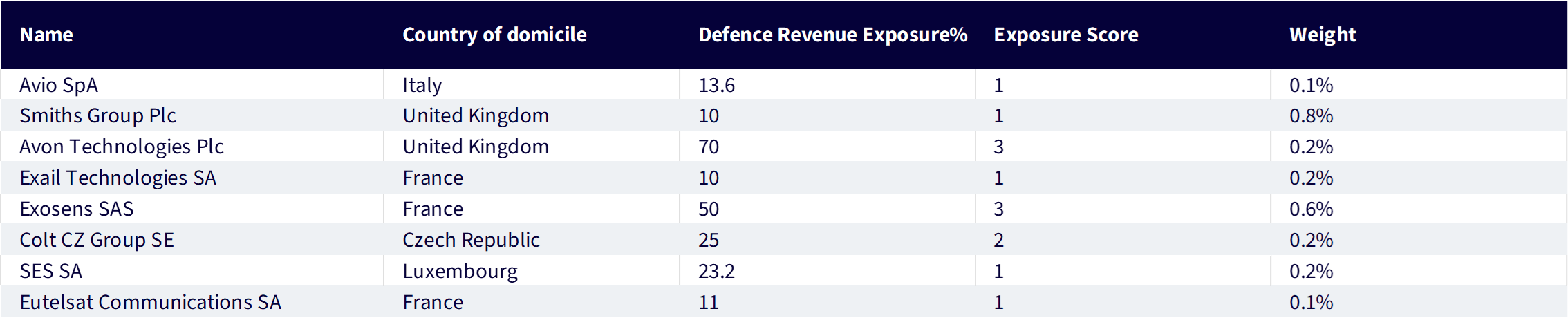
Source: FactSet, WisdomTree. Holding weights as of 19 September 2025. Revenue exposure as of 31 August 2025, the screening date of the most recent rebalancing.
New entrants and how they add value
Avio S.p.A is Europe’s specialist in solid rocket propulsion for air-defence missiles and space launch. Its inclusion in WDEF adds a strategic niche. Avio supplies rocket motors for Common Anti-air Modular Missile – Extended Range (CAMM-ER) and components for ASTER 30, while also building P120C solid boosters and cryogenic turbopumps for Ariane 6. Over the past year, Avio signed a €150mn contract with MBDA Italia for CAMM-ER rocket motors7. Avio announced roughly €60mn of orders with MBDA France for ASTER-30 motors and aerodynamic surfaces. In H1 2025, Avio’s results highlighted a €1.7bn backlog and a new supplemental agreement with a US Government armed force to expand tactical missile solid motor capacity.
Smiths Group Plc – Smiths detection unit supplies the US Department of Defence with JCAD (Joint Chemical Agent Detector) and the next generation Aerosol and Vapor Chemical Agent Detector (AVCAD) which helps provide a steady programme-driven demand. It diversifies WDEF into CBRN protection.
Avon Technologies Plc adds a personal protective equipment pillar, which includes respirators and Next Generation (NG) Integrated Head Protection System (IHPS) helmets. This exposure tends to benefit from multi-year Indefinite Delivery/Indefinite Quantity (IDIQ) contracts and urgent operational demand, offering a different cycle than traditional platforms. Multiple NG IHPS delivery orders have followed in 2025: $18mn (announced 6 January 2025) and US$17.6mn (announced 3 March 2025), providing evidence that soldier system refresh cycles are active and budgeted. Avon Technologies previously screened below 10%, but with improved order momentum and a clearer mix, the company was able to cross the 10% revenue defence threshold.
Exail Technologies SA provides exposure to Autonomous Underwater Vehicles (AUVs), Uncrewed Surface Vehicles (USVs) and inertial navigation systems. This exposure offers capabilities at the core of NATO mine-countermeasures and seabed security. In the Belgium- Netherlands replacement Mine Countermeasures (rMCM) program, sea trials have progressed. Exail’s Inspector-125 USV launch/recovery from the mothership has been demonstrated. The world-first Launch and Recovery (LAR) of a USV from the rMCM mothership demonstrates that the concept works at sea. The mothership can stay outside the minefield while unmanned vehicles do the dangerous work. That reduces risk to crews and is faster than legacy, man-in-the-field approaches. Exail also announced a fleet order of five DriX H-8 USVs from Europe8.
Exosens, the former photonics group, adds electro optical night vision and low light imaging components that are seeing secular up-shifts in demand from the Ukraine conflict and NATO night fighting doctrine. The company listed in Paris on 7 June 2024 and exceeded its IPO guidance with a 35% revenue increase to € 394.1mn. Exosen increases WDEF’s soldier-overmatch exposure and pairs naturally with Avon’s helmets and respirators.
Colt CZ Group SE adds direct leverage to small arms and ammunition, amid a fast turn event-driven demand tied to NATO replenishment and Eastern European rearmament, complementing WDEF’s heavier long lead programs. Colt CZ Group SE recently closed the acquisition of Sellier & Bellot (S&B) on 16 May 2024 for US$350mn, vertically integrating into ammunition9. 2024 revenue increased due to organic growth and the consolidation of Sellier & Bellot. EBITDA increased by 61.6% to CZK 2,358.3mn for the six months ended 30 June 2025, compared to the six months ended 30 June 2024.
SES SA brings a multi-orbit satcom operator with deep government/MILSATCOM exposure (via GovSat and US programmes). That adds critical infrastructure resilience and assured communications exposure to WDEF. SES SA acquired Intelsat, creating a 120 satellite GEO+MEO operator with greater scale10. GovSat-2 was also announced to meet rising secure-comms demand11.
Eutelsat’s 2023 merger with OneWeb created the world’s first integrated Geostationary Earth Orbit (GEO) and Low Earth Orbit (LEO) operator, which has been useful for sovereign connectivity, backhaul and Intelligence, Surveillance and Reconnaissance (ISR) support. It diversified WDEF’s exposure within space communications. Eutelsat, alongside SES and Hispasat is part of the SpaceRISE consortium selected to deliver Infrastructure for Resilience, Interconnectivity and Security by Satellite (IRIS2) – the EU’s secure connectivity programme12.
What’s not in the price?
Post the September rebalance, WisdomTree Europe Defence UCITS Index is positioned for strong earnings growth, with earnings per share expected to rise by 16% in one year and 15% in the next two years13. This reflects expanding market share, multi-year procurement cycles, and increasing defence budgets across Europe. While cash flow per share may dip temporarily as companies scale operations, debt levels are projected to decline, ensuring financial stability.
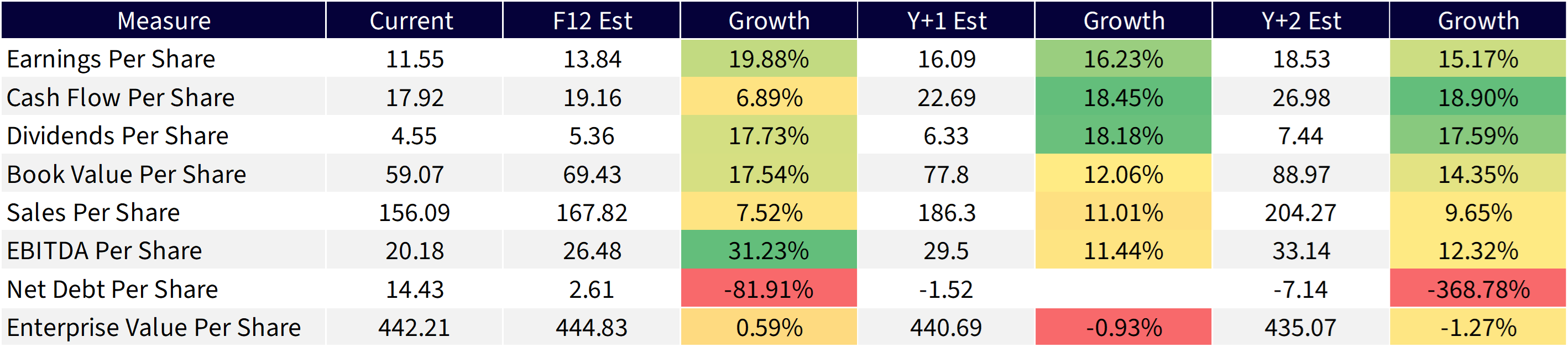
Source: Bloomberg, WisdomTree as of 8 October 2025. Forecasts are not an indicator of future performance and any investments are subject to risks and uncertainties.
A higher P/E ratio doesn’t mean it’s expensive
At first glance, the current Price-to-Earnings (P/E) ratio for the European defence sector at 38x may appear elevated. However, this reflects current earnings levels, not future profitability. The defence sector operates on long-term contracts, meaning that earnings expansion takes time to materialise.
As order backlogs convert into revenue and profitability scales up over the next few years, earnings growth will naturally drive the P/E ratio down. By 2026 and 2027, with higher earnings expectations already forecasted, valuation multiples are expected to become more attractive.
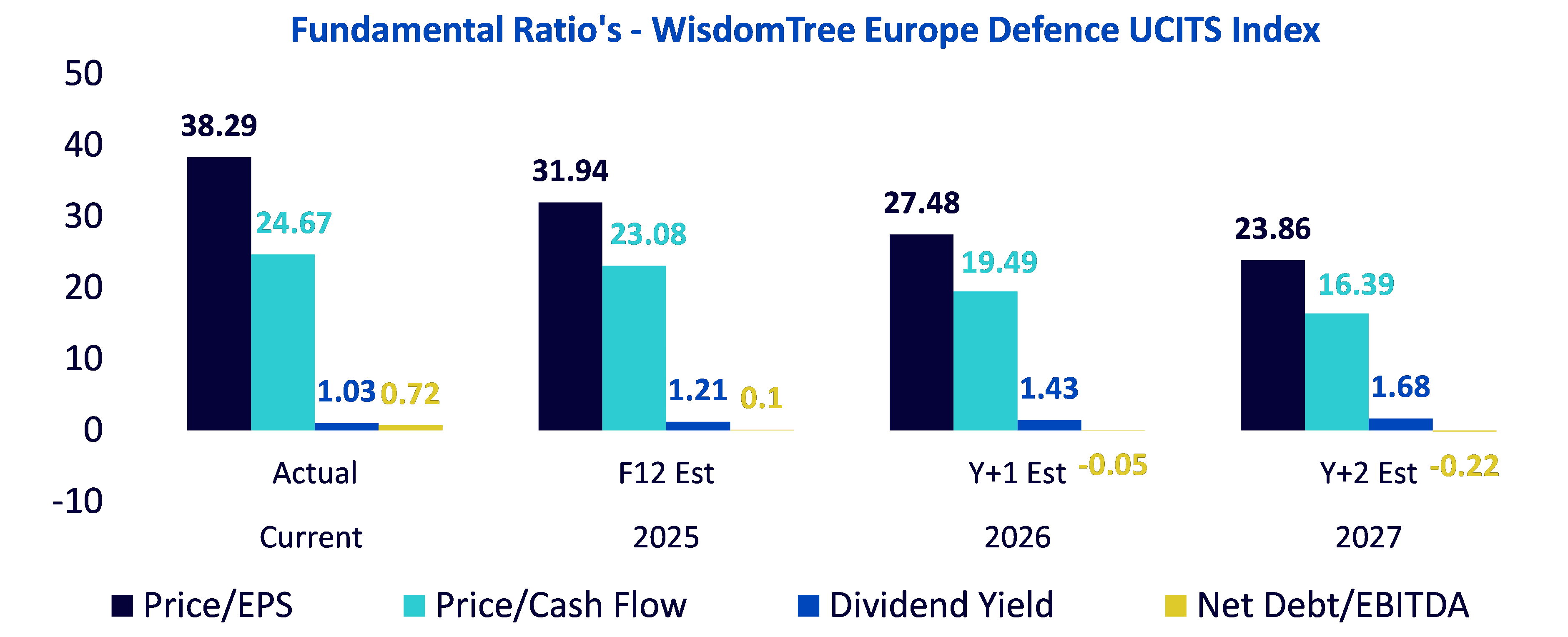
Source: Bloomberg, WisdomTree as of 8 October 2025. Forecasts are not an indicator of future performance and any investments are subject to risks and uncertainties.
Conclusion
Europe’s defence cycle is no longer hypothetical; it is policy-backed and operationally urgent. As governments transition from intent to implementation, capital is flowing into the enablers of modern deterrence: resilient communications, autonomy at sea, night-fighting sensors, and personal/CBRN protection. The September rebalance positions WDEF squarely on that spend, adding eight names that diversify sub-sectors and booking cycles while keeping the index’s discipline on defence revenue, liquidity and ESG. While execution, budget timing and geopolitics remain the key risks the direction of travel is clear, and the portfolio is built to participate in Europe’s multi year rearmament cycle.
1NATO, 23 September 2025
2Reuters as of 8 October 2025
3Defence News, 29 September 2025
4Bloomberg as of 8 October 2025.
5FactSet, WisdomTree as of 19 September 2025.
6FactSet, WisdomTree. Holding weights as of 19 September 2025, 31 August 2025, revenue exposure as of the screening date of the most recent rebalancing.
7Source: Avio, company website as of 4 December 2024
8Naval News as of 30 June 2025
9Colt Group, company website as of 16 May 2024
10SES, Company website as of 17 July 2025
11SES, Company website as 24 July 2025
12SES, company website as of December 2024
13Bloomberg, WisdomTree as of 8 October 2025








 Previous Post
 All Posts