





 Print Page
Still just using your ISA for cash? You could be missing out


Key Takeaways
- Cash has an important role in an ISA, but holding too much for too long can erode purchasing power due to inflation.
- Combining a reduced Cash ISA allocation with a diversified global stock portfolio has, historically, improved long-term outcomes.
- While stocks carry short-term risk, the likelihood of positive returns increases significantly over longer investment horizons.
With Cash ISA1 limits set to tighten and inflation eroding returns, even a small allocation to equity investments could make a meaningful difference over time. On 6 April 2027, the Cash ISA limit will fall from £20,000 to £12,000 for under 65s, leaving the 2026–27 tax year as the final opportunity to use the full allowance. The aggregate allowance for Cash ISAs and Stocks and Shares ISAs will remain at £20,000 and over 65s will still be able to put their full allowance into cash. In this blog, we’ll explore the effect of changing from a Cash ISA-only plan to one that uses the new2 annual Cash ISA allowance (£12,000) and allocates the remaining £8000 to a global, diversified stock basket within a Stocks and Shares ISA. Cash allocations have their place, but too much for too long can hurt purchasing power.
When a cash position makes sense
Investing in lower-risk instruments, such as cash, and earning a relatively lower return isn’t inherently bad. On the contrary, there are good reasons why you might have a sizeable position in cash. For example:
- Saving for a house deposit, wedding, or school fees which are due in the next few years
- Having an emergency fund to provide a liquidity buffer for unforeseen and uncomfortable times
- Nearing retirement
Labelling cash investments as ‘wrong’ and a wasted opportunity isn’t right. The key is to define the appropriate amount (for example, how many months of expenses does my emergency fund need to cover?).
But if you are choosing cash due to a lack of knowledge about investing or a fear of making mistakes or losing money then you may be missing out on growth potential and greatly underestimating the effects of inflation on purchasing power.
In the following section, we’ll show what happens to your ISA savings plan when investing solely in cash, and what happens if a portion of that is invested in a diversified basket of global stocks.
The effects of adding stocks and shares to your ISA plan
To show the real effects of only investing in cash, we’ve simulated a monthly savings plan where, over a year, £20,000 is invested in a Cash ISA plan earning the average variable deposit rate. We date the simulation back to 1988, from when we have UK inflation data available. For simplicity and comparability over time, we assume a constant annual Cash ISA allowance of £20,000 throughout the entire period, even though actual allowance limits were significantly lower in earlier years and ISAs were only introduced in 1999. This approach helps us clearly show the impact of holding cash alone over the long term, rather than reflect exactly what an investor would have experienced.
From 1988 to 2026, the strategy would have returned a cumulative return of 76.5% on the invested capital. That might not sound too bad for an ultra-low risk investment, but when accounting for inflation, the real return was -2.2%, implying that this plan did not manage to preserve the value of the invested capital.
While interest rates and inflation are strongly connected to each other (central banks usually lift interest rates to combat high inflation), inflation often comes unexpectedly and compresses real returns before central banks can react, as was seen post COVID-19.
Figure 1: Comparing two different allowance strategies. The impact of adding stock investments over the long term (1988-2026).
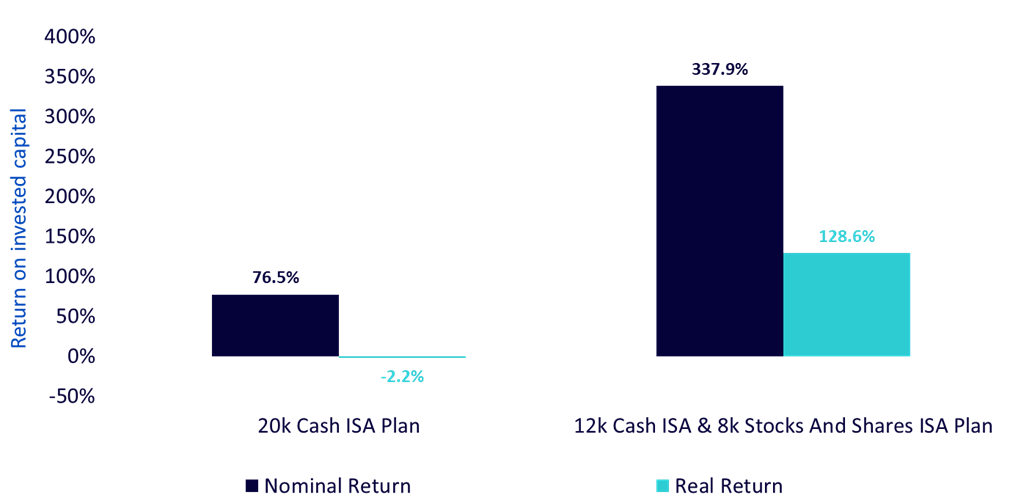
Source: Bank of England, Bloomberg, MSCI. Data from January 1988 to February 2026. The 20k Cash ISA Plan illustrates a monthly savings plan with regular monthly contributions totalling £20,000 per annum. Cumulative returns are based on the variable-rate Cash ISA deposit rate (excluding unconditional bonuses, not seasonally adjusted) as published by the Bank of England. Prior to 2011, the rate is approximated using the Bank of England’s Bank Rate. The 12k Cash ISA & 8k Stocks and Shares ISA Plan follows the same methodology, with £8,000 of the £20,000 annual contribution invested in the MSCI World Net Total Return Index (GBP). Nominal returns are not adjusted for inflation. Real returns are calculated by adjusting nominal returns for changes in the UK Consumer Price Index (CPI). Historical performance is not an indication of future performance, and any investments may go down in value.
As a second example, we split the annual allowance, with £12,000 going to the Cash ISA plan and the remaining £8,000 allocated to a global stock tracker within a Stocks and Shares ISA. Despite the majority of invested capital still remaining within the cash plan, the stock allocation makes a big difference: in nominal terms, the invested capital more than quadrupled while, in real terms, the investment more than doubled.
Hence, the long-term impact of a reduced Cash ISA contribution, combined with a diversified stocks investment, has been hugely beneficial in the past. And, of course, the reason why stocks have performed better than cash is that stocks are inherently risky. In the next section, we will learn how to put risk into perspective by choosing the appropriate investment time horizon.
Understanding risk with respect to the investment horizon
Over the short term, investments in stocks carry a high risk of losing all or part of their value. Since 1988, almost 38% of the monthly returns of the MSCI World Index in British pounds were negative. Even when considering returns over one year, there has still been a 21% chance that the investment lost value.
However, in Figure 2, we can also see that the longer the investment horizon, say 5 or 10 years, the lower the chance of losing money with a global, diversified stocks investment. Over 5 years, there has been an almost 90% chance that returns were positive, and over 10 years, over 96%.
Figure 2: The proportion of negative outcomes rapidly decreases with the length of the investment.
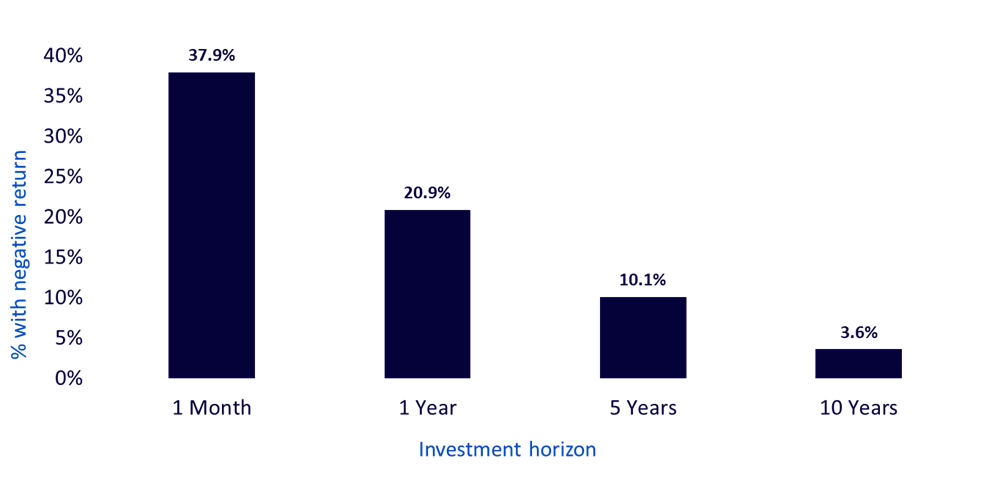
Source: Bloomberg, MSCI. Data from January 1988 to February 2026. The bars represent the percentage of periods with negative returns out of all observed periods for each respective investment horizon, based on the MSCI World Net Total Return Index (GBP). For example, the 1-month value shows the proportion of all 1-month periods in which the index delivered a negative return. Historical performance is not an indication of future performance, and any investments may go down in value.
What we take away is that, for risk-averse investors, building a stock-based savings plan takes time. It also means that, when saving for a large purchase, for example a house deposit, correctly identifying when the payment is due is important. For example, if the plan is to buy a house within the next 5–10 years, the opportunity cost of a cash-only investment can exceed the risk taken by a diversified investment in the global stock market. Whereas if you’re buying a house next month, a cash rate doesn't sound so bad.
Summary
Not all cash allocations are bad, quite the opposite, there are good reasons why we should invest in a Cash ISA. The problem is when the allocation becomes too large and is held for too long. We showed that the new allowance3 for Cash ISAs, combined with a global stock portfolio within a Stocks and Shares ISA, can help to maintain purchasing power. At the same time, we showed that the risk of losing money has historically decreased with longer investment horizons. Though the Cash ISA limit isn’t decreasing until next April (2027), you don’t need to wait until then to start exploring the potential growth opportunities that a Stocks and Shares ISA can offer.
1. ISA = individual savings account.
2. The ‘new’ allowance will come into effect from 6 April 2027.
3. The Cash ISA allowance will drop from £20,000 to £12,000 in April 2027.



 Previous Post
 All Posts