





 Print Page
AT1s: a grand cru year for a maturing market


Key Takeaways
- 2025 confirmed that AT1s have matured into a core part of the fixed income universe. The market absorbed record issuance with strong institutional demand, showing genuine structural depth.
- Liberation Day tested this maturity. Volatility rose, but the sell-off was contained and investors bought the dip. CoCos remained notably more stable than European bank equities, reflecting confidence in the strength and regulation of European banks.
- While further spread tightening may be limited, AT1s still offer around 6% yield-to-worst and stand out as an attractive option for investors seeking higher income with controlled risk.
As we move through the final quarter, it's worth taking stock of what 2025 has delivered for AT1s. The year has shaped up to be a strong one. Perhaps not an all-timer, but certainly a grand cru given the macro noise and volatility across other asset classes. Figure 1 shows cumulative performance that reflects a market which has matured meaningfully over the past decade.
Figure 1: Cumulative Performance
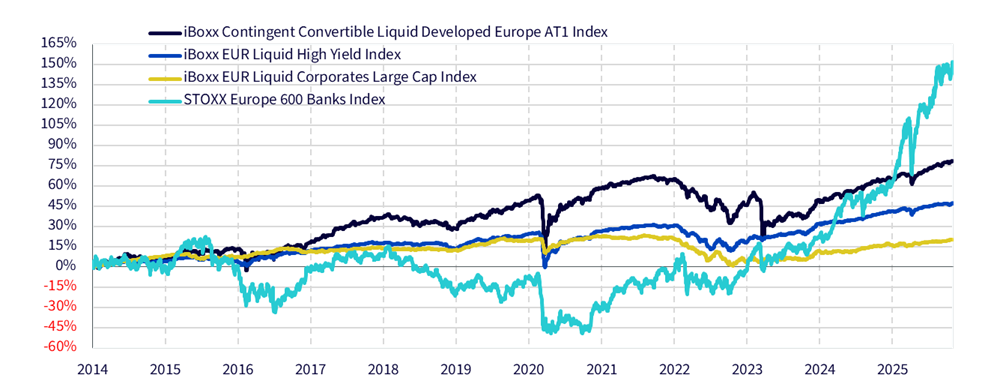
Source: WisdomTree, Bloomberg. Period from 31 December 2013 to 31 October 2025. Based on returns in EUR. All fixed income indices are total return indices; all equity indices are net total return indices. Performance includes backtested data. Performance of the iBoxx Contingent Convertible Liquid Developed Europe AT1 Index is based on the EUR-hedged version of the strategy. The iBoxx Contingent Convertible Liquid Developed Europe AT1 Index (EUR Hedged) started its live calculation on 09 March 2018. You cannot invest directly in an index. Historical performance is not an indication of future performance and any investments may go down in value.
A healthy primary market
Primary issuance remained robust throughout 2025. Order books frequently ran to more than ten times deal size, with the market absorbing elevated supply without strain. Outstanding AT1 volumes reached record highs. Yield appeal played a part, but this was not simply opportunistic money chasing carry, as institutional demand showed genuine depth. The investor base has evolved, with insurers and asset managers now participating consistently, signalling a structurally durable market rather than one reliant on anchor orders.
Extension risk: the market’s coming of age
The bigger shift this year came around extension risk. Historically, bonds with thin back-end economics were penalised, yet in 2025 they led performance. When Deutsche Bank skipped a US dollar call in April, an event that would once have triggered contagion fears, the market barely flinched. Investors instead focused on robust capital levels, stable regulation and reset economics, concluding that extension was not a material concern. Whether that confidence reflects clear-eyed analysis or complacency is debatable, but it has unquestionably defined the tone of the year.
Liberation Day: a true stress test, calmly passed
Liberation Day offered one of the first stress tests for CoCos in several years. Spreads widened sharply at first, but the sell-off was notably contained by historical standards, and, importantly, investors bought the dip. This ‘buy-the-dip’ reflex was a defining moment as it revealed that AT1s have become an established institutional asset class rather than a speculative niche. What was particularly striking was the relative stability of CoCos compared with other asset classes, including European bank equities and broader credit markets. While bank stocks exhibited larger drawdowns, AT1s remained orderly. This showcased investors’ confidence in the fundamental strength of European banks, which continue to operate with strong capital buffers and under rigorous supervision. The conversation around AT1s has clearly shifted from existential risk to relative-value positioning.
Contagion from the US: a sentiment story, not a structural one
Recent spread widening in European AT1s has reflected contagion from US regional banking stress, where private credit exposures, such as the First Brands case and other loan issues, have come under pressure. This is a purely US story. European and UK banks remain well-capitalised and tightly regulated, with none of the structural vulnerabilities of US regional lenders. The move in spreads appears to be driven more by sentiment than by fundamentals, and if that’s the case, it presents selective entry opportunities for investors.
Outlook: maturity, stability and yield
Looking ahead to 2026, further spread tightening from current levels may be limited, given the already strong performance and tighter valuations. However, AT1s continue to offer an attractive yield of just under 6% (yield to worst as of 31 October 2025), supported by the solid capital position of the European banking sector.
The past year has shown that the AT1 market has truly come of age. Contingent convertible bonds are now a mainstream part of the fixed income toolkit, capable of withstanding periods of stress, rewarding long-term investors and can deliver a combination of yield and resilience.
For investors seeking higher income and diversification within their fixed income portfolios, AT1s provide an opportunity that blends income potential, stability and exposure to one of the most resilient banking systems globally.






 Previous Post
 All Posts