




 Print Page
Tariffs and turbulence: finding stability with Quality


Key Takeaways
- In light of rising global economic uncertainty and recent trade-related disruptions, the Quality factor—defined by strong balance sheets and consistent profitability—has historically helped reduce drawdowns and improve resilience during periods of elevated market volatility.
- Unlike more cyclical factors, Quality has delivered positive average returns across all phases of the business cycle. Over rolling 10-year periods, it has outperformed the market 90% of the time while limiting downside risk during periods of underperformance.
- WisdomTree’s Quality Dividend Growth and Quality Growth strategies provide systematic, rules-based access to high-quality companies. Both strategies have demonstrated superior risk-return characteristics versus traditional benchmarks, enhancing the efficiency of equity portfolios.
Last month, US President Donald Trump initiated a series of aggressive trade policies, imposing a 10% universal tariff on all imports and escalating duties on Chinese goods to as high as 245%. These measures, part of his "Liberation Day" agenda, aim to bolster domestic manufacturing but have introduced significant volatility into global markets. The immediate aftermath saw a sharp decline in stock indices and a contraction in US economic growth, raising concerns among investors about the stability of their portfolios.
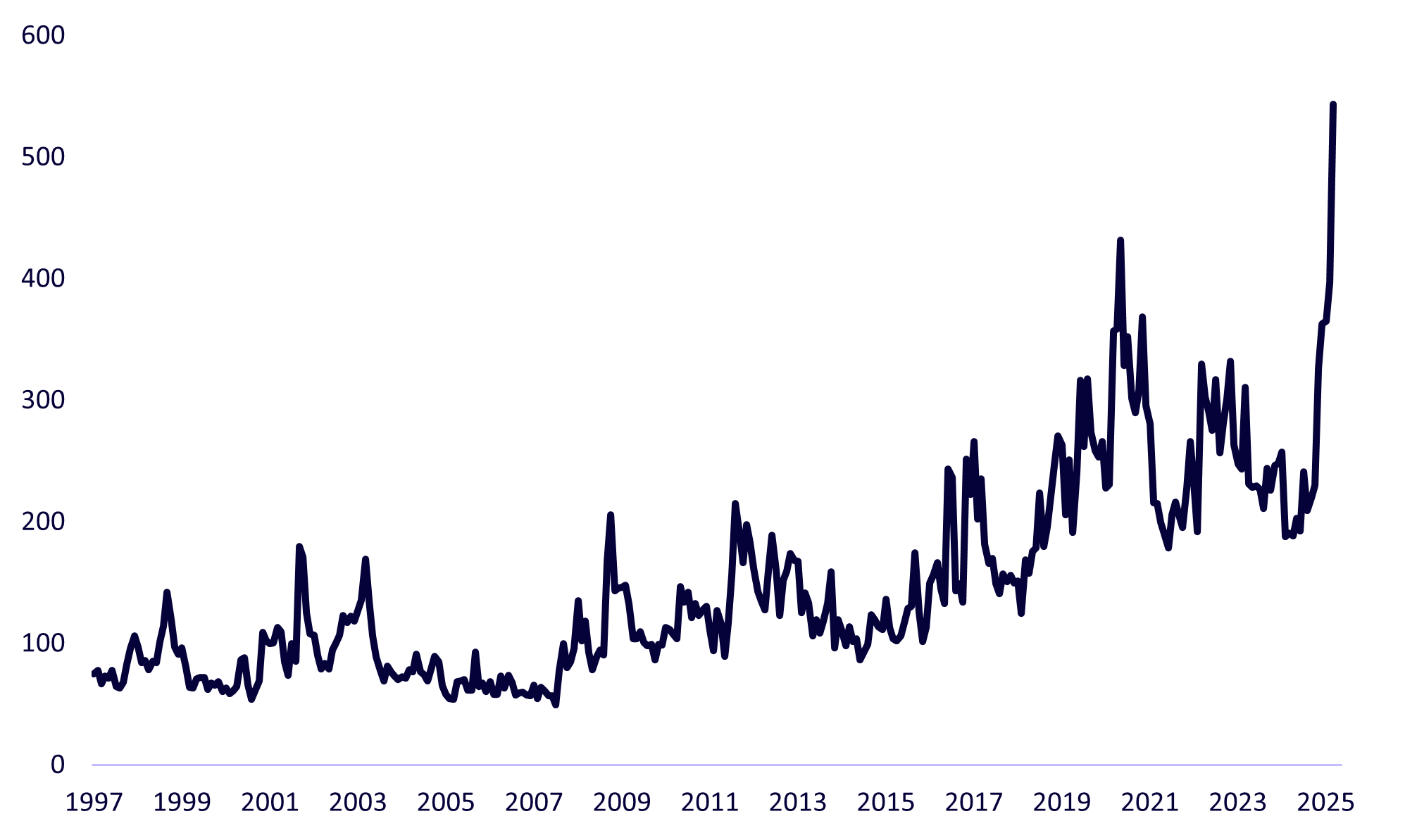
According to the Global Economic Policy Uncertainty Index (developed by Baker, Bloom, and Davis), global uncertainty has recently surged to all-time highs. This index, which measures the frequency of newspaper references to economic uncertainty across major economies, provides a sobering look at just how uncertain the outlook has become.
Figure 1: Global Economic Policy Uncertainty Index
 Source: Baker, Bloom & Davis, Bloomberg, WisdomTree, monthly data available as of close 31 March 2025. Historical performance is not an indication of future performance, and any investments may go down in value.
Periods of heightened uncertainty are often accompanied by greater volatility, deeper drawdowns, and a surge in risk aversion. In such times, the instinct might be to seek safety in cash or the perceived comfort of broad-based diversification. But history offers another perspective—investing in Quality.
Amidst this backdrop of heightened economic uncertainty, the Quality investment factor has emerged as a potential haven. Characterised by companies with strong balance sheets, consistent earnings, and robust profitability, Quality investments have historically demonstrated resilience during periods of market stress. As trade tensions continue to unsettle markets, allocating assets toward Quality-focused strategies may offer investors a means to navigate the turbulence while seeking stable returns.
Quality: a resilient factor through market cycles
The Quality factor, which tilts toward companies with strong balance sheets, high return on equity and return on assets, has demonstrated consistent outperformance, especially during turbulent market environments. Unlike more cyclical factors like Value, Size, Momentum or even Low-volatility, Quality tends to offer a smoother ride while maintaining steady outperformance versus the market.
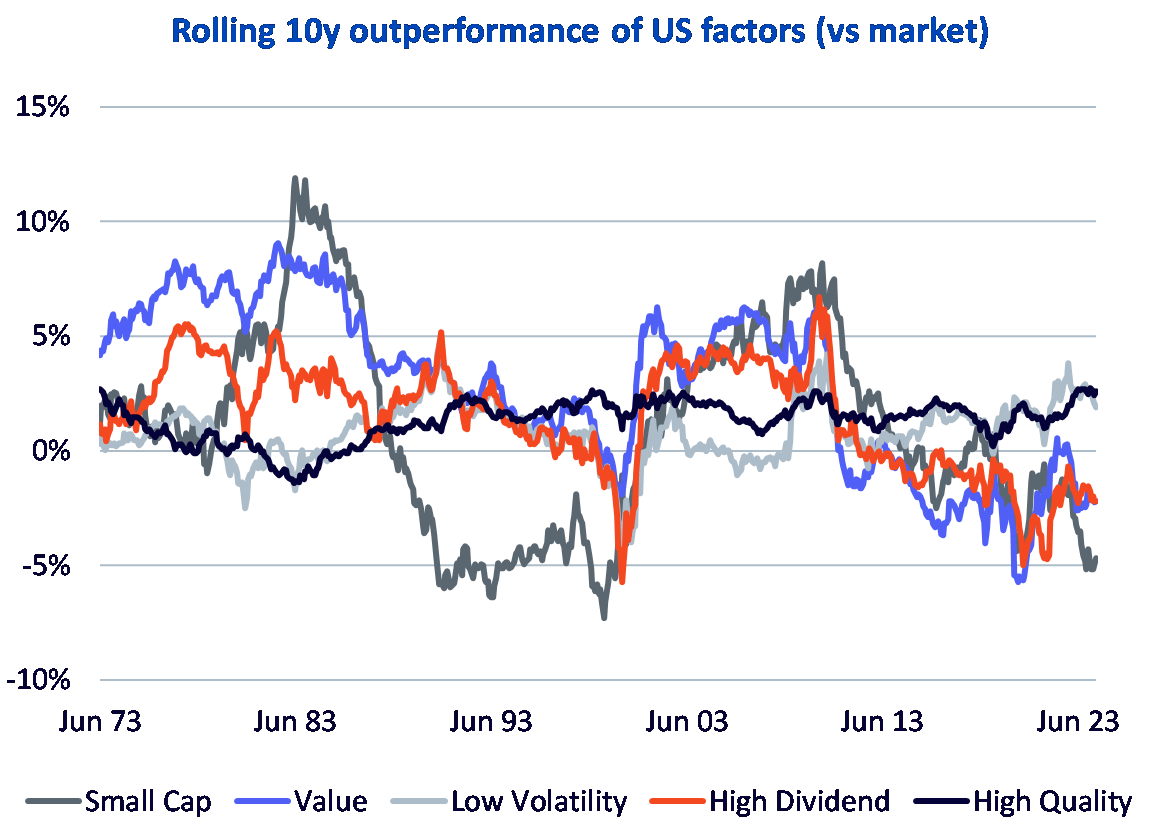
Over the long term, Quality has not only outperformed on a return basis but has also delivered a more stable experience for investors. A look at 10-year rolling returns of the world’s largest stock market shows that Quality has been a standout across time periods and market regimes. Not only does Quality outperform the market 90% of the time on a rolling 10-year window, it also offers strong resilience with the lowest worst underperformance.
Figure 2: Rolling 10-year annualised outperformance of US factors (vs market)
Sources: WisdomTree, Ken French, data as of 31 December 2024 and represents the latest date of available data. Value: High 30% Book to Price portfolio. Size: Low 30% portfolio. Quality: High 30% portfolio. Low Vol: Low 20% portfolio. High Div: High 30 portfolio. "&" Market: all CRSP firms incorporated in the US and listed on the NYSE, AMEX or NASDAQ. Historical performance is not an indication of future performance, and any investments may go down in value.
What makes this even more compelling is Quality’s behaviour across different phases of the business cycle—expansion, peak, contraction, and trough. While most factors tend to be cyclical, Quality has shown positive average returns across all four stages.
Figure 3: Quality stocks tend to perform strongly across the business cycle

Sources: WisdomTree, Ken French, data as of 31 December 2024 and represents the latest date of available data. Quality=High 30% portfolio. Market: all CRSP firms incorporated in the US and listed on the NYSE, AMEX or NASDAQ. Historical performance is not an indication of future performance, and any investments may go down in value.
This combination of long-term upside and resilience in downturns makes Quality an attractive core allocation—particularly when macro risks are elevated.
Two pathways to Quality: WisdomTree’s targeted approaches
At WisdomTree, we believe investors can benefit from a rules-based, focused implementation of the Quality factor. Our two flagship ranges represent different expressions of the same foundational principle:
WisdomTree Quality Dividend Growth range
This strategy seeks to combine Quality and Dividend Growth by identifying companies with high return on equity, high return on assets, and strong earnings growth expectations. The result is a portfolio tilted toward profitable companies that have the capacity to grow dividends over time.
WisdomTree Quality Growth range
For those seeking high-growth potential without compromising on Quality fundamentals, the Quality Growth range focuses on companies that exhibit both strong profitability and strong growth metrics. These are typically firms reinvesting in their future yet anchored by financial discipline.
Together, these strategies offer differentiated access to Quality—one through the lens of dividend growth, and the other through future-oriented growth potential.
Delivering better outcomes: risk-return efficiency
To illustrate the impact of these strategies on a portfolio, we analysed the risk-return profiles of WisdomTree’s Quality Dividend Growth and Quality Growth indices relative to traditional market benchmarks.
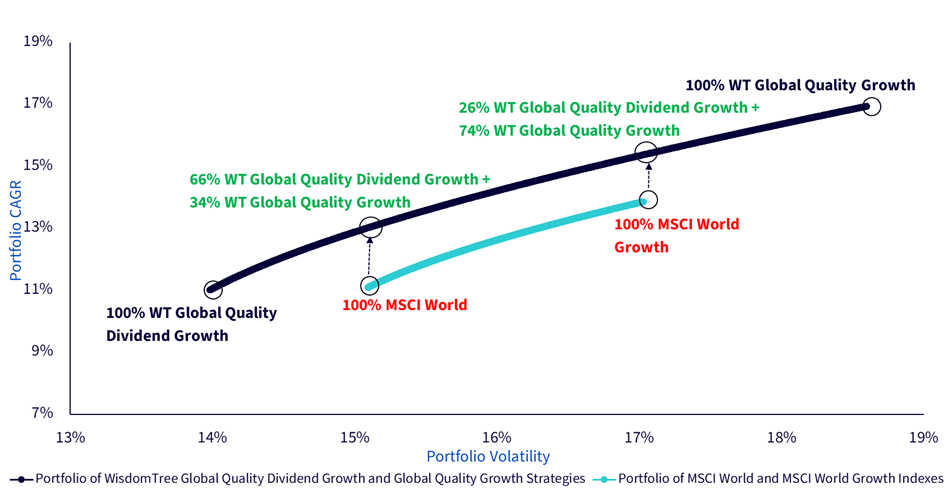
Figure 4: Efficient frontier of WisdomTree Global Quality Growth and Global Quality Dividend Growth vs MSCI World and MSCI World Growth
Source: WisdomTree, FactSet, Bloomberg. Based on backtested data on Net total returns from 16 Oct 2015 to 31 Dec 2024. Historical performance is not an indication of future performance, and any investments may go down in value.
As shown in Figure 4, both strategies offer superior placement on the efficient frontier—delivering higher returns for each unit of risk taken and, in some cases, reducing total volatility altogether.
A couple of key conclusions from the efficient frontier are:
- Hypothetical portfolio with 66% WisdomTree Global Quality Dividend Growth and 34% WisdomTree Global Quality Growth could have potentially generated 1.9% more annualised returns compared to MSCI World for the same volatility.
- Hypothetical portfolio with 26% WisdomTree Global Quality Dividend Growth and 74% WisdomTree Global Quality Growth could have potentially generated 1.5% more annualised returns compared to MSCI World Growth for the same volatility.
Conclusion: building confidence amid uncertainty
In today’s macroeconomic environment, elevated uncertainty across a range of indicators has led many investors to reassess portfolio positioning. A strategic allocation toward Quality—implemented through disciplined, rules-based methodologies—can support portfolio resilience while preserving long-term return potential.
Amid shifting market dynamics, maintaining exposure to companies with durable fundamentals may serve as a sound, forward-looking approach to equity allocation. WisdomTree’s differentiated Quality offerings in the form of the Quality Dividend Growth range (with four different regional exposures - Global, US, Eurozone and the UK) and the Quality Growth range (with two different regional exposures Global and the US) could offer strong building blocks for resilient portfolios positioned for long-term growth.




 Previous Post
 All Posts