





 Print Page
What does 2025 hold for 2024’s ‘winners’: Bitcoin, Japan and Small Cap EM?


Key Takeaways
- For global multi-asset portfolios, ~1.5% neutral allocation to bitcoin is expected to become a widely accepted standard, with underweighting or excluding bitcoin increasingly perceived as a potentially suboptimal choice without strong justification.
- 2025 is shaping up to be another favourable year for Japan owing to its longer-term structural story of improving corporate governance and earnings growth momentum.
- The shifting global landscape favours EM small-cap equities over large caps due to their superior insulation from trade wars, reduced sensitivity to US dollar fluctuations, and strong dividend potential.
As we start a new year, we’re looking back at a selection of strong performing assets from 2024 and their outlook for 2025. Part 1 of this two-part series, covers Bitcoin, Japan and Small Cap Emerging Markets.
Bitcoin’s institutionalisation: 2024 achievements and 2025 outlook
2024 marked a pivotal moment for bitcoin, showcasing significant growth in both adoption and institutionalisation. The momentum began with the listing of physical bitcoin exchange-traded products (ETPs) in the US, culminating in bitcoin price reaching its all-time high of over $100,0001 in December.
By the end of the year, the global market capitalisation of listed, investable assets stood at approximately $216 trillion2. Cryptocurrencies, with a combined market cap exceeding $3 trillion3, accounted for approximately 1.5%4 of the global market portfolio. This positioned the crypto asset class alongside established categories such as high-yield bonds, inflation-linked bonds, and emerging markets small-cap equities in terms of their market capitalisations.
Institutional investors increasingly embraced bitcoin ETPs, recognising bitcoin’s potential as a volatile yet uncorrelated asset to improve the risk-return profiles of their multi-asset portfolios. Net inflows into physical bitcoin ETPs surpassed $34 billion5 globally in 2024, reflecting growing confidence in the asset class. Moreover, many institutional investors started to acknowledge that opting for no allocation to bitcoin was an active decision to underweight, requiring a robust investment thesis to justify.
The trends that emerged in 2024 are expected to accelerate and evolve throughout 2025. Institutionalisation is likely to deepen as bitcoin gains greater acceptance among traditional portfolio managers. Institutional investors are anticipated to enhance their multi-asset strategies to better incorporate bitcoin into their portfolios. The approximately 1.5% neutral allocation to bitcoin is expected to become a widely accepted standard, with underweighting or excluding bitcoin increasingly perceived as a potentially suboptimal choice.
Figure 1: Bitcoin in a multi-asset portfolio
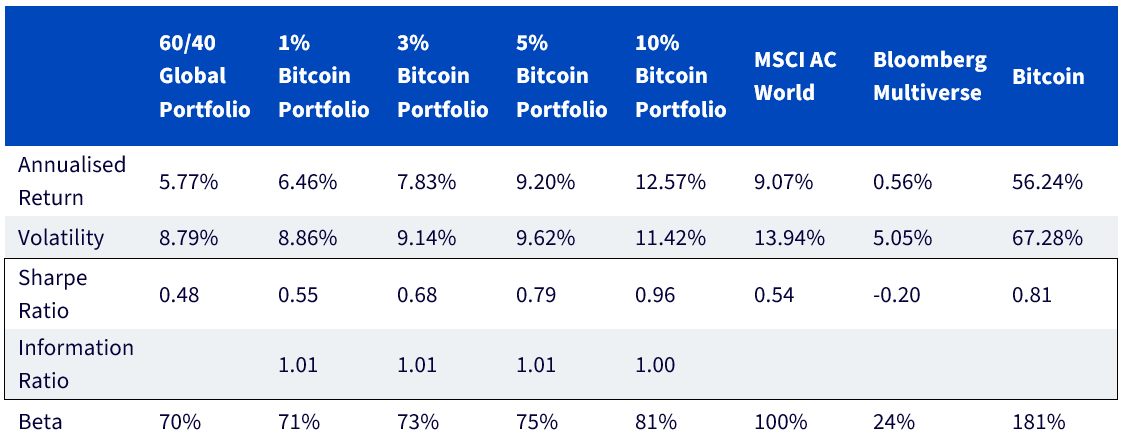
Source: Bloomberg, WisdomTree. From 31 December 2013 to 30 November 2024. In USD. Based on daily returns. The 60/40 Global Portfolio is composed of 60% MSCI All Country World and 40% Bloomberg Multiverse. You cannot invest directly in an index. Historical performance is not an indication of future performance and any investment may go down in value.
Bitcoin’s resilience and value as an uncorrelated, alternative investment are likely to attract broader recognition, further solidifying its role in global portfolios. Additionally, the market may see the growth of innovative bitcoin-based financial products, giving investors some control around drawdowns and/or volatility.
The developments of 2024 laid a solid foundation for bitcoin’s evolution into a mainstream asset. As 2025 unfolds, bitcoin is well-positioned to solidify its status, drawing an even broader investor base. Continued adoption and potentially friendlier regulatory environments should also allow bitcoin to maintain or even increase its share of the global market portfolio.
Unlocking value in Japan
Japanese equities raced ahead in 2024 with the Nikkei 225 Index having its best year since 1989, despite some market volatility6. Even after gains for the second year straight, Japan’s equity valuation, Price to Earnings (P/E) ratio is below its five-year average. Japan’s rally has been broad based, consistent with the robust earnings trend by Japanese corporates. In addition, Japan’s structural reform story continued in 2024 with companies increasingly focusing on return on capital.
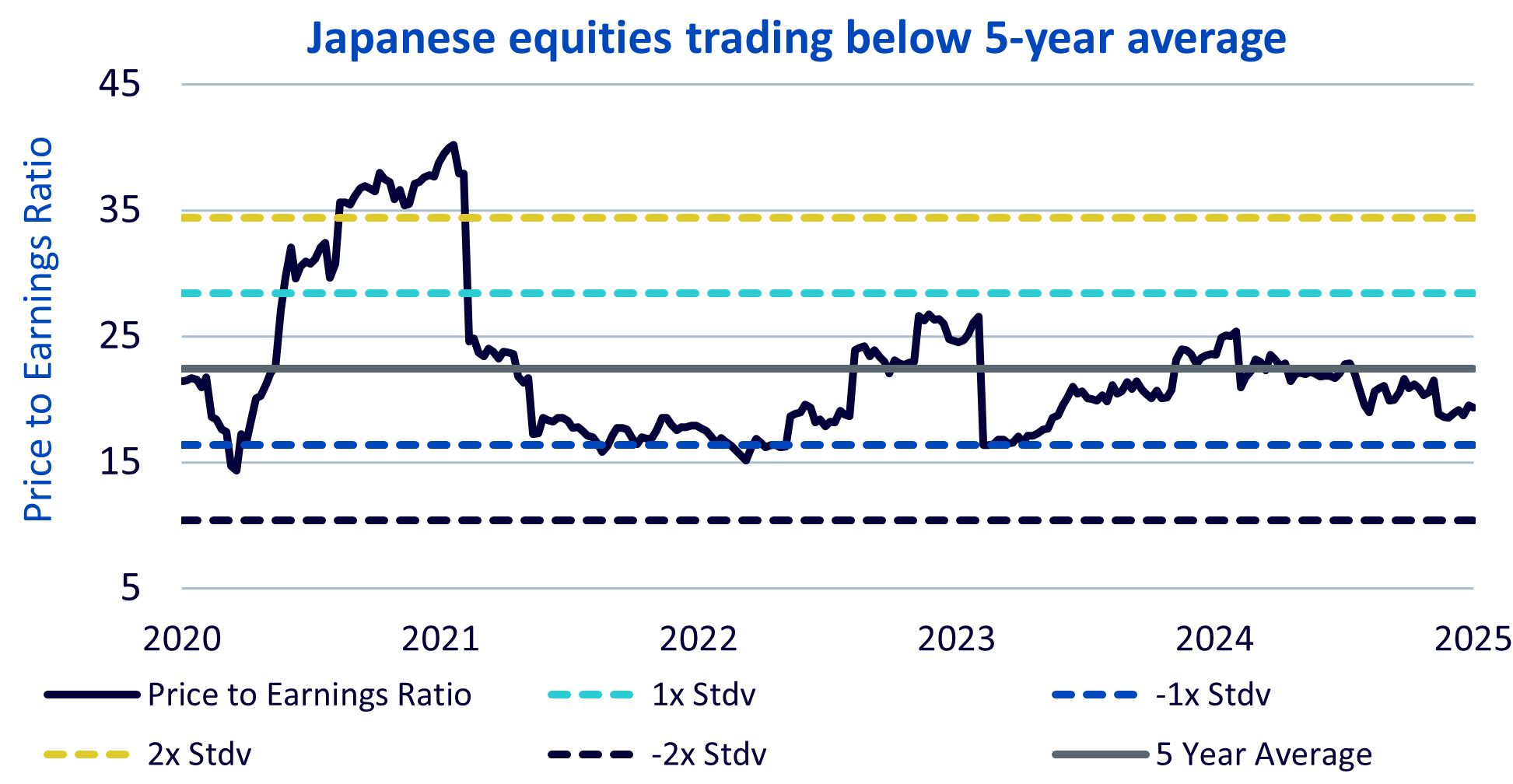
Source: Bloomberg, WisdomTree from 3 January 2020 to 3 January 2025. Historical performance is not an indication of future performance and any investment may go down in value.
Prime Minister Shigeru Ishiba faced some turbulence after taking office in October 2024 but managed to win a run-off vote by mid-November allowing him to stay in power. Yet, given Ishiba’s fragile minority government, he will need to seek support from the opposition parties including the Democratic Party for the People (DPP) leading to tax cuts and other subsidies to help boost disposable income.
The shift to an inflationary economy
Real income growth turned positive in 2024 on the back of continuing wage growth. There are compelling reasons to believe that real wage growth could reignite growth in consumption. Rengo, Japan’s largest labour union federation announced its target wage hike of more than 5% for 2025. This supports a continuation of healthy wage growth in Japan, as nearly 70% of Japan’s employee population works for small and medium enterprises (SME)7.
A knock-on effect of inflation is that it stimulates corporate reforms. The inflationary environment is pushing companies to channel the excess cash via payouts to shareholders or capital expenditures to create value. The potential ripple effect of the changes involving Seven & I Holdings and the merger talks between Honda & Nissan indicate a critical juncture for Japanese corporates.
Catalysts for 2025
Trump’s tariffs are likely to take centre stage in 2025. Since the pandemic, Japanese companies are more dependent on the US and less so on China. Japan, however, may not be too high on Trump's trade agenda given the importance the US places on Japan as one of its most important allies. Considering the impact of tariffs might be more heavily felt in China, Japan could benefit by gaining more market share at China’s expense. In addition, Japan's manufacturers may draw some comfort as many are engaged in production within the US itself, which have been major sources of employment.
The potential for sustained US dollar strength (yen weakness) under Trump’s agenda results in greater responsibility for the Bank of Japan (BOJ) to ensure inflation expectations stabilise at the 2% price stability target. This environment favours tilting towards value oriented Japanese stocks that benefit from higher US interest rates, weakening yen and large-scale share buybacks by low Price to Book companies.
A trump card for EM Small Caps
Emerging market (EM) small caps have outperformed EM large caps by 143% over the past 24 years. The Federal Reserve’s monetary easing cycle, China’s coordinated fiscal and monetary stimulus, and a wave of EM sovereign ratings upgrades provided significant tailwinds for EM equity markets throughout the year. Whilst Trump’s re-election (and the prospect of higher tariffs and a strengthening US dollar) disrupted some of this momentum, EM small-cap equities stand out for their stronger domestic orientation and resilience against external shocks, such as trade tensions and currency fluctuations.
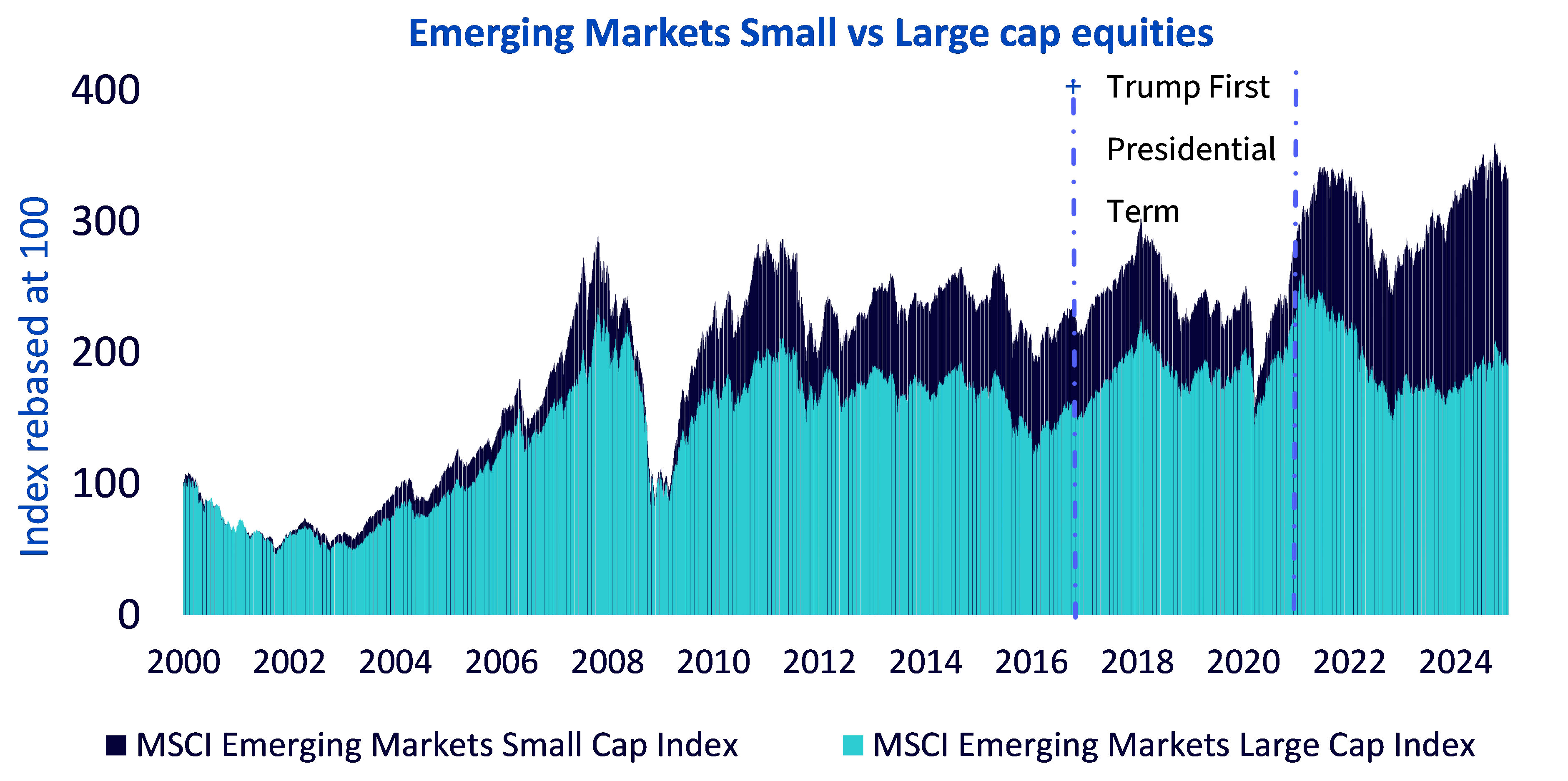
Source: Bloomberg, WisdomTree from 3 January 2000 to 1 January 2025. Historical performance is not an indication of future performance and any investment may go down in value.
There are three reasons why EM small-cap equities excel in the current landscape:
1. Resilience to tariff wars
During President Trump’s first term (2017–2021), EM small-cap equities gained 54%, outperforming the 42% rise in EM large caps . A key factor driving this outperformance was their reliance on domestic revenues rather than international trade. This reduced their direct exposure to tariffs and trade-related disruptions, particularly those targeting cross-border goods.
2. Insulation from US dollar strength
EM small-cap equities are less sensitive to US dollar movements compared to large caps. Over the past decade, the correlation between the US dollar’s 12-month change and the forward EPS growth rate was -0.27 for EM small caps, significantly lower than the -0.63 correlation observed for EM large caps.
With Trump’s policies expected to maintain US dollar strength in 2025, EM small caps offer greater insulation, allowing investors to weather currency-related volatility more effectively.
3. Small-caps thrive on domestic growth
EM small-cap equities tend to perform exceptionally well in periods of strong domestic economic recovery, like the one we are currently experiencing across many EM economies. Their localised focus enables them to capitalise on internal growth drivers, making them an attractive option for diversification and resilience in today’s uncertain global environment.
For investors seeking growth, income, and diversification, EM small caps appear to represent an opportunity in 2025 and beyond.
1 Artemis Terminal. 31 December 2024.
2 Bloomberg, WisdomTree. 30 November 2024.
3 Artemis Terminal. 31 December 2024.
4 WisdomTree. 31 December 2024.
5 Bloomberg, WisdomTree. 31 December 2024.
6 Bloomberg as of 30 December 2024.
7 Japanese Trade Union Confederation (JTUC-Rengo) as of November 2024.
8 Bloomberg from 3 January 2000 to 31 December 2024.
9 Bloomberg from 2 January 2017 to 30 December 2021.







 Previous Post
 All Posts