




 Print Page
Thematic outlook: Look closely, opportunities abound


Key Takeaways
- Energy addition remains a core driver, with high conviction in strategic metals and nuclear energy.
- Geopolitical fragmentation is sustaining defence spending and reshaping critical supply chains.
- Technology investment is focused on infrastructure, including physical artificial intelligence, quantum progress and data centres.
It is the mid-15th century. In a small workshop in Mainz, Johannes Gutenberg brings together movable metal type, ink and a wine press to create something radically new, the printing press. Its significance is not obvious at first. But over time, knowledge is no longer copied by hand. It multiplies, spreads and shapes new intellectual pursuits. From science and literature to philosophy and politics, the printing press transforms communication, but it also changes the world.
Today, innovations such as artificial intelligence (AI) can feel unprecedented. Perhaps they are. Or perhaps every generation experiences technologies that seem unprecedented in the moment. Change itself is not new. What is new is the ability to access it. Investors can now gain exposure to world-changing innovations early in their development through a vast and growing menu of thematic investment opportunities.
Our latest thematic outlook focuses on three key areas: energy addition; geopolitics; and technology. This blog summarises the key messages from the outlook.
Energy addition
Electricity demand is rising alongside electrification, AI infrastructure and industrial policy. Rare earth elements sit at the centre of this buildout. Their magnetic properties improve wind turbine efficiency. They enhance electric vehicle motors and support battery performance. They are also used in electrolysers and other clean technologies. International Energy Agency analysis points to a sharp rise in cleantech demand over the coming decade, requiring materially higher primary supply. With production concentrated and new capacity slow to develop, structural demand growth is expected to create persistent tailwinds for rare earths as well as many other strategic metals.
Nuclear power is also swiftly becoming a mainstream part of the energy mix. In late 2025, the US government, Brookfield and Cameco announced a strategic partnership centred on Westinghouse reactor technology, signalling substantial new build plans. Equity markets reacted sharply to these plans. With 31 countries having pledged to triple global nuclear capacity by 2050, current project pipelines are expected to expand rapidly. So, as governments translate their commitments into actionable plans, the uranium and nuclear value chain is likely to continue responding, as it has done last year.
Figure 1: Global renewable capacity additions outlook
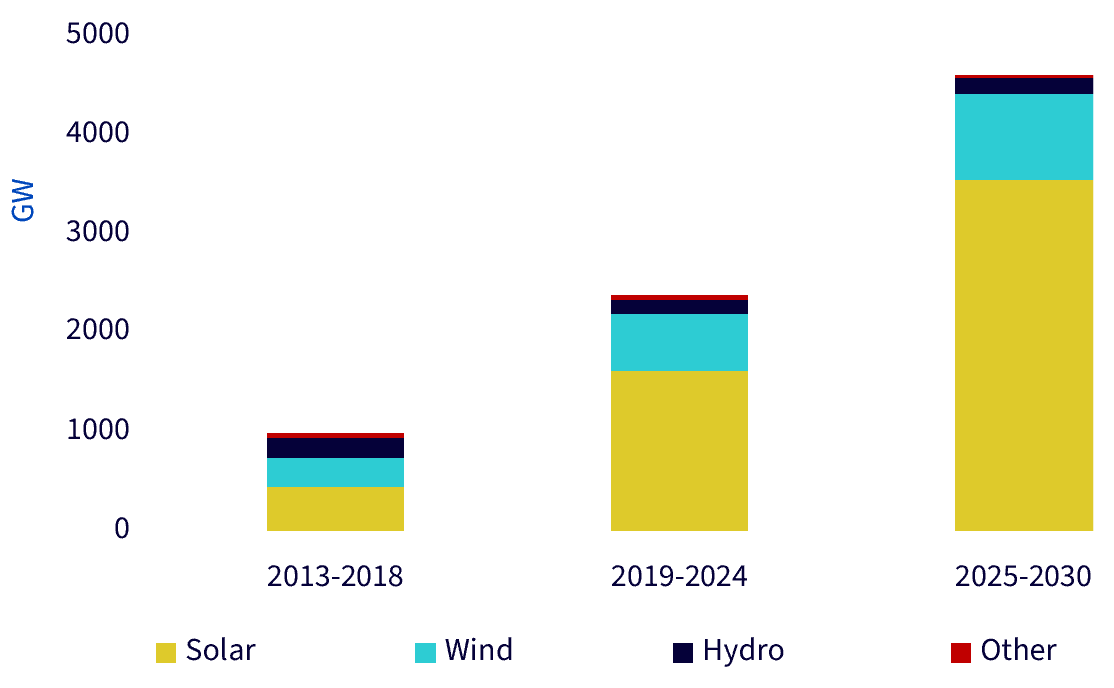
Source: IEA, Renewables October 2025 report. ‘Other’ includes hydropower, bioenergy, geothermal, concentrated solar power, and ocean. Forecasts are not an indicator of future performance, and any investments are subject to risks and uncertainties.
Renewable energy continues to broaden beyond traditional wind and solar deployment. Bloom Energy’s series of announcements in 2025, including major partnerships linked to AI data centres and a strengthened balance sheet, highlighted rising demand for reliable, lower-carbon power solutions. Hydrogen fuel cells and other distributed technologies are gaining attention as power users prioritise resilience and energy security. With global electricity demand rising and financing conditions easing, new business models and new leaders are emerging across the renewable landscape.
Energy addition is expected to remain a driving force for many themes in the year ahead.
Geopolitics
Rare earths and strategic metals were highlighted earlier in the context of energy addition. They also carry a clear geopolitical dimension. In October 2025, the United States and Australia agreed a joint framework to secure the mining and processing of critical minerals essential for defence and advanced technologies. The agreement spans investment, faster permitting, stockpiling and recycling, all aimed at building more resilient supply chains. China’s dominance in rare earth mining and, importantly, refining has developed over several decades and is expected to persist (see figure 2). For countries dependent on these materials, concentration risk is encouraging a deliberate reshaping of supply chains along geopolitical lines.
Figure 2: Global rare earth supply concentration
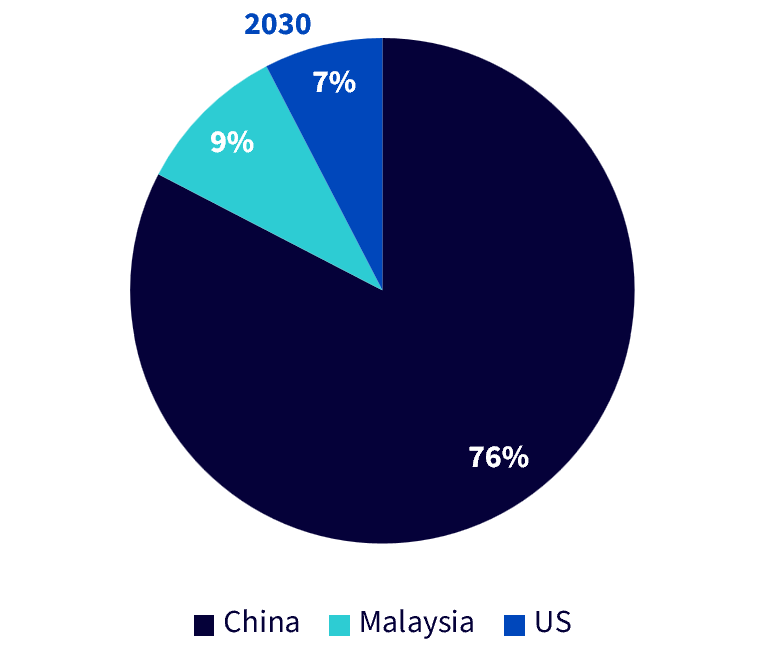
Source: International Energy Agency, Global Critical Minerals Outlook 2025. All figures are in kilo tonnes (kt). Forecasts are not an indicator of future performance, and any investments are subject to risks and uncertainties.
Defence spending in Europe remains a structural story in our view. For example, the Italian shipbuilding company, Fincantieri, has announced an order backlog of €60bn, giving them an order visibility for the next 10 years1 . This reflects the strong demand for their capabilities suited to hybrid and asymmetric warfare. Governments are committing to multi-year procurement programmes not to tackle any single conflict, but to future-proof their defences. Political signals from the United States and tensions closer to home have reinforced Europe’s focus on greater defence autonomy. As budgets are formalised and contracts awarded, revenue visibility across parts of the European defence sector is expected to improve further.
The defence story extends beyond Europe. Poland’s multibillion-dollar agreement with South Korea’s Hanwha Aerospace illustrates how procurement is becoming more global and like in Europe, following a partnership model. NATO2 members have committed to higher defence spending thresholds, and several countries are already exceeding them. Defence budgets across parts of Asia are also rising amid heightened regional tensions. Japan’s record $58bn defence budget is an example3 . As fragmentation deepens, defence investment is expected to remain structurally elevated across regions.
In 2026, geopolitics will continue to drive the narrative for defence spending in Europe, Asia, and beyond and we will continue to see countries scrambling to secure their supplies for critical minerals.
Technology
Technology remains central to the thematic landscape, and in our view the infrastructure buildout is far from complete. At CES 20264 , Nvidia’s Jensen Huang described physical AI as reaching its ‘ChatGPT moment’, signalling a shift from systems that generate text to machines that reason and act in the real world. From autonomous vehicles to robotics and smart factories, AI is increasingly embedded in physical processes. The semiconductor rally in 2025 reflected this depth. Nvidia’s GPUs5 and Micron’s high-speed memory illustrate how demand spans multiple layers of hardware. As AI moves into industrial and mobility applications, capital expenditure across chips, sensors and automation systems is expected to remain strong.
Quantum computing is also moving steadily along its roadmap. In late 2025, IonQ announced record accuracy levels in key quantum operations, an important step in reducing computational errors. IBM continues to target the end of the decade for commercially viable fault-tolerant systems, while other technology leaders are investing heavily in their own approaches. Timelines remain uncertain and volatility is likely. However, progress is being made and the world is already excited about the potential use cases for quantum computers in industries like drug discovery and material science. Quantum computing may still be early in its development cycle, but research milestones and corporate investment are expected to keep the theme firmly on investors’ radar in 2026.
Figure 3: Quantum computing market growth outlook
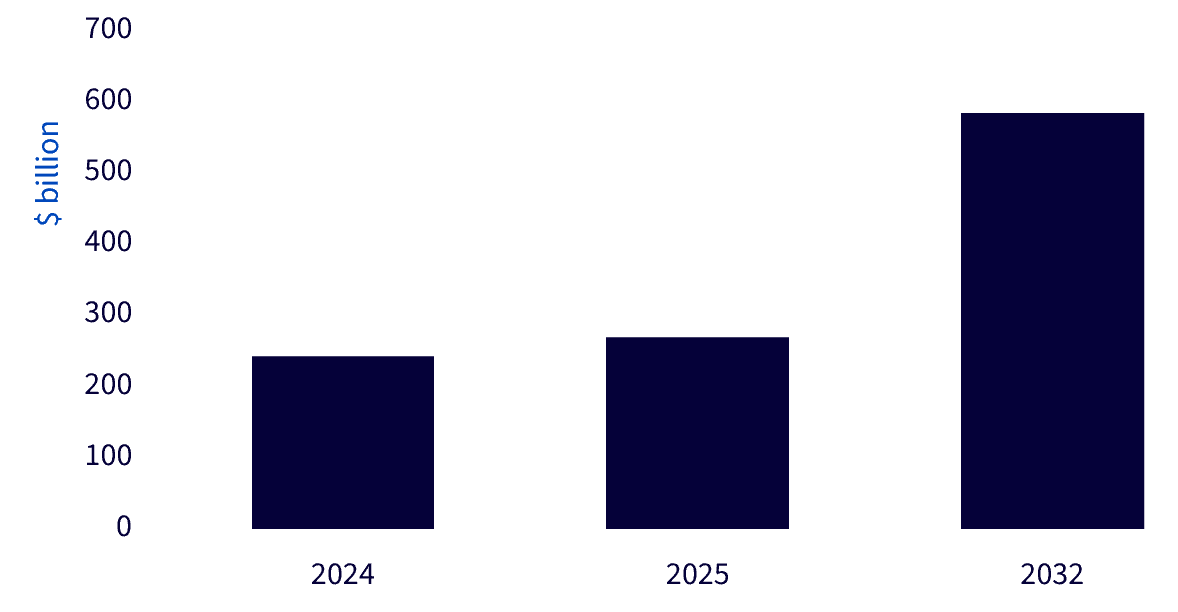
Source: Fortune Business Insights, December 2025. Forecasts are not an indicator of future performance, and any investments are subject to risks and uncertainties.
The data centre buildout provides the physical backbone of this technological expansion. SoftBank’s $4bn acquisition of DigitalBridge at the end of 2025 underlined the strategic value of digital infrastructure6. AI requires power, cooling, fibre connectivity and specialised real estate. Companies such as Digital Realty and Equinix, alongside diversified property groups expanding into data centres, are positioned to benefit. With interest rates easing and electricity demand rising, financing conditions are becoming more supportive. In our view, the data centre ecosystem remains one of the clearest expressions of the AI infrastructure theme.
In 2026, technology investment is expected to remain focused on building the systems that power the next phase of innovation.
Conclusion
2025 was a strong year for thematic investors, with many well-reasoned ideas delivering compelling returns. In our view, 2026 offers a similarly broad opportunity set. Our highest conviction sits with strategic metals and rare earths, alongside uranium and nuclear energy, followed by defence and selected areas of technology infrastructure like physical AI. At the same time, we remain open to new themes emerging as the year unfolds.
These are interesting times for thematic investing. Not simply because change is constant, but because access to invest in that change has never been greater.
1. Fincantieri, Dec 2025.
2. North Atlantic Treaty Organization.
3. Al Jazeera, Dec 2025.
4. Consumer Electronics Show.
5. Graphics processing unit.
6. DigitalBridge, December 2025.




 Previous Post
 All Posts