




 Print Page
Myth-busting barriers to entry


Key Takeaways
- In 2025, clearer regulatory frameworks across the EU, UK and US have helped dispel the idea that crypto operates without oversight, providing more defined and institutional-grade access points.
- Bitcoin’s volatility has sharply declined, now comparable to equities, while institutional tools like regulated futures and options allow investors to manage risk, not avoid it.
- With over US $200 billion in physical crypto exchange-traded product (ETP) assets and growing involvement in tokenised treasuries, the real barrier to crypto adoption is no longer structural, but psychological.
Professional investors continue to circle the same old ‘risks’, but the market has already moved on.
A WisdomTree pan-European survey, conducted by Censuswide between June and July 2025 (802 respondents), found that the top perceived barriers to cryptocurrency adoption remain consistent: a lack of regulation (21.6%), high volatility (19.1%), and limited institutional participation (18.7%).
Figure 1: Top perceived barriers to cryptocurrency allocation among professional investors
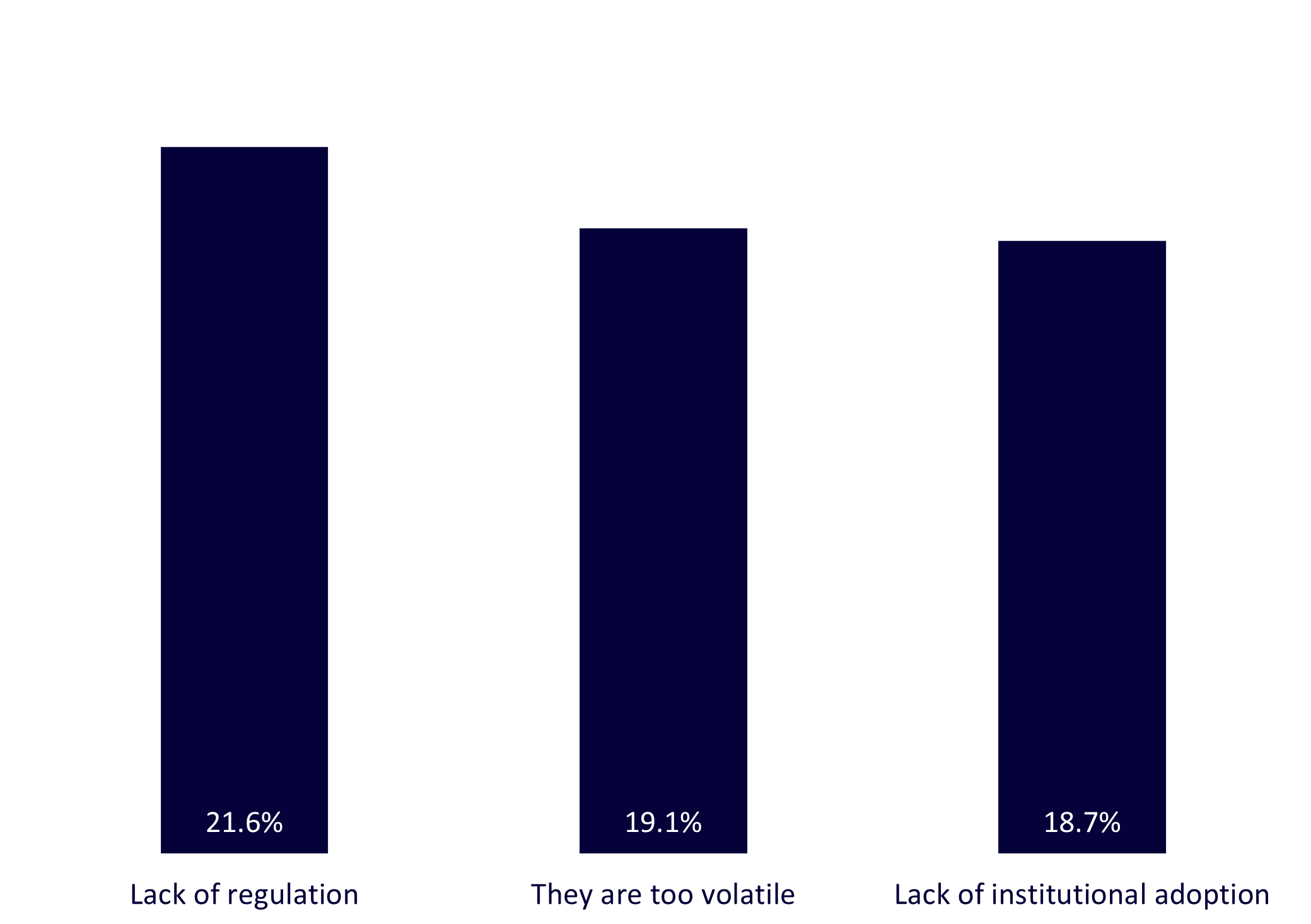
Source: Pan-European WisdomTree survey, June-July 2025, 802 respondents, conducted by Censuswide.
Yet each of these barriers is diminishing in real time. The rules are here, volatility is contextual and institutional adoption is measurable.
Myth 1: ‘crypto lacks regulation’
Reality: regulation is now firmly in place and, in some regions, those frameworks are leading the way.
The digital asset landscape has matured at remarkable speed.
- Europe’s Markets in Crypto-Assets (MiCA) regulation, which entered into force in 2024, provides a unified rulebook for crypto across the European Union, the most comprehensive framework globally.
- The UK Financial Conduct Authority (FCA) now permits both professional and retail investors to access Bitcoin and Ether exchange-traded products (ETPs) that are listed on London Stock Exchange (LSE), marking a clear endorsement of regulated access pathways.
- In the United States, the Genius Act establishes federal standards for stablecoins, defining eligible issuers, mandating full asset backing and ensuring priority creditor status for holders in insolvency scenarios.
The challenge is not the presence of regulation, but the outdated perception that it is still missing. Today, regulatory clarity is established and has become a differentiator.
Myth 2: ‘crypto is too volatile for professional portfolios’
Reality: volatility is real, but it is measurable, contextual and manageable.
Yes, bitcoin moves. So do growth equities. Volatility, once amorphous, has become a quantifiable and investable characteristic.
Figure 2: bitcoin volatility converging toward equity market levels
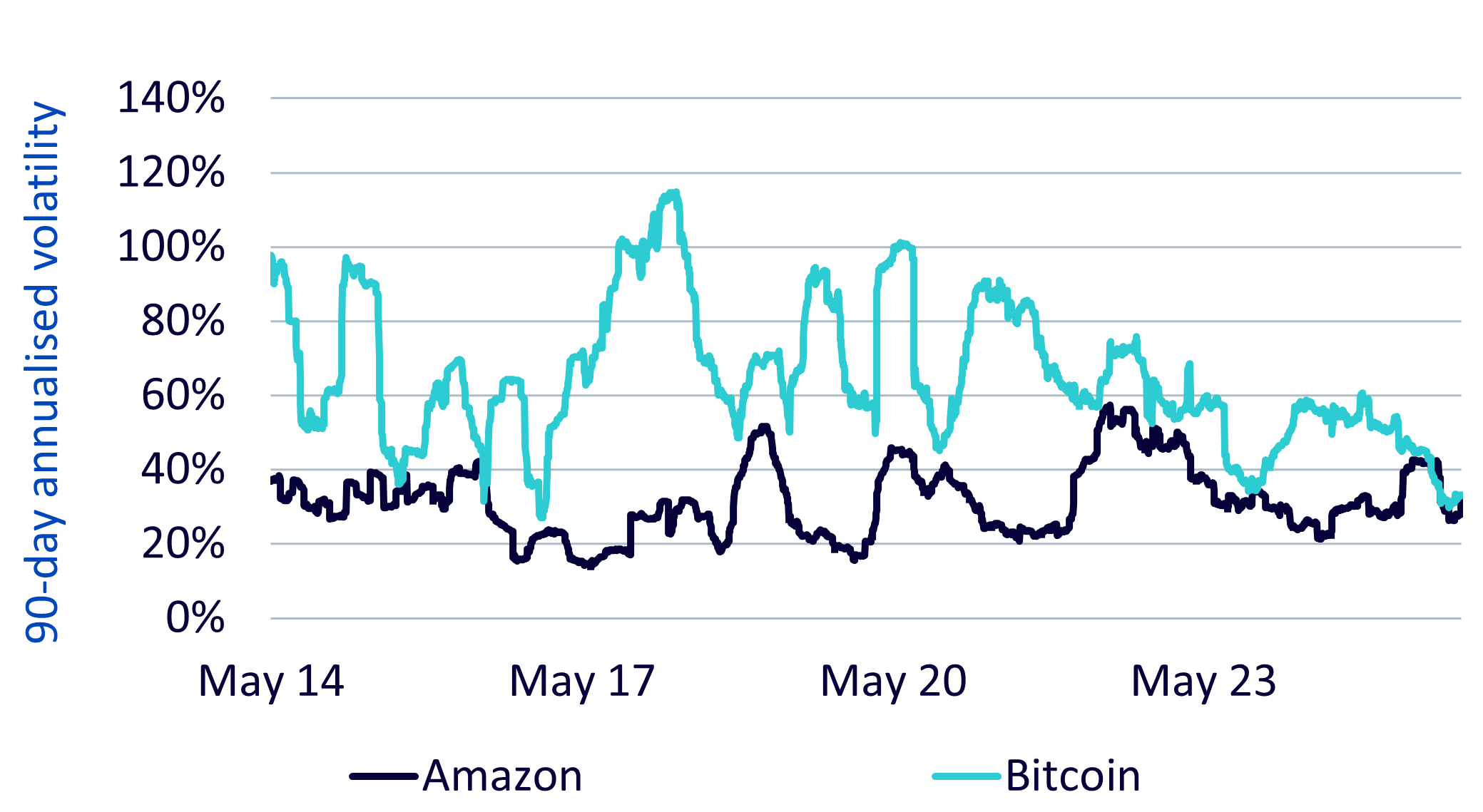
Source: Optuma, WisdomTree. 31 October 2025.
As of 31 October 2025, bitcoin’s 90-day annualised volatility sits at 32%, down from triple-digit levels in 2017 and now comparable to emerging-market equities. For context, Amazon’s 90-day volatility is 1% higher, as it is 33% at the end of October 20251.
Crucially, professional investors now have institutional-grade tools, such as bitcoin futures and options, to hedge exposures, express macroeconomic views, or capture structural alpha.
Volatility is the signature of early-stage, asymmetric growth assets, the same dynamic that has historically underpinned innovation cycles.
Moreover, bitcoin’s long-term correlation to equities and bonds remains low, reinforcing its potential as a portfolio diversifier.
Volatility is not a wall to entry. It is a parameter to manage and, for informed allocators, a source of opportunity.
Myth 3: ‘institutional investors have not adopted crypto’
Reality: they have, and often in ways that are not immediately visible.
Institutional adoption is no longer theoretical. It is quantifiable and accelerating.
As of 30 October 2025, global physical crypto ETPs collectively manage nearly $205 billion in assets, with bitcoin representing over $164 billion of that total2. Net inflows remain positive year-to-date, despite market fluctuations.
Figure 3: Global view of physical crypto ETP assets under management
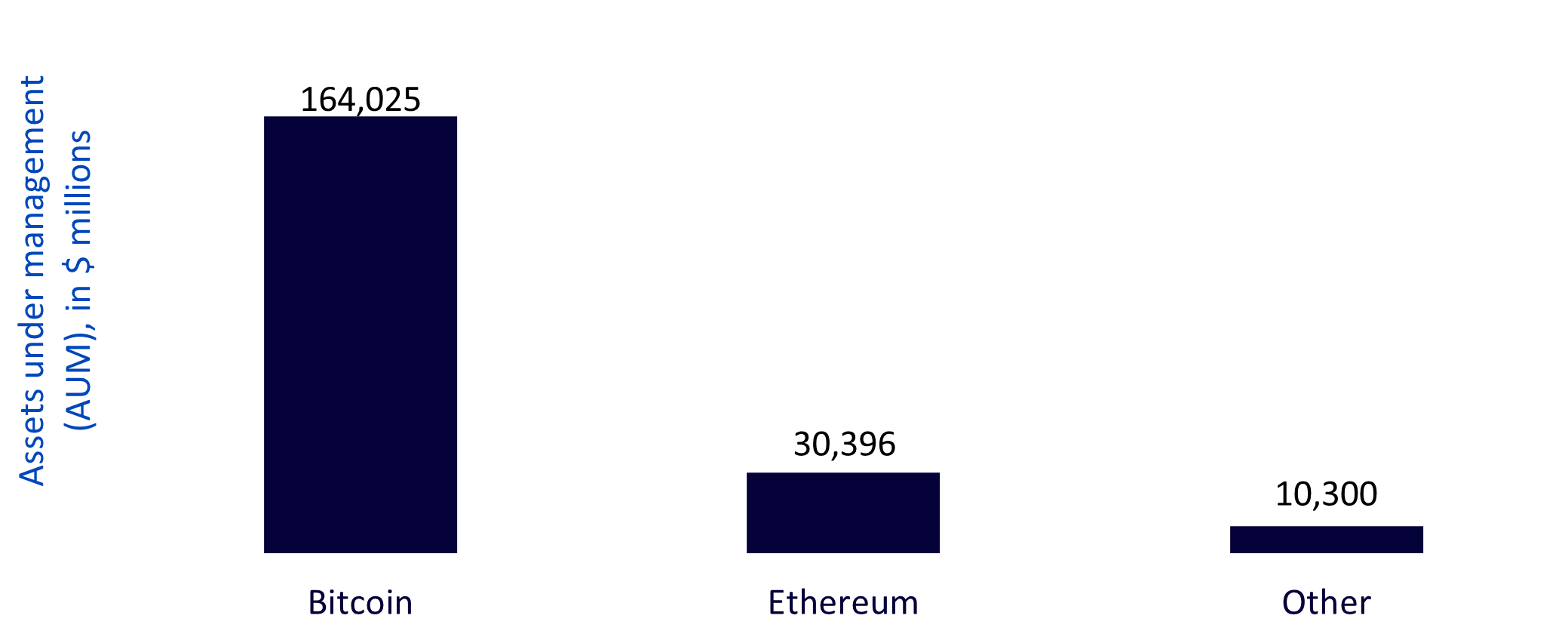
Source: Bloomberg, WisdomTree. 30 October 2025. Actively managed crypto ETPs and ETFs are excluded.
Major custodians and service providers have integrated digital asset infrastructure into their core service stacks. Even where institutions do not hold tokens directly, they are participating through tokenised treasuries, blockchain settlement pilots and fund tokenisation initiatives.
The institutional foundation is solid, built through compliant, operationally efficient vehicles that meet fiduciary standards. Adoption is advancing because volatility and regulation have become more predictable and manageable.
Reframing ‘barriers’ as knowledge gaps
Every emerging asset class begins with perception gaps. For professional investors, the competitive edge lies in identifying where narrative lags reality.
The data now signals a second-wave adoption phase, one centred on portfolio integration rather than speculation. Institutional access is expanding through ETPs, tokenised money markets and on-chain infrastructure designed for compliance, security and scale.
Conclusion: the new entry point
Crypto’s story has become one of convergence between digital networks and traditional finance. For allocators still on the sidelines, the question has evolved from “Is it safe?” to “what is my exposure strategy?”
As the boundaries blur between crypto and conventional markets, those who discard outdated myths and recognise how far the regulatory and institutional landscape has matured will be best positioned to capture the next wave of growth. The real barriers are no longer structural. They are psychological.
1Source: Optuma, WisdomTree. 31 October 2025.
2Source: Bloomberg, WisdomTree. 30 October 2025. Actively managed crypto ETPs and ETFs are excluded.





 Previous Post
 All Posts