




 Print Page
Hard money forecasts: bitcoin and gold in 2030 and beyond


Key Takeaways
- In response to persistent inflation and surging sovereign debt, investors are reallocating toward hard assets like bitcoin and gold, which now represent 14% of global money stock.
- WisdomTree’s model outlines three 2030 scenarios: deflationary, base, and inflationary, where bitcoin’s forecast ranges from $120k to $500k, and gold from $3k to $5.5k, depending on monetary expansion and adoption trends.
- Even small allocations to bitcoin and gold can enhance portfolio resilience in a world of fiscal erosion and fiat dilution, with bitcoin offering especially strong upside under inflationary pressures.
As inflation proves persistent, sovereign debt escalates, and institutional trust wanes, investors are reassessing hard assets. Gold has long been the inflation hedge of choice, but bitcoin has emerged as a credible digital challenger.
Bitcoin and gold: 3 model forecasts for 2030 and beyond paper introduces a disciplined, scenario-based framework to forecast the future valuations of both assets to 2030 and beyond.
The historical backdrop
Since 1970, global money supply has exploded from under $1 trillion to $180 trillion – a 180x expansion. This tidal wave of fiat creation, fuelled by loose monetary policy and perpetual bailouts, has outpaced real growth and eroded long-term purchasing power.
As a result, hard money assets – those that cannot be easily printed or manipulated – have gained traction. Gold, with its 5,000-year track record, remains the traditional hedge. But bitcoin has joined the conversation, offering a verifiably scarce, decentralised, and digital alternative.
Together, bitcoin and gold now account for approximately 14% of global money, with bitcoin commanding around 8% of the hard money basket. This suggests a growing institutional and retail pivot toward assets resistant to monetary dilution.
Figure 1: Hard money basket, now and 10 years ago
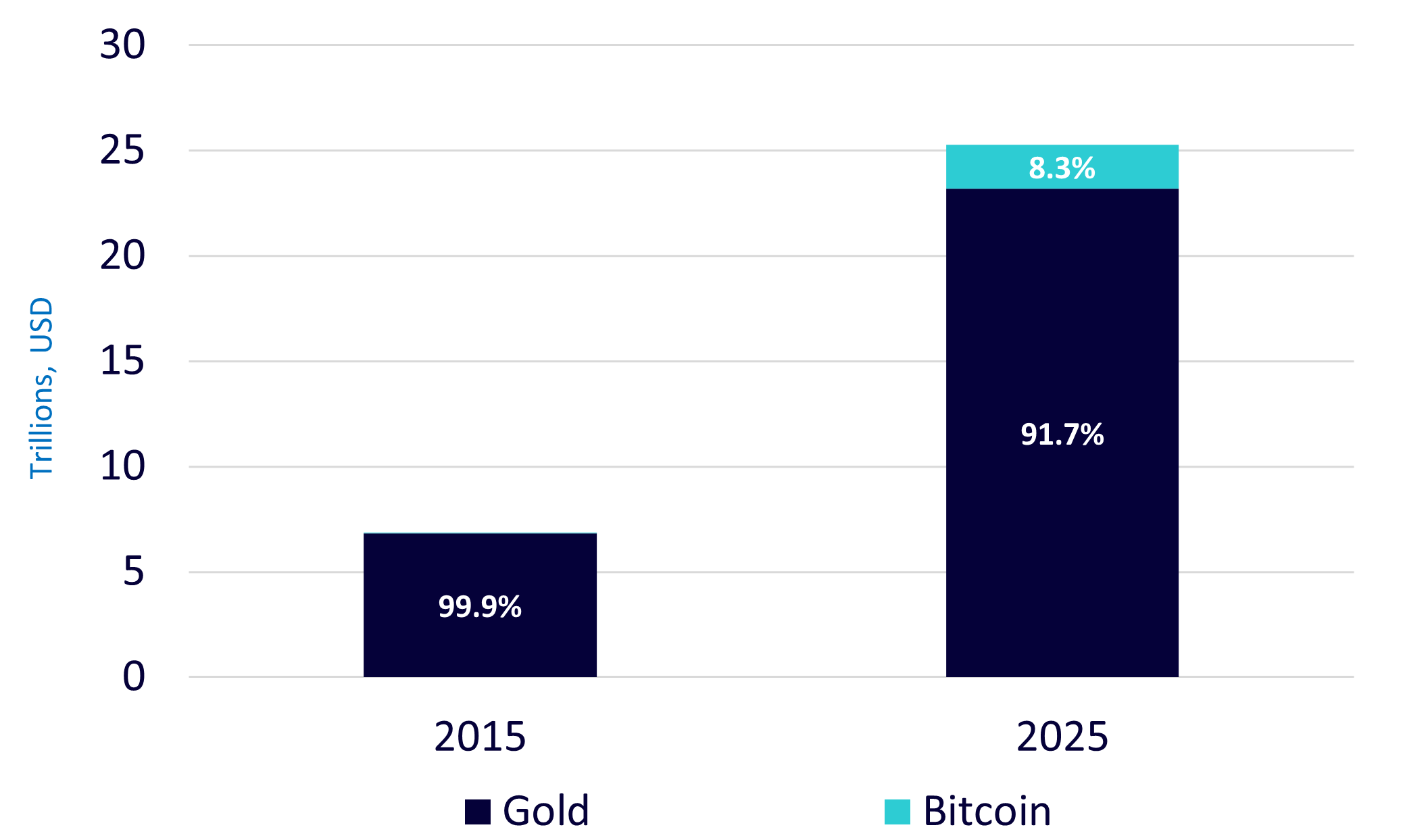
Source: Bloomberg, CoinGecko, World Gold Council. As of end of May 2025. Historical performance is not an indication of future performance and any investments may go down in value.
Framework
To assess the future value potential of these assets, we introduce a simple, yet disciplined valuation model grounded in monetary dynamics. The model estimates future market capitalisations and subsequent prices for bitcoin and gold based on four core variables:
- Forecasted global money supply under deflationary, base, and inflationary scenarios.
- The share of that supply allocated to “hard money” assets.
- Bitcoin’s share within the hard money asset pool.
- Projected supply of bitcoin and gold over time.
This framework is captured in the formula:
Pricebitcoin = M x H x B / Sbitcoin
Where M is the total money supply, H is the portion allocated to hard assets, B is bitcoin’s share of that hard asset pool, and Sbitcoin is bitcoin’s circulating supply. The gold price can be calculated similarly by replacing B and Sbitcoin with (1-B) and Sgold.
Assumptions and results
We model three future scenarios for money supply growth and its implications for bitcoin and gold prices.
Deflationary case – hard assets shrink as a share of the pie:
- Global money supply compounds at 3%, reaching $206 trillion by 2030.
- Hard money assets fall to 12% of money supply, resulting in a $21 trillion combined market capitalisation for bitcoin and gold.
- Bitcoin’s share of hard-asset basket rises to 10%, a modest increase from current levels.
- Bitcoin remains supply-capped, and gold supply grows at 1.5% per year with a decay factor of 0.951.
Base case – reversion to historical norms supports both bitcoin and gold:
- Money supply grows 5%, reaching $230 trillion by 2030.
- Hard money assets rise to 15% of supply, the historical median, creating a $35 trillion market.
- Bitcoin captures 15% of hard-asset basket as adoption accelerates.
- Supply constraints mirror those in the deflationary case.
Inflationary case – fiat panic fuels a flight to digital scarcity:
- Money supply grows 7%, reaching $260 trillion by 2030.
- Hard money asset share climbs to 20%, still below the 1970s’ peak.
- Combined hard-asset market capitalisation hits $50 trillion.
- Bitcoin captures 20%, reflecting growing institutional interest and scepticism of fiat systems.
- Supply assumptions remain unchanged.
These assumptions drive three distinct trajectories for bitcoin and gold, which we summarise below.
Figure 2: Model results
Strategic insights and investment rationale
Bitcoin and gold serve distinct yet complementary roles in an investment portfolio. Gold offers historical legitimacy and stability, while Bitcoin offers programmable scarcity and asymmetric upside potential. Together, they offer a multifaceted shield against fiat debasement and systemic shocks.
The structural reality of modern monetary policy turbocharges the case for these hard money assets. With central banks locked into expansionary frameworks, assets that sit outside the fiat system stand to benefit – bitcoin disproportionately so in high-inflation scenarios.
From a practical standpoint, incorporating even modest allocations to bitcoin and gold can enhance a portfolio’s resilience and optionality, particularly in an increasingly inflation-prone and politically unstable macro regime.
This is not just theory. The paper delivers a transparent, data-driven valuation framework across multiple money supply growth paths. It avoids overhyped predictions and presents realistic scenario analysis rooted in monetary history. More importantly, it positions bitcoin not as a rogue asset but as part of a strategic hard money framework that aligns with long-term wealth preservation goals.
Conclusion
For institutions serious about safeguarding capital amid fiscal erosion and monetary overreach, this paper delivers the blueprint. Do not just react – position. Read Bitcoin and gold: 3 model forecasts for 2030 and beyond and future-proof your asset allocation strategy.
1Each year, the mining growth rate is multiplied by 0.95, and therefore the growth rate decays by 5%. Historically, gold has been mined at a rate between 0.5% and 1.5% of supply. Current levels are closer to the latter rate, but World Gold Council estimates depleting below ground supply that aligns with reduced mining production in the years to come.

 Previous Post
 All Posts