




 Print Page
Beijing Without Breakthroughs: What the Trump–Xi Summit Means for Investors


Key Takeaways
- Stability, not a reset. The summit delivered de-escalation, not resolution. Structural fault lines across technology, supply chains and Taiwan remain fully intact.
- Critical minerals: the thesis is intact. No agreement on critical minerals reinforces the strategic imperative for Western supply chain diversification.
- Agricultural commitments are not agricultural conviction. Agricultural purchase commitments are politically motivated and reversible. The durable case for commodity exposure rests on food security, energy costs and climate risk, not trade diplomacy.
US President Trump concluded his May 13 to 15 visit to Beijing, the first by a sitting US president in nearly a decade, and markets were watching closely for signs of a structural reset in the world's most consequential bilateral relationship. What they got instead was managed stability: warm optics, directional language, and incremental commitments that fall well short of the breakthrough many had hoped for. For investors, the visit reinforces rather than resolves two of the most compelling structural themes in global markets right now: the fracturing of critical mineral supply chains and the growing strategic value of agricultural trade flows.
What the Summit Delivered
On the surface, the tone was constructive. Both presidents exchanged praise, Trump described the bilateral relationship as on track to become "better than ever", and Xi confirmed a return visit to the White House in September. The summit was focused on constructive strategic stability and a commitment to step up communications, language that deliberately signals de-escalation without committing to anything concrete.
The most tangible deliverables that emerged were in trade. China signalled openness to substantial purchases of soybeans, beef, energy products and Boeing aircraft. President Trump cited potential orders of 750 aircraft and GE engines. US Treasury Secretary Scott Bessent indicated that both sides are exploring tariff reductions beginning with around $30bn of non-critical trade. China also renewed import licences for hundreds of US beef plants, and discussions are under way on a "board of investment" to facilitate Chinese investment in non-sensitive US industries.
One stronger than expected outcome was on Iran: both sides explicitly agreed that Iran cannot acquire nuclear weapons, and that the Strait of Hormuz must remain open. Chinese officials signalled opposition to any tolls in the Strait and expressed interest in increasing US oil purchases to reduce reliance on that geopolitical chokepoint over time, a clearer convergence of interests than most observers anticipated.
Why the Summit was a disappointment
Strip away the diplomatic theatre, and the structural tensions remain firmly intact. Technology policy which arguably was the most consequential dimension of the relationship, produced no meaningful progress. Earlier reports had suggested the US cleared around ten Chinese firms to buy Nvidia H200 AI chips, but Scott Bessent was explicit that there is no immediate news on expanded access to advanced semiconductors. That omission matters enormously as technology transfer and export controls are at the heart of the US-China rivalry, and the visit did nothing to resolve them.
Taiwan, meanwhile, hardened rather than softened. Xi described it as the "most important issue" anchoring the relationship and warned of "serious consequences" if mishandled. Trump said he made no commitments on Taiwan and that US policy has not changed. The asymmetry of stakes on this issue means it will continue to act as a ceiling on how far the relationship can normalise.
Perhaps most telling is the broader structural backdrop. China's share of global nominal Gross Domestic Product (GDP) has been declining since 2021, evident from the chart below, reversing three decades of catch up with the US.
Figure 1 – China is no longer catching up with the US
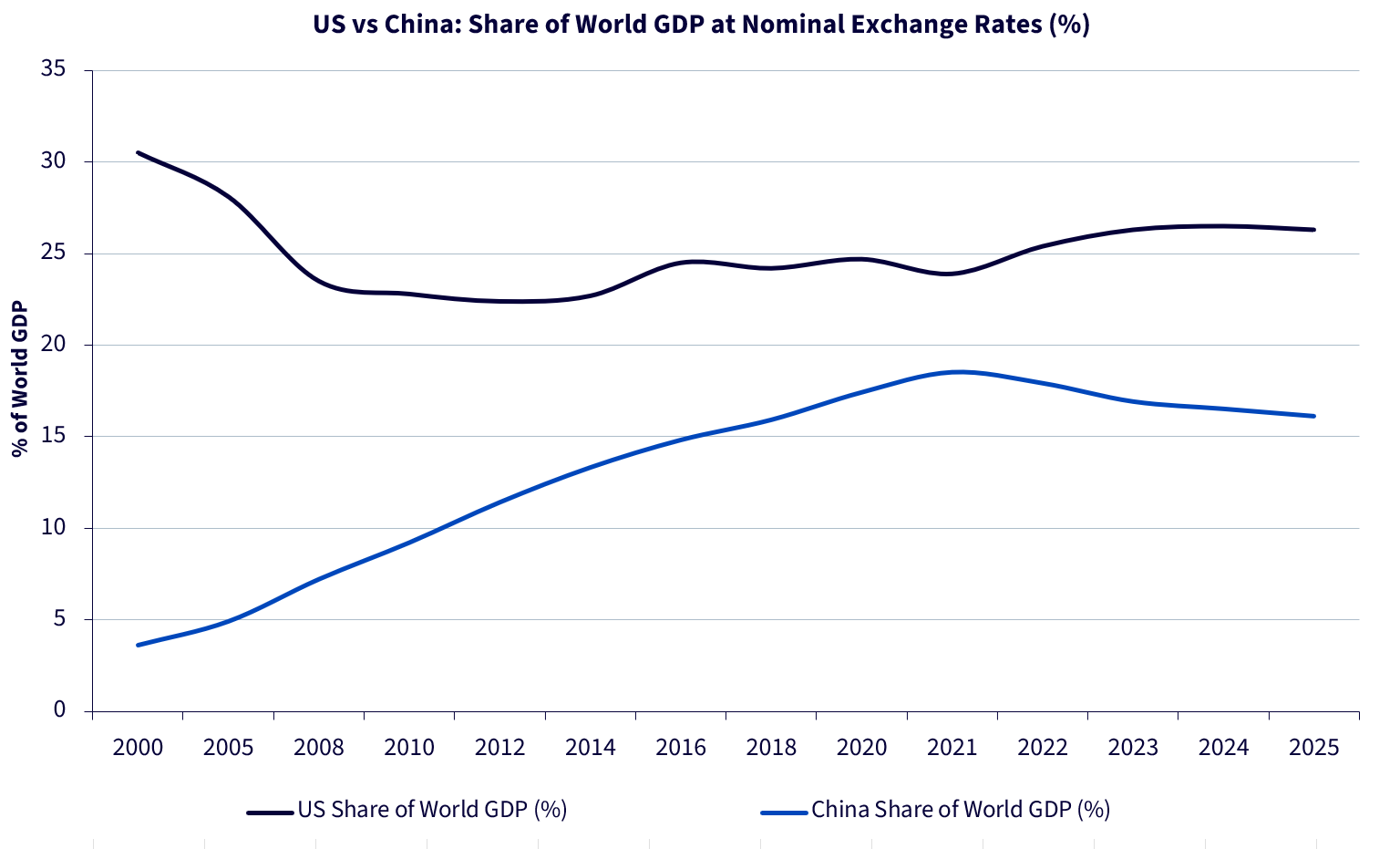
Source: WisdomTree, International Monetary Fund (IMF) as of 31 December 2025. Historical performance is not an indication of future performance and any investments may go down in value.
This is not simply a currency story: it reflects an inefficient use of resources, an industrial strategy optimised for military-technological parity with the US rather than domestic welfare.
In a nutshell, the Trump-Xi visit established a floor under the relationship but raised no ceiling. The bilateral reset investors were hoping for spanning across reopening technology flows, easing export controls or restoring investment confidence – did not materialise.
The summit's failure to resolve structural tensions is not just a geopolitical footnote, it has direct read-throughs to asset allocation, and two WisdomTree products sit squarely at the intersection of these themes.
The case for investing in Strategic Metals and Rare Earth Miners
The most glaring omission from the Beijing summit was any agreement on critical minerals. China maintains near-total dominance over the processing of rare earth elements and strategic metals, materials essential to electric vehicles, defence systems, renewable energy infrastructure, and semiconductor manufacturing. The absence of any framework agreement on mineral trade, export controls or supply chain access means the strategic imperative for Western governments and companies to diversify away from Chinese supply remains completely unaddressed.
This is precisely the environment in which the WisdomTree Strategic Metals and Rare Earth Miners UCITS ETF (Ticker: RARE) is designed to perform. The WisdomTree Strategic Metals and Rare Earths Miners UCITS ETF offers a targeted equity exposure by focusing on miners and related companies positioned across the strategic metals and rare earths ecosystem. This includes companies poised to benefit directly from Department of Defense critical minerals investment programmes, reshoring incentives, and the structural demand surge driven by the energy transition and the AI hardware cycle. The longer the geopolitical impasse persists without structural resolution, the more durable the investment case for diversified critical mineral exposure becomes. The Beijing summit, in this respect, was not a setback for RARE, it was a reaffirmation of the thesis.
The case for investing in Agricultural Commodities
China's purchase commitments on agricultural goods were among the more concrete deliverables to emerge from the summit, with Trade Representative Jamieson Greer indicating potential commitments to substantial purchases of soybeans and beef. But investors should be careful about reading this as a resolution of agricultural trade risk. Purchase commitments are politically motivated and historically volatile, they can be scaled back as quickly as they are made.
The structural case for agricultural commodity exposure is not dependent on the arc of US-China trade diplomacy. Global food security concerns, energy-linked input cost pressures (fertiliser, fuel) on the back of the Iran war, and climate-driven supply disruption remain powerful secular drivers. The WisdomTree Agriculture ETC (Ticker: AIGA) tracks the Bloomberg Agriculture Subindex Total Return (Ticker: BCOMAGTR Index) comprising futures on coffee, corn, cotton, soybeans, soybean oil, soybean meal, sugar, and wheat, captures this structural backdrop. It reflects the return on fully collateralised futures positions, quoted in USD. In an environment where geopolitical volatility can generate sharp and rapid moves in agricultural prices, the ETC offers an efficient way to build that exposure within a portfolio. In 2026, the WisdomTree Agriculture ETC (Ticker: AIGA) has attracted US$1.5bn in inflows, taking the assets under management to US$1.7bn (as of 20 May 2026) underscoring the growing institutional interest in diversified agricultural commodity exposure.
Conclusion
The Trump–Xi summit delivered what most seasoned observers expected: de-escalation without transformation. The diplomatic relationship has stabilised, but the structural fault lines — in technology, critical minerals, Taiwan, and industrial policy remain unchanged. For investors, the lesson is that geopolitical normalisation is not imminent, and portfolios that are positioned for a fragmented, multipolar world remain better placed than those betting on a bilateral reset. RARE and AIGA offer two complementary expressions of that view, one capturing the supply chain diversification imperative in strategic metals, the other providing durable exposure to the agricultural commodity complex in an era of persistent global uncertainty.

 Previous Post
 All Posts