





 Print Page
Direct crypto or blockchain equities?


Key Takeaways
- Blockchain equities allows investors to participate in the long-term structural growth of the ecosystem while managing risk through diversified, cash-generating businesses.
- Categorised as enablers and engagers, these firms connect the decentralised economy with traditional economy, pairing familiar business models with the disruptive innovation of blockchain technology.
- For those without direct crypto exposure, blockchain equities offer access to similar adoption themes through more familiar investment vehicles. For crypto holders, they provide differentiated upside beyond token price movements.
Institutional appetite for digital assets and related investments is rapidly evolving. With recent adopters still exclusively focused on bitcoin, the conversation has expanded to include the broader blockchain ecosystem, particularly equities linked to blockchain infrastructure and adoption.
This shift comes as optimism returns to the crypto market and investors are becoming increasingly familiar with the space. The macro backdrop is supportive, with renewed interest in disruptive innovation across financial services, especially in asset tokenisation, decentralised finance, and stablecoin-driven payment rails. Meanwhile, the regulatory regime appears to be shifting meaningfully in the US, opening new doors for firms to engage more confidently.
As the ecosystem matures, a growing number of investors are incorporating blockchain equities into both their equity and alternatives allocations. Some have gone further, building diversified exposure across direct crypto, public equities, venture capital, and crypto hedge funds to access the rapidly evolving space. In this blog, we break down the two primary public market approaches: direct crypto exposure (via single assets or index products like ETPs) and blockchain-related equities, exploring their characteristics, use cases, and risk profiles. We then narrow our focus to blockchain equities, examining how investors can evaluate and differentiate opportunities across this segment.
Digital assets: two options
There are two main pathways for gaining exposure to the blockchain economy in public markets, direct crypto exposure or through equities.
Direct crypto exposure
This includes mature cryptocurrencies like bitcoin and Ethereum, either held directly or via exchange-traded products (ETPs), as well as earlier-stage projects accessible through various investment channels. These assets offer the most direct exposure to the crypto price cycle—driven by supply and demand dynamics, network adoption, tokenomics, and broader macro forces. While the space remains volatile and valuation frameworks are still evolving, it also offers a rich landscape for innovation and growth. Investors must navigate a wide range of opportunities, particularly among small and mid-cap tokens, where differentiation is critical as the market continues to mature and consolidate.
Blockchain equities
These are public companies building, enabling, or benefiting from blockchain infrastructure and applications. They serve as bridges between the decentralised crypto economy and traditional markets, often disrupting legacy business models through innovation. Within this space, exposures can be segmented into:
- Enablers: companies providing infrastructure, such as bitcoin miners and hardware manufacturers.
- Engagers: companies leveraging blockchain for payments, trading, tokenisation, and other services.
These firms capture the disruptive potential of blockchain technology while offering investors a more familiar evaluation framework, by generating revenues, cash flows, and publishing standard financial statements. Importantly, enablers and engagers exhibit distinct characteristics and value drivers, allowing for diversification not just across this equity segment, but also relative to direct crypto holdings within a portfolio. Figure 1 below shows some of the key differences investors should be aware of.
Figure 1: Investment characteristic comparisons
Source: WisdomTree. ETP = exchange-traded-product. EV/EBITDA = Enterprise Value/Earnings Before Interest, Taxes, Depreciation, and Amortisation. EV = Enterprise Value.
Mapping the blockchain investment universe
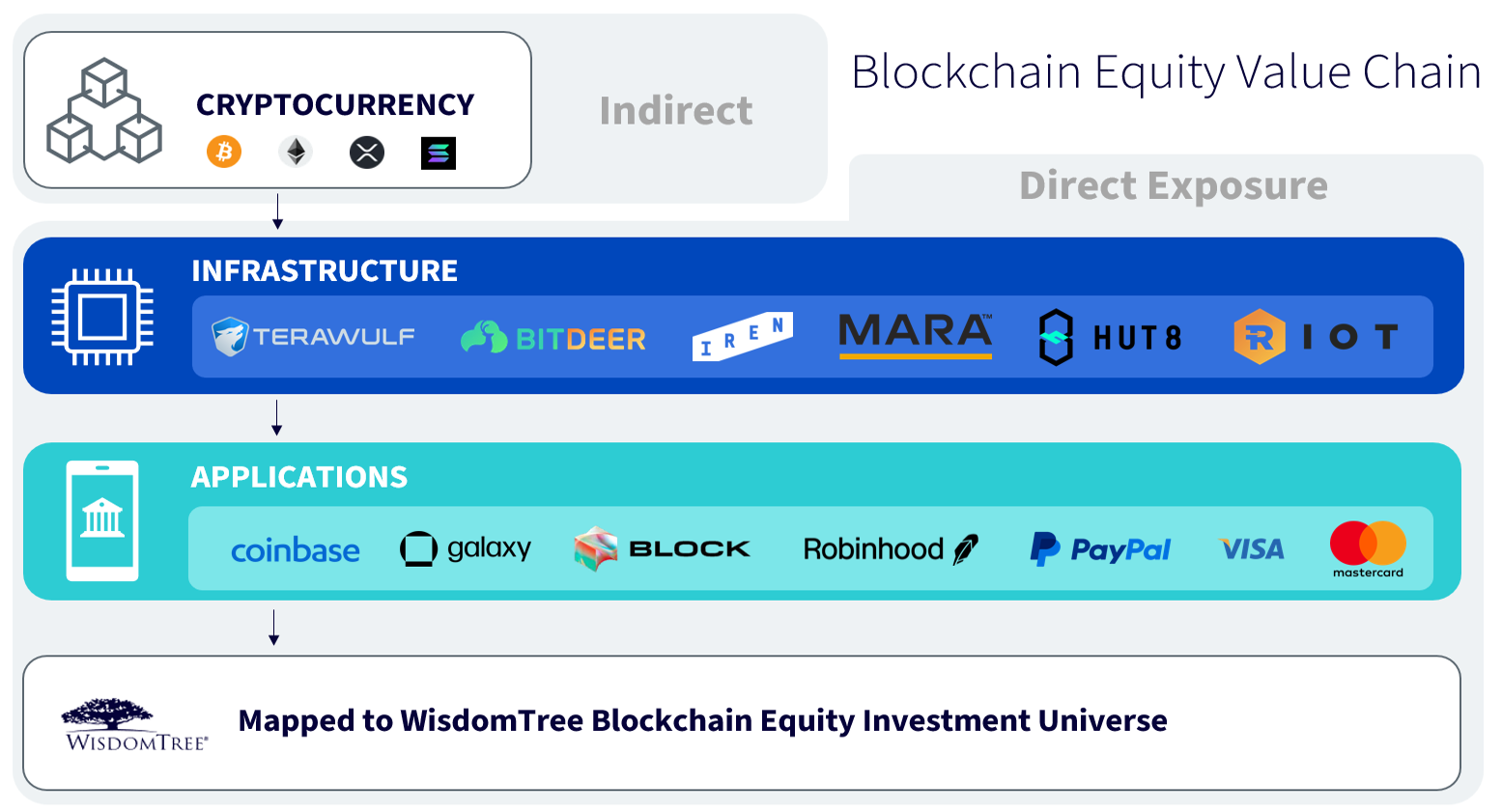
When investing across the crypto and blockchain ecosystem, it’s essential to map the opportunity set into functional layers, spanning from core protocols to applications shaping real-world industries. Cryptocurrencies themselves offer a decentralised means of transacting value and supporting applications and services. But this infrastructure doesn’t run itself, it depends on a wide range of contributors, from miners securing proof-of-work chains to validators staking in proof-of-stake chains. These participants represent a foundational layer of infrastructure, often referred to as enablers.
Further downstream are the engagers—firms building services on top of blockchain technology or integrating it into traditional business models. These include applications in payments, capital markets, supply chains, and digital identity. While the underlying blockchains and protocols themselves may be either public or private, the real-world interfaces and delivery of services occur through these firms.
Mapping this landscape is key to identifying investable opportunities. In WisdomTree’s blockchain equity universe, enablers and engagers are classified based on their functional roles, allowing investors to access different parts of the value chain in a structured, transparent way.
Figure 2: Blockchain Equity Universe Mapping
Source: WisdomTree.
By understanding where each company sits - whether securing networks, developing infrastructure, or driving adoption through services, we can construct intelligent portfolios designed to capture the breadth of blockchain innovation. These companies are actively reshaping how financial and digital infrastructure operates, bridging the gap between decentralized technologies and real-world use cases.
The balance of risk and return
Not all blockchain-related exposures behave the same. A comparative look at return and volatility profiles reveals meaningful differences between cryptocurrencies like bitcoin and Ethereum, and equity-based exposures such as enablers and engagers.
Enablers often exhibit the highest volatility, driven by their strong correlation to bitcoin amplified by operational leverage. These businesses, dominated by miners, operate capital intensive data centres, face variable input costs (notably energy), and often carry significant debt. Many also hold bitcoin on their balance sheets as a treasury asset, adding further sensitivity to crypto market cycles.
Engagers, by contrast, tend to operate more diversified business models. While still exposed to crypto trends, their revenues are anchored in traditional service lines where blockchain technology is being applied to enhance or transform existing operations. This creates more dispersion across the risk-return spectrum. Engagers include firms offering payments, custody, trading platforms, lending, and digital asset infrastructure and, thus, may benefit from blockchain and crypto adoption without being too directly tied to any cryptocurrencies price.
In this space, selectivity is key: while enablers often cluster due to similar business models, some miners are materially more efficient and better capitalised than others. Likewise, top-tier engagers are embedding blockchain technology more deeply into institutional infrastructure and traditional economic use cases, establishing firm footing in high-growth areas with large total addressable markets.
Figure 3: Trailing 1Y returns and volatility by group

Source: WisdomTree, Koyfin as of May 27, 2025.
Beta to bitcoin
To further illustrate the drivers of equity performance across blockchain names, we analysed daily stock return regressions against both bitcoin and the broad equity market (S&P 500). This reveals how much of a stock’s return is explained by crypto versus traditional equity exposure - and how much is left to idiosyncratic factors such as operational execution, capital structure, and investor sentiment. This simple two-factor ‘style regression’ model is structured as follows:
Rᵢ = α + βm·Rm + βBTC·RBTC + ε
Where:
- Ri = Return of the blockchain equity
- Rm = Return of the market (S&P 500)
- RBTC = Return of Bitcoin
- βm = Sensitivity to traditional equity markets
- βBTC = Sensitivity to Bitcoin
- α = Intercept (alpha)
- ε = Idiosyncratic (unexplained) return
This ‘style analysis’ reveals a wide dispersion in how each stock behaves relative to crypto and market benchmarks:
- Galaxy Digital (GLXY) and Coinbase (COIN) exhibit moderate bitcoin beta, reflecting their roles as financial intermediaries in the crypto ecosystem. Their revenues are tied more to trading volumes and institutional activity than to the absolute price of bitcoin, resulting in lower directional sensitivity.
- Hut 8 (HUT) is a classic high-beta bitcoin miner, operating a more pure-play model with substantial BTC holdings relative to its firm size. Bitdeer (BTDR) shows a similar profile, with high beta reflective of its operational leverage - typical for vertically integrated miners.
- TeraWulf (WULF) stands out with a lower bitcoin beta but a higher market beta, reflecting its push into artificial intelligence (AI) and high performance computing (HPC) infrastructure, which introduces new growth drivers not fully captured in the model.
- Across the group, unexplained variance is relatively high, signaling significant idiosyncratic risk beyond these two factors. This indicates a wide scope for return dispersion driven by firm-specific fundamentals, strategy, and execution.
Figure 4: Style regression summary statistics
Source: WisdomTree, Bloomberg, as of 27 May 2025. Regressions using daily returns from 30 April 2024 to 27 May 2025. All Beta coefficients are statistically significant to the 99th percent confidence interval. Beta coefficient to the SP500 Index (market) return is denoted βM while the beta coefficient to bitcoin return is denoted βBTC. HPC / AI refers to high performance computing and artificial intelligence. For investors, this analysis underscores why not all blockchain equity exposures are created equal. Understanding risk profiles is essential for building smarter, more intentional exposure across the crypto-equity landscape - helping to capture the structural themes driving blockchain forward.
Conclusion: choosing the right exposure
Direct crypto offers unmatched exposure to digital assets, but it also comes with heightened volatility, evolving regulation, and significant analytical complexity. For investors who haven’t yet made the full leap, blockchain equities offer a strong adjacent opportunity, providing access to similar long-term adoption trends through familiar corporate structures, with financial transparency and operational oversight. For those already invested in crypto, they offer differentiated exposure beyond cryptocurrency price movements.
A balanced mix of enablers and engagers allows investors to tap into blockchain innovation. Whether used on their own or as part of a broader crypto sleeve alongside direct crypto exposure, blockchain equities can offer a powerful addition to portfolios for investors seeking access to the disruptive potential of blockchain technology.





 Previous Post
 All Posts