




 Print Page
Why traditional value investing may be due for an update


Key Takeaways
- Not all value strategies are created equal: Traditional value metrics such as price-to-book and price-to-earnings ratios have become less effective in modern markets. The blog highlights how shareholder yield, which focuses on dividends and buybacks, may offer a more intuitive and durable definition of value.
- The WisdomTree Europe Value strategy combined outperformance with downside resilience in 2026: The strategy outperformed major European value benchmarks year to date while also experiencing the shallowest drawdown during the Iran conflict, demonstrating that disciplined portfolio construction can improve resilience during periods of volatility.
- Capital discipline matters in today’s market environment: In an environment shaped by geopolitical uncertainty, slowing growth and elevated volatility, investors are increasingly rewarding companies with durable cash flows, strong balance sheets and shareholder-friendly capital allocation. The WisdomTree Europe Value approach is designed to emphasise those characteristics systematically.
Europe’s market revival is happening against a fragile macro backdrop
European equities may continue to present attractive opportunities for investors seeking strong valuations, dividend income and diversified sector exposure. Despite improving corporate fundamentals and stabilising macro conditions across the region, many European companies still trade at relatively reasonable valuations compared to historical levels and other regions.
At the same time, the market environment remains increasingly uncertain. Sticky inflation, slowing growth expectations and renewed geopolitical tensions, including the recent Iran-related volatility episode, have reinforced the importance of portfolio resilience and disciplined stock selection. Investors have become more selective, favouring companies with stronger balance sheets, durable cash flows and greater earnings visibility.
This backdrop has renewed interest in value investing across Europe, particularly as investors look for opportunities outside of crowded market leadership areas. However, not all value strategies are built equally. Traditional value approaches can often deliver very different outcomes during periods of market stress, making portfolio construction and stock selection increasingly important in today’s environment. The WisdomTree Europe Value strategy offers a differentiated approach within the European value universe.
Strong relative performance in 2026
One of the most notable features of the strategy this year has been its ability to outperform traditional European value benchmarks while maintaining stronger downside resilience.
The chart below highlights the year-to-date performance comparison between the WisdomTree Europe Value UCITS Index and several widely followed European value benchmarks.
Figure 1: Year-to-date performance of the WisdomTree Europe Value Strategy
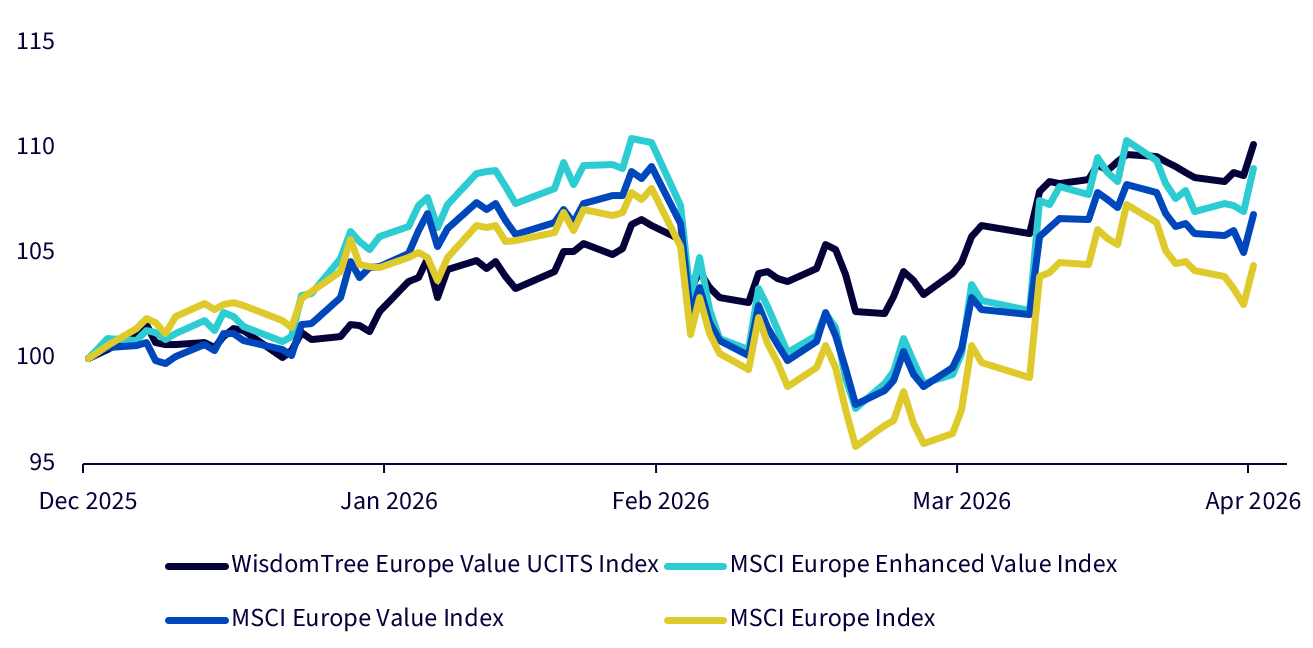
Source: WisdomTree, MSCI, Bloomberg Finance L.P. From 31/12/2025 to 30/4/2026. The WisdomTree Europe Value Strategy is represented by the WisdomTree Europe Value UCITS Index. Historical performance is not an indication of future performance and any investment may go down in value. You cannot invest directly in an index.
The WisdomTree Europe Value UCITS Index delivered the strongest year-to-date performance among the peer group shown, outperforming the MSCI Europe Enhanced Value Index, MSCI Europe Value Index and the broader MSCI Europe Index. Importantly, the strategy historically achieved this with lower observed drawdowns than selected peers over the period shown.
During the sharp market weakness associated with the Iran conflict, the WisdomTree Europe Value UCITS Index also experienced the shallowest drawdown among the group. While traditional value benchmarks saw materially deeper declines, WisdomTree’s methodology helped cushion downside participation (see Figure 3).
The combination of strong relative performance and improved downside resilience is notable because it reflects the strategy’s structural characteristics rather than short-term tactical positioning. The WisdomTree Europe Value UCITS Index is constructed to provide long-term exposure to companies with attractive shareholder return characteristics while incorporating screens based on Quality and Momentum intended to avoid some of the traditional pitfalls associated with value investing.
As recent market volatility demonstrated, those same characteristics can also help cushion portfolios during periods of heightened uncertainty.
Why traditional definitions of Value have become less effective
Value investing has historically delivered long-term excess returns, but traditional valuation metrics such as price-to-book or price-to-earnings ratios have become less effective in modern markets. In an economy increasingly driven by intangible assets, intellectual property and capital-light business models, accounting-based valuation multiples do not always capture the true economic value of a company.
As a result, companies trading at low valuation multiples are not always fundamentally attractive, while firms generating strong cash flows and consistently returning capital to shareholders may be overlooked. This is where WisdomTree’s approach meaningfully differentiates itself. Rather than relying primarily on traditional accounting-based valuation ratios, the strategy focuses on shareholder yield and capital return discipline as a more economically intuitive measure of value.
Shareholder yield as an alternative Value signal
Rather than relying on traditional price-based valuation metrics, the WisdomTree Europe Value UCITS ETF (that tracks the WisdomTree Europe Value UCITS Index) uses shareholder yield as a core signal for identifying attractive companies.
Shareholder yield measures how much capital a company returns to shareholders through a combination of dividends and share buybacks. This approach focuses on companies actively generating and distributing cash to shareholders, which can more effectively signal financial strength and capital discipline than simple accounting ratios. Historical analysis suggests shareholder yield has historically been associated with stronger long-term return dispersion than traditional price-to-book measures.
Historical risk premia from shareholder yield
Figure 2 below compares long-term annualised returns across quintiles formed using shareholder yield versus traditional price-to-book metrics.
The data shows that the highest shareholder yield quintile generated the strongest long-term returns, while the lowest shareholder yield cohort significantly underperformed. Return dispersion across shareholder yield quintiles was also more intuitive and consistent than traditional price-to-book approaches, where differentiation between quintiles was weaker. Most strikingly, the highest shareholder yield quintile delivered meaningfully stronger annualised returns than the cheapest price-to-book cohort. The data suggests shareholder yield may provide an alternative lens for identifying companies with strong capital return characteristics. Rather than simply buying ‘cheap’ companies, the strategy seeks companies capable of consistently returning capital to shareholders.
Figure 2: Historical returns of the two approaches to Value
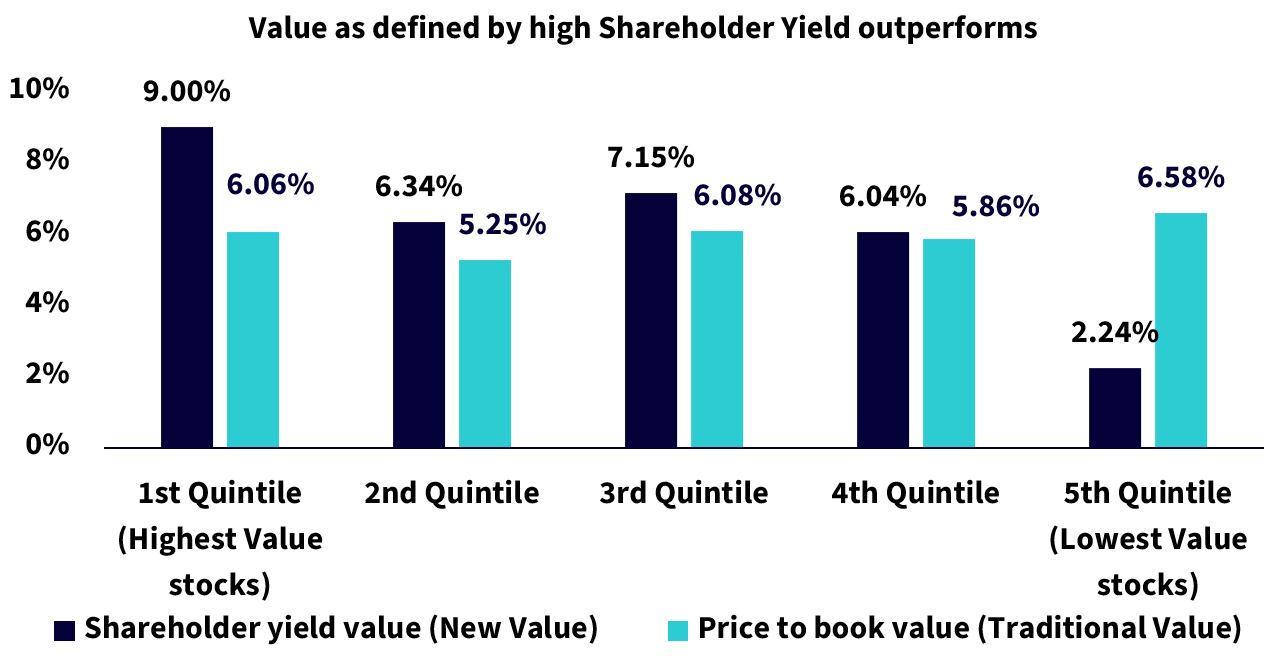
Sources: WisdomTree, MSCI, From 31/12/2007 to 31/3/2026. Quintile portfolios are created using end of December data each year and constituents are equally weighted. Shareholder yield = 1st quintile (highest shareholder yield) within the MSCI Europe Index. Price-to-Book = 1st quintile (lowest P/B) within the MSCI Europe Index. You cannot invest directly in an index. Historical performance is not an indication of future performance and any investment may go down in value.
Conclusion: a resilient European equity allocation
The WisdomTree Europe Value UCITS ETF offers investors a differentiated approach to European value investing.
Rather than simply buying the cheapest stocks, the strategy seeks to identify companies returning significant capital to shareholders while also demonstrating stronger quality characteristics, healthier momentum profiles and greater capital discipline.
This methodology has historically delivered strong shareholder yield risk premia while also helping reduce exposure to classic value traps.
In 2026, these characteristics have translated into strong year-to-date outperformance and shallower drawdowns during the Iran conflict.
As investors continue navigating a world defined by geopolitical uncertainty, uneven growth and elevated volatility, the WisdomTree Europe Value UCITS ETF may offer investors an alternative approach to accessing European value equities.
Figure 3: The WisdomTree Europe Value Strategy offered the highest resilience among the peer group
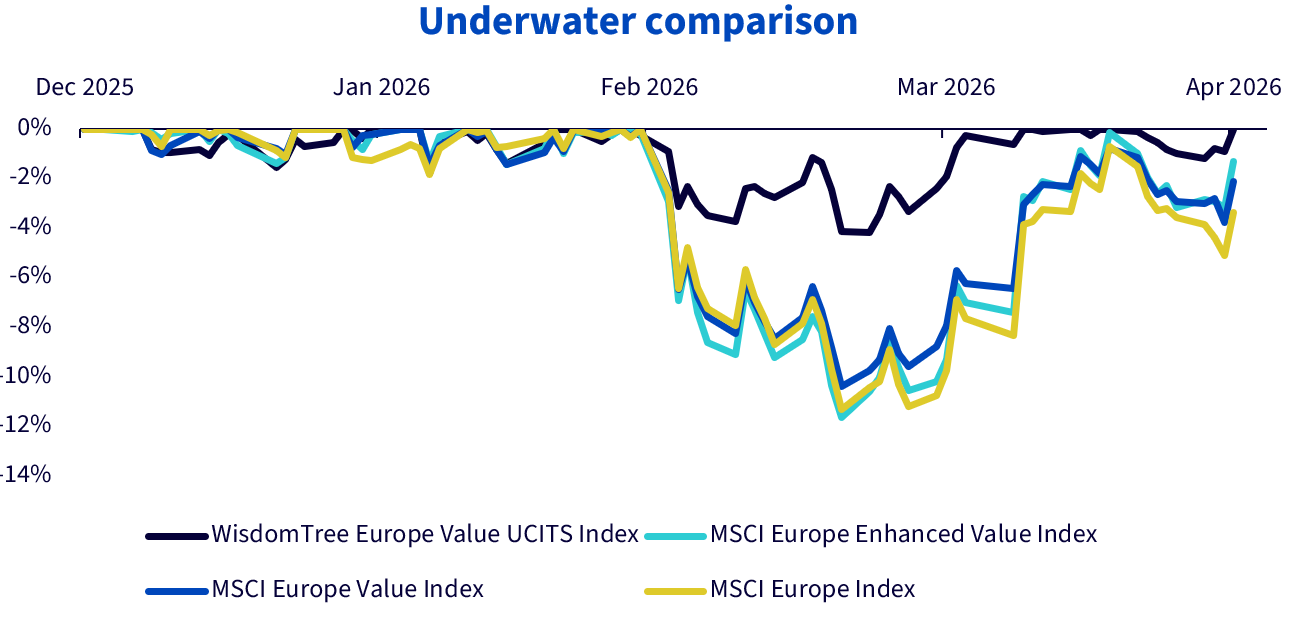
Source: WisdomTree, MSCI, Bloomberg Finance L.P. From 31/12/2025 to 30/4/2026. The WisdomTree Europe Value Strategy is represented by the WisdomTree Europe Value UCITS Index. Historical performance is not an indication of future performance and any investment may go down in value. You cannot invest directly in an index.
As with all equity investments, the value of investments and any income derived from them may go down as well as up and investors may not get back the amount originally invested. Investments focused on Europe may be adversely affected by regional economic or geopolitical events. Value investing strategies can underperform growth strategies and broader equity markets for extended periods. Companies identified through shareholder yield or other factor-based methodologies may not outperform the wider market and there can be no guarantee that the strategy will achieve its investment objective. Past performance is not a reliable indicator of future performance. Any references to historical market behaviour or performance scenarios are provided for illustrative purposes only and are not indicative of future returns.



 Previous Post
 All Posts