




 Print Page
Geopolitics fuels Europe’s defence drive


Key Takeaways
Europe’s defence landscape is undergoing a seismic shift amid evolving geopolitical currents. Two recent developments – US President Donald Trump’s retreat from mediating a Russia–Ukraine ceasefire and a landmark UK–EU trade deal granting the UK access to EU defence funding – are reshaping Europe’s security posture. Together, these events are accelerating Europe’s drive for strategic autonomy in defence and spurring unprecedented investments in military capabilities.
Implications of Trump’s ceasefire U-turn on European security
Trump’s recent decision to step back from efforts to broker a Ukraine–Russia ceasefire has sent ripples through European capitals. After a high-profile call with Russia’s Vladimir Putin, Trump announced that Moscow and Kyiv would “immediately” begin ceasefire talks – but pointedly signalled that the US would no longer play mediator1. He declined to impose new sanctions on Russia despite earlier threats, stating “there’s a chance of getting something done” and warning that “if it doesn’t – just going to have to back away” 2. In fact, Trump bluntly remarked “This is not my war” as he indicated he might abandon the peace process without progress.
European leaders reacted with alarm. On being briefed about Trump’s call, EU officials vowed to increase pressure on Moscow – announcing new sanctions even as Washington held off3. The optics of an American president reluctant to support Ukraine reinforced Europe’s realisation that it may be left to fend for its own security.
UK–EU defence pact: A new era of cooperation
In a parallel development, Europe has been bolstering its internal unity through a major UK–EU trade and security deal. This recently struck agreement – part of a wider post-Brexit economic pact – includes a formal defence and security partnership between Britain and the EU4. Notably, the UK will also join an EU military mobility project (PESCO) to facilitate the rapid movement of troops and equipment across Europe. After years of Brexit-related estrangement, Britain and Europe are again closing ranks on defence – a significant geopolitical shift on its own.
Crucially, the agreement “paves the way” for UK-based defence firms to access the EU’s hefty defence funding programs. In particular, the UK is poised to participate in the EU’s new Security Action for Europe (SAFE) initiative – a €150 billion fund (about £130 billion) providing loans for joint defence projects. By welcoming the UK into such initiatives, Europe is fortifying a pan-European defence ecosystem capable of deterring threats independently. In sum, this deal is a force multiplier: it strengthens Europe’s defence technological and industrial base (DTIB) and aligns British and EU security policy at a time when a cohesive front is needed against common adversaries.
Strategic autonomy and a surge in defence investment
Taken together, Trump’s quasi-isolationist stance and the UK–EU defence rapprochement are accelerating a trend already in motion – Europe’s dramatic increase in defence spending and autonomy. The war in Ukraine had acted as an initial wake-up call, shattering illusions about Europe’s security environment. Now, transatlantic uncertainties are cementing the resolve to rearm. The result is nothing less than an historic ramp-up in European defence investment.
Targeted exposure with WisdomTree to Europe’s defence buildout
For those seeking to capitalise on this theme, the WisdomTree Europe Defence UCITS ETF (WDEF) offers a unique, targeted exposure. Launched on 11 March 2025, this exchange-traded fund (ETF) is the first of its kind focusing exclusively on Europe’s defence and aerospace sector. In the first 10 weeks since launch, the ETF has garnered more than US$2Bn in AUM, indicating strong investor interest in European companies that are at the heart of Europe’s defence policy priorities. The ETF tracks an index of European companies generating at least 10% of their revenue from the defence sector, allowing investors to gain broad coverage of the key players driving Europe’s rearmament. WDEF prioritises companies with a higher exposure to the defence industry by assigning an exposure score:
- Exposure Score 3: companies with > 50% exposure to defence activities
- Exposure Score 2: companies with 25% to 50% exposure to defence activities
- Exposure Score 1: companies with 10% to 25% exposure to defence activities
Companies will then be weighted by free-float market capitalisation adjusted by the exposure score. Unlike the MSCI Europe Aerospace and Defence Index which follows a market cap-weighted approach based on GICS classification. WisdomTree’s differentiated approach of adjusting the free float market capitalisation by the exposure score allows the portfolio to be tilted towards companies generating a higher revenue exposure from the defence sector. Currently, 70.8% of the WisdomTree Europe Defence UCITS Index is allocated to companies with > 50% defence revenue, compared to only 40% in the MSCI Europe Aerospace and Defence index5.
Spotlight on UK defence champions inside WDEF
The ETF holds a portfolio of around 24 companies, representing the core of Europe’s defence industry. Several holdings are involved in joint European projects (like the Eurodrone UAV, the future fighter jet programs, or EU-funded R&D via the European Defence Fund). As the UK–EU deal enables British firms to partake in EU initiatives, the fund’s inclusion of UK’s prime defence contractors like BAE and Rolls-Royce plus niche specialists like Babcock and QinetiQ, ensures investors also benefit from that new opportunity.
Importantly, the country mix of the WDEF is balanced among Europe’s defence heavyweights – 28% France, 25% UK, 18% Germany, 13% Italy, with the remainder spread across Sweden, Spain, Norway and others.
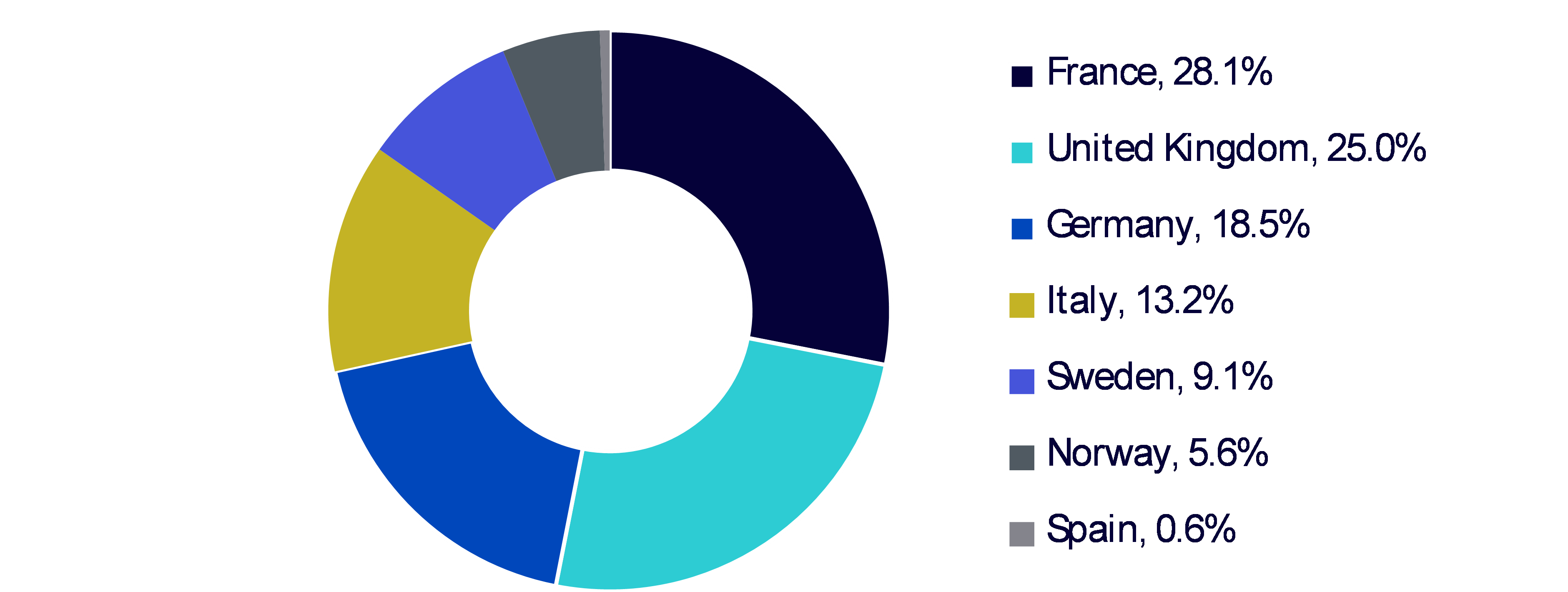 Source: WisdomTree. Holdings are based on target weights as of 31 April 2025. You cannot invest directly in an index. Historical performance is not an indication of future performance and any investments may go down in value.
Conclusion
Europe is entering a new era of defence self-reliance and military investment. Trump’s pullback from Ukraine diplomacy has only stiffened Europe’s resolve to bolster its own security, while the UK–EU trade deal has removed barriers to continent-wide defence cooperation. The geopolitical and policy shifts are clear: European strategic autonomy in defence is no longer just a buzzword but a guiding principle backed by budgets and action. This paradigm shift is translating into real opportunities for Europe’s defence industry – and those investing in it. European defence equities have rallied strongly, and the long-term case for the sector remains compelling as European governments ramp up spending on rebuilding deterrence.
1Politico.com as of 19 May 2025
2Reuters as of 19 May 2025
3Reuters as of 20 May 2025
4Bloomberg as of 20 May 2025
5Source: WisdomTree, Bloomberg, FactSet. Holdings as of 31 April 2025. Defence revenue exposure is sourced from multiple in-house and external sources. WisdomTree / WTEUDEFN denotes WisdomTree Europe Defence UCITS Index (NTR). MSCI/ MXEU0AD denotes MSCI Europe Aerospace & Defence Index. You cannot invest directly in an index. Historical performance is not an indication of future performance and any investments may go down in value.








 Previous Post
 All Posts